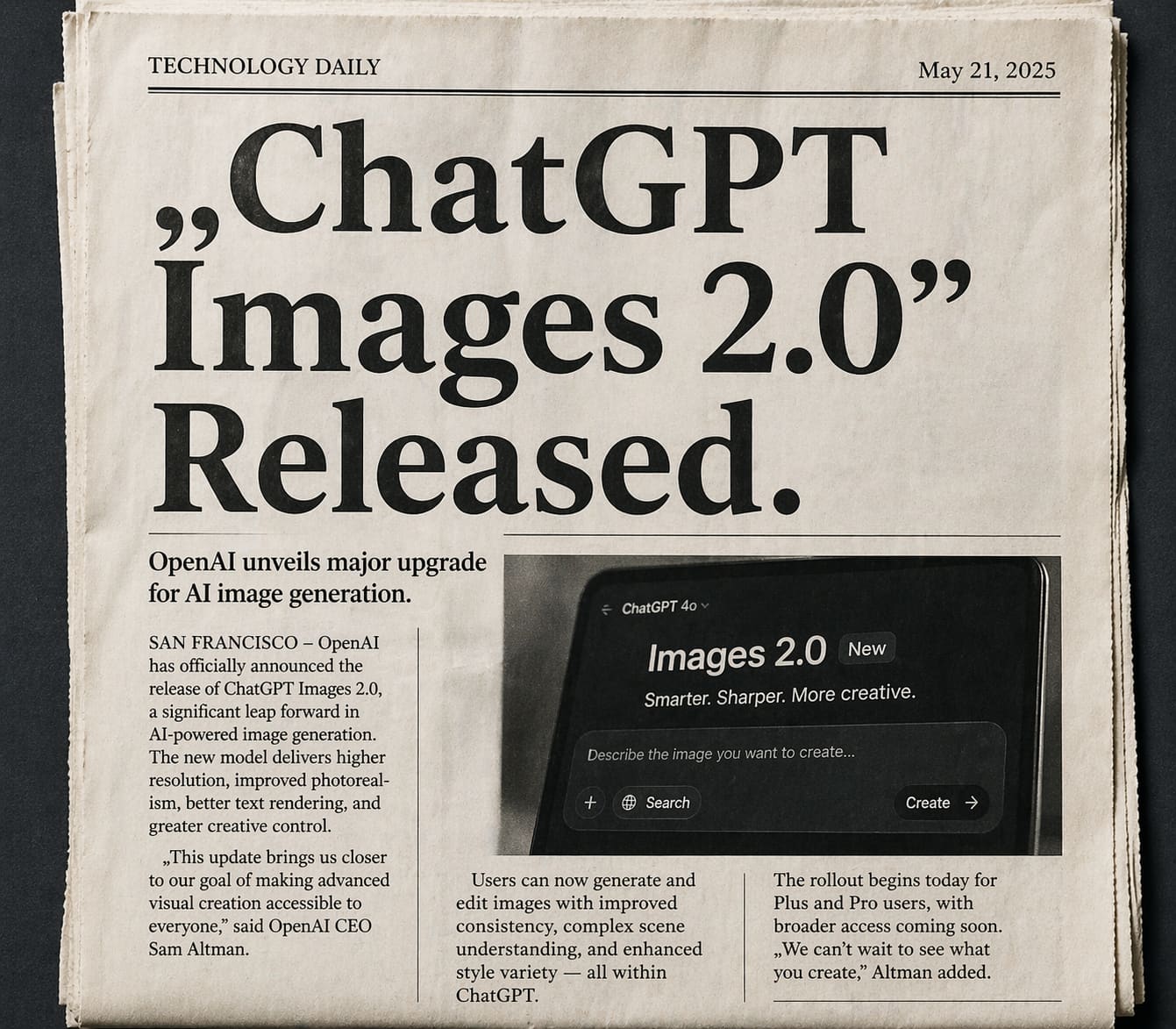
ChatGPT Images 2.0 Is Here — Why This Release Matters More Than Viral AI Art


OpenAI’s new image model is not just about prettier AI pictures. ChatGPT Images 2.0 brings sharper text rendering, better editing, flexible aspect ratios, and a smoother creation workflow across all ChatGPT plans.
ChatGPT Images 2.0 Is Here — Why This Release Matters More Than Viral AI Art
OpenAI introduced ChatGPT Images 2.0 on April 21, 2026, and the upgrade looks bigger than a typical “new image model” headline.
Yes, the outputs are more impressive.
But the more important shift is that image generation inside ChatGPT is becoming far more usable for real creative work, not just one-off prompt experiments.
What ChatGPT Images 2.0 Actually Adds
This release improves more than style or realism.
According to OpenAI, ChatGPT Images 2.0 is designed to be better at:
- following detailed instructions
- rendering text more accurately inside images
- editing existing images
- generating in different aspect ratios
- handling more polished, design-oriented outputs
You can read the official announcement here:
Introducing ChatGPT Images 2.0
In short, it looks like OpenAI is pushing image generation closer to usable design assistance, not just visual novelty.
Why People Are Reacting So Hard
The viral reaction makes sense.
When people say “I can’t believe this is 100% AI,” they are usually reacting to one of three things:
- the realism
- the layout consistency
- the fact that the model can now handle text and structured visuals much better than older image systems
That last part is especially important.
Beautiful images are easy to admire. Useful images are much harder to produce.
If a model can create stronger posters, infographics, branded compositions, or editable draft visuals with fewer retries, that is a much more meaningful upgrade than raw aesthetics alone.
The Bigger Win: Editing, Not Just Generating
One of the strongest practical upgrades is that ChatGPT Images 2.0 is not limited to creating new images from scratch.
OpenAI also highlights image editing, including the ability to:
- upload an existing image
- select a specific area
- describe the change in chat
- regenerate with a chosen aspect ratio
That matters because real creative work is usually iterative.
Most people do not need “one perfect prompt.”
They need:
- versioning
- corrections
- faster refinement
- the ability to adjust one part without rebuilding everything
That makes the tool much more relevant for creators, marketers, founders, and content teams.
Availability Makes This More Interesting
Another notable detail: OpenAI says ChatGPT Images 2.0 is available on all ChatGPT tiers.
That lowers the barrier to trying it dramatically.
On top of that, OpenAI’s help documentation says:
- image creation is available on web, iOS, and Android
- images can be edited after generation
- generated images are stored in the ChatGPT Images area
- flexible aspect ratios are now supported
For users, this matters because it turns image generation into something closer to an always-available built-in tool rather than a separate experiment.
Where This Could Be Genuinely Useful
The strongest use cases are not “make a random fantasy image.”
They are tasks like:
- social media visuals
- blog cover drafts
- ad creative concepts
- product mockups
- poster and flyer exploration
- infographic-style content
- visual ideation for landing pages or campaigns
If text rendering and editing continue to improve, ChatGPT becomes much more competitive in the space between image generation, light design work, and creative iteration.
That is the real story behind the release.
Final Take
ChatGPT Images 2.0 matters because it pushes AI image generation closer to usable output, not just impressive demos.
The headline is not only that the images look better.
The headline is that the workflow looks more practical:
- better control
- better text handling
- better editing
- better access across ChatGPT
That is why this release is worth paying attention to.
<!-- linkloot-ai-search-backfill:2026-05-08 -->Key takeaways
- ChatGPT Images 2.0 Is Here — Why This Release Matters More Than Viral AI Art is worth tracking, but it should not be treated as an automatic recommendation.
- The practical signal is whether this changes what builders can actually ship, automate, or rely on this week.
- The strongest next step is to compare the practical trade-offs instead of reacting to the headline.
Practical LinkLoot angle
For a deeper comparison path, use the related LinkLoot guide on ChatGPT prompts. It gives this post a second layer: not just what happened, but how to decide whether it belongs in your tool stack, content workflow, or buying shortlist.
| Decision point | What to look for | Why it matters |
|---|---|---|
| Fit | Does it solve a recurring problem? | One-off curiosity rarely deserves workflow space. |
| Limits | Are caps, pricing, access, or platform rules clear? | Hidden limits change the real value quickly. |
| Switching cost | Can you test it without rebuilding your setup? | Small tests beat full migrations. |
What to verify before you act
Before changing a workflow, check the official rollout notes, access limits, pricing, regional availability, and whether the feature is available to your account tier.
ChatGPT Images 2.0 Is Here — Why This Release Matters More Than Viral AI Art is worth watching, but the decision depends on fit, current availability, limits, and cost.
Try the related loot
Best provider for OpenClaw in 2026: what to buy, what to avoid, and what actually saves money