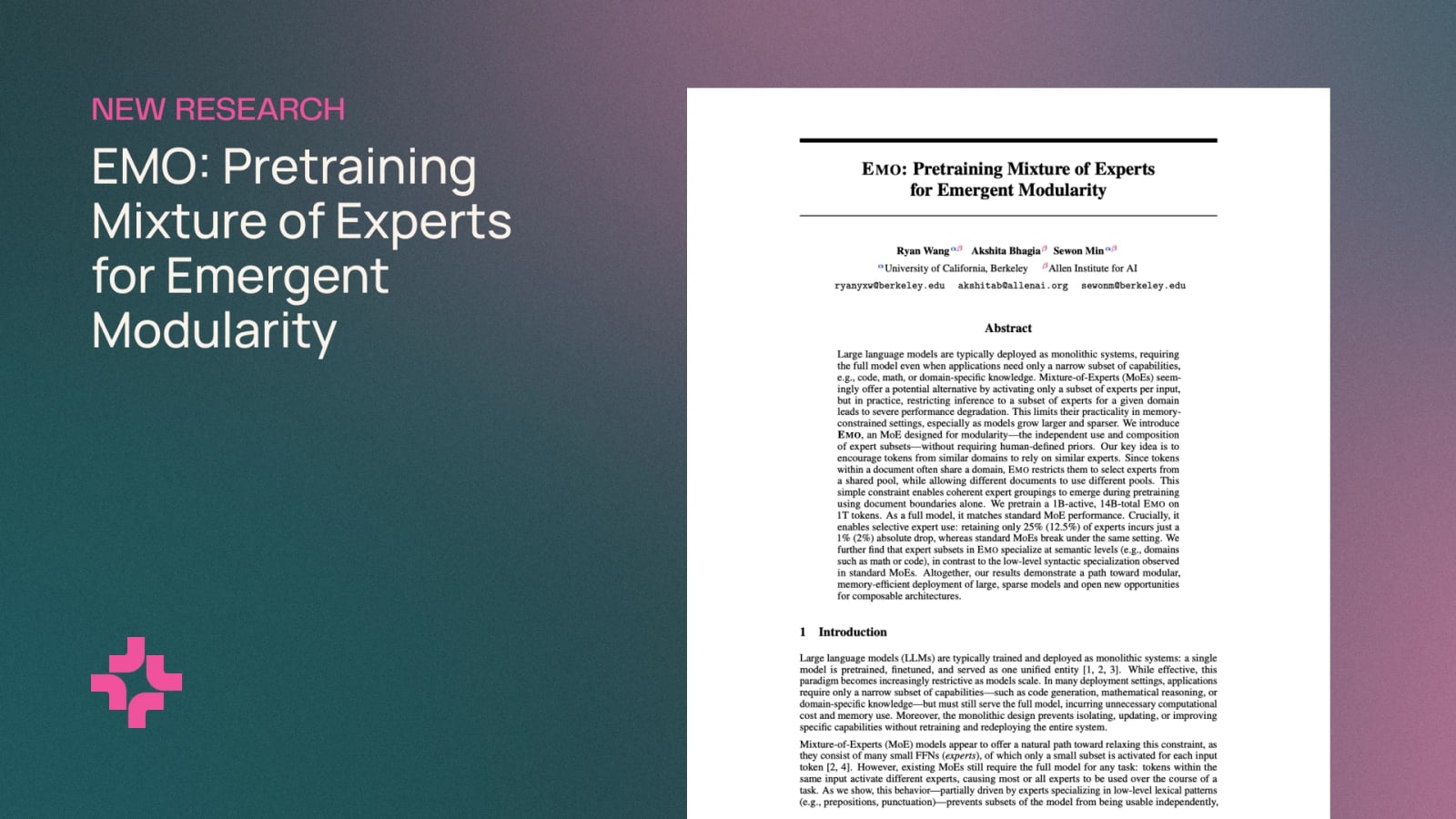
EMO shows how sparse AI models can keep most performance while using far fewer experts


AllenAI’s EMO release argues that mixture-of-experts models can become meaningfully modular instead of acting like one giant model with sparse marketing.
EMO is a newly released mixture-of-experts model from AllenAI that is explicitly trained for modularity instead of treating sparsity as an implementation detail. According to the Hugging Face release post and the arXiv paper, the 1B-active, 14B-total model was trained on 1 trillion tokens and can retain near full-model performance even when only a small subset of experts is used for a task. The core claim is practical: keep 25% of experts and lose about 1% absolute performance, or keep 12.5% and lose about 3%, while standard MoEs degrade much more sharply.
Key takeaways
- EMO is designed so expert subsets map to semantic domains like math, code, or biomedical content rather than low-level token patterns.
- The released paper says EMO uses document boundaries as a weak supervisory signal so tokens from the same document route through a shared expert pool.
- AllenAI reports that the full model matches a comparable standard MoE on general benchmarks while staying much more usable under selective expert loading.
- The release includes a paper, model collection, code, and a visualization tool, which makes the claim easier to inspect than a paper-only announcement.
| Checkpoint | EMO claim | Why it matters |
|---|---|---|
| Full-model size | 14B total parameters, 1B active | Signals a sparse model aimed at lower active compute per task |
| Selective use | 25% experts costs about 1% absolute performance | Suggests more practical deployment knobs for memory-limited serving |
| Smaller subset | 12.5% experts costs about 3% absolute performance | Makes modular routing more credible beyond lab demos |
| Specialization | Experts cluster around semantic domains | Improves the case for composable expert subsets |
Why it matters
If you care about inference cost, routing control, or serving specialist variants without shipping multiple separate models, EMO is more interesting than a generic “new model released” story. The practical angle is not that it beats every frontier model; it is that it reframes MoEs as something you may be able to deploy selectively instead of always paying for the full sparse system.
For builders, the useful workflow question is simple: can you identify a narrow workload, rank which experts that workload actually uses, and then keep a smaller memory footprint without breaking outputs? If the answer becomes reliably yes, modular MoEs become much more attractive for domain-serving, on-prem evaluation, or experimental agent backends where cost and memory ceilings matter.
A fair limitation: this is still a research release, not a turnkey production serving recipe. You still need to validate routing behavior, benchmark your own tasks, and decide whether the operational complexity of expert selection beats simpler pruning or smaller dense models.
What to verify before you act
The paper’s headline numbers are promising, but the details matter more than the slogan. Verify whether your workload resembles the domains used in the release examples, whether your evaluation requires full-model generality, and whether your serving stack can actually benefit from loading smaller expert subsets. Also check the released code path before assuming the reported memory-accuracy tradeoff transfers cleanly into your own inference environment.
EMO is trained so experts form semantically meaningful groups that can be reused as smaller task-specific subsets.
If you track agent backends, inference stacks, or model cost control, EMO is worth bookmarking alongside broader workflow guides like /guides/ai-agent-tools and /guides/ai-workflow-automation.
The big caveat is healthy skepticism: EMO looks genuinely useful on paper, but the value for most teams depends on whether selective expert loading survives real benchmark pressure outside the release bundle.
Share your own knowledge as loot
Request access to the guided creator beta and get feedback on your first submission.