
Google and Anthropic: The next AI power struggle is about compute, not just cash


Google’s expanded support for Anthropic shows how the AI market is being reshaped by compute access, cloud leverage, and strategic dependencies — not just headline investment numbers.
The latest escalation in the AI race is no longer just about who ships the best model. It is increasingly about who can secure capital, chips, cloud capacity, and long-term infrastructure at industrial scale. Google’s expanded backing of Anthropic makes that shift unmistakably clear.
Read as a simple funding story, this looks like another giant AI investment round. Read more carefully, it looks like something bigger: a structural alliance in which financing, cloud demand, compute access, and competitive positioning reinforce each other.
This is not just funding — it is infrastructure strategy
Google’s deeper commitment to Anthropic matters because deals like this rarely function as passive capital deployment. In practice, they often strengthen both sides at once.
Anthropic gets more room to train frontier models, expand product development, and compete more aggressively with rivals such as OpenAI. Google, meanwhile, tightens its relationship with one of the most important independent AI labs in the market.
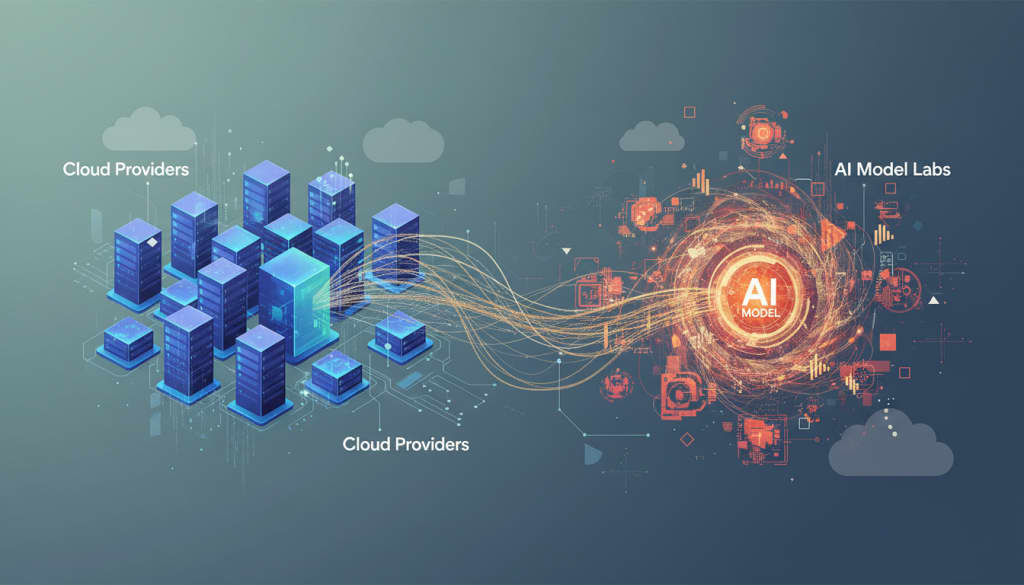
That turns the agreement into more than a financial story. It becomes part of a broader infrastructure strategy in which hyperscalers do not merely invest in AI companies — they help create long-term demand for their own cloud and compute ecosystems.
The real bottleneck is compute
A lot of public discussion still focuses on model benchmarks. But the harder bottleneck is increasingly compute. Training, refining, and serving advanced AI systems globally requires enormous access to accelerators, energy, networking, and reliable large-scale infrastructure.
That is why deals like this are so powerful. They reduce uncertainty for both parties:
- The AI company gets more predictable access to compute.
- The infrastructure provider secures a major high-volume customer.
- Both sides become more strategically aligned.
- Rivals are pushed to form similar capital-plus-infrastructure relationships.

This creates an unusually strong feedback loop. Capital finances growth, growth drives compute demand, and compute demand strengthens the investor’s own infrastructure position. That is not a normal venture pattern anymore. It is a circular market structure.
Why Anthropic is strategically valuable to Google
Anthropic is not just another model company. It has become one of the most credible alternatives to OpenAI, it carries strong research legitimacy, and Claude already has real market presence. That makes proximity to Anthropic highly valuable for Google.
First, it keeps Google close to major external innovation even when breakthroughs happen outside Google’s own model stack. Second, it helps counterbalance the strategic gravity around Microsoft and OpenAI, while also responding to Amazon’s own Anthropic positioning. Third, it strengthens Google’s broader infrastructure narrative: not only building AI internally, but also powering major external AI players.
In other words, Google is not only buying exposure to upside. It is buying position.
More efficient market, higher concentration risk
These alliances solve real problems. They accelerate research, simplify deployment, and can improve product quality for customers. But they also increase the odds that the AI market becomes organized around a few tightly connected camps.
At that point, the issue is no longer just price or market share. It is structural influence over:
- training capacity
- distribution channels
- enterprise access to top-tier models
- data and security standards
- political and regulatory leverage
That is why regulators are unlikely to care only about one individual financing round. The bigger concern is cumulative concentration. If the same giants are simultaneously investing, supplying chips, selling cloud capacity, and shaping market access, the result can look less like competition and more like ecosystem control.
The bigger story behind the headline
The real headline is not simply that Google is putting more money into Anthropic. The bigger headline is that the AI market is evolving into an industry where capital ties, infrastructure ties, and technology ties are becoming harder to separate.
For founders, investors, and publishers, that shift matters. AI companies can no longer be judged only by product output. The more relevant questions are now:
- Who supplies the compute?
- Which cloud stack sits underneath?
- What strategic trade-offs are built into the relationship?
- How replaceable is that partnership in reality?
What to watch next
Google’s closer alignment with Anthropic is a signal for the next phase of AI competition. The winners may not be determined only by research quality, but by who can convert research into durable industrial infrastructure.
For readers, creators, and operators watching the AI tool ecosystem, that matters far beyond Big Tech. It affects which products get built, how quickly they scale, what they cost, and how dependent the market becomes on a small number of platforms.
No. Deals like this are usually also about cloud usage, compute access, and strategic market positioning.
Key takeaways
- Google and Anthropic: The next AI power struggle is about compute, not just cash is worth tracking, but it should not be treated as an automatic recommendation.
- The practical signal is whether this changes what builders can actually ship, automate, or rely on this week.
- The strongest next step is to compare the practical trade-offs instead of reacting to the headline.
Practical LinkLoot angle
For a deeper comparison path, use the related LinkLoot guide on AI agent tools. It gives this post a second layer: not just what happened, but how to decide whether it belongs in your tool stack, content workflow, or buying shortlist.
| Decision point | What to look for | Why it matters |
|---|---|---|
| Fit | Does it solve a recurring problem? | One-off curiosity rarely deserves workflow space. |
| Limits | Are caps, pricing, access, or platform rules clear? | Hidden limits change the real value quickly. |
| Switching cost | Can you test it without rebuilding your setup? | Small tests beat full migrations. |
What to verify before you act
Before changing a workflow, check the official rollout notes, access limits, pricing, regional availability, and whether the feature is available to your account tier.
Google and Anthropic: The next AI power struggle is about compute, not just cash is worth watching, but the decision depends on fit, current availability, limits, and cost.
Try the related loot
UI-TARS Desktop is a serious local computer-use agent — if you lock down the setup