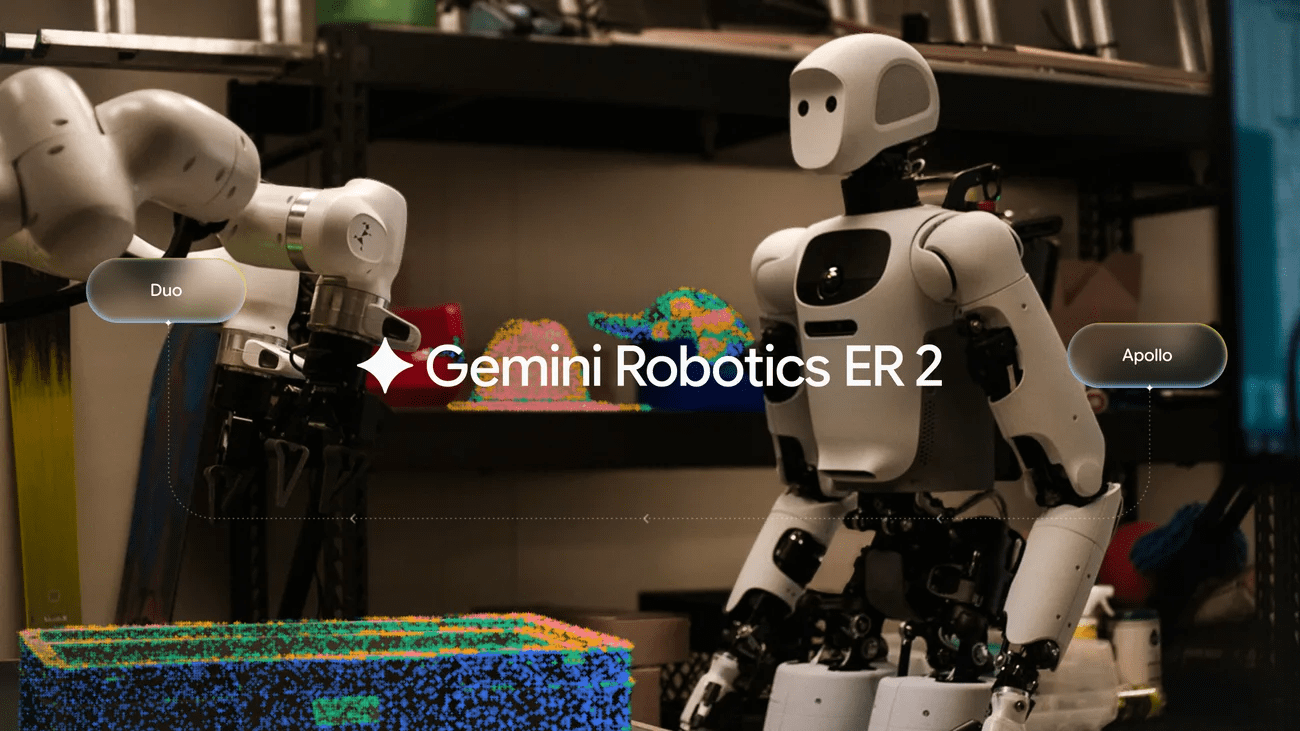
Google releases Gemini Robotics ER 2 for public API preview


Google DeepMind has released Gemini Robotics ER 2 through the Gemini API and AI Studio, adding public preview endpoints for embodied reasoning, video progress tracking, and multi-robot orchestration.
Google DeepMind has moved Gemini Robotics ER 2 into public preview for developers through the Gemini API and Google AI Studio. The release matters because ER 2 is not just a demo model for lab robots: it exposes two named endpoints that developers can call for embodied reasoning, real-time robot orchestration, and video-based task progress tracking.
Key takeaways
- Google released
gemini-robotics-er-2-previewandgemini-robotics-er-2-streaming-previewon July 30, 2026. - ER 2 is the reasoning layer for robots, built to interpret text, images, video, and audio before calling robot functions or lower-level controllers.
- The streaming endpoint targets low-latency robot agents using the Gemini Live API.
- Existing ER 1.6 users face an August 31, 2026 shutdown and should plan migration.
Gemini Robotics ER 2 reaches developers
The official Gemini API release notes list two new embodied reasoning endpoints for robotics. The standard preview endpoint adds spatial reasoning, code execution, multi-step tool orchestration, video moment finding, progress classification, and multi-robot coordination. The streaming preview endpoint is optimized for low-latency robot agents using bidirectional audio and video input.
Google’s robotics documentation describes Gemini Robotics ER models as vision-language models that perceive physical environments, reason about space and time, plan multi-step tasks, and orchestrate tools. In practice, ER 2 sits above robot-control systems: it decides what should happen next, then hands execution to a VLA model, navigation API, manipulator API, or other robot function.
Why the streaming endpoint changes the workflow
Robotics demos often break down when a system has to stop, think, and restart after every observation. ER 2’s streaming endpoint is aimed at that gap. It lets a robot process continuous audio and video, call functions with lower latency, and track progress while the physical task is still underway.
That makes the release relevant beyond robotics labs. Teams building warehouse, inspection, teleoperation, field-service, and humanoid prototypes can now test whether a frontier multimodal model can coordinate task plans and progress checks without building every planner from scratch.
Limits before production use
This is still a preview model family. Google’s documentation says developers remain responsible for safe robot environments, including notice and consent when video, voice, or likeness data from identifiable people may be collected. The docs also warn about hallucinations, prompt quality, visual-input quality, computational cost, and API key restrictions.
The important distinction is access. Gemini Robotics 2 and on-device robotics models remain more restricted, while ER 2 is the model surface developers can start evaluating through Google’s public API tooling.
Migration date for ER 1.6
Google says gemini-robotics-er-1.6-preview will shut down at the end of August 2026. Developers already using ER 1.6 should test the ER 2 model codes now rather than waiting for a late-month replacement scramble.
Source check
- Google AI API release notes confirm the July 30, 2026 release and the two ER 2 model endpoints.
- Gemini Robotics ER documentation describes the model roles, capabilities, migration path, limitations, and August 2026 ER 1.6 shutdown.
- Google DeepMind model page corroborates Gemini Robotics ER 2 as the embodied reasoning model in the current robotics family.
Try the related loot
Scrape Changing Websites with Anansi Self-Healing Selectors and MCP