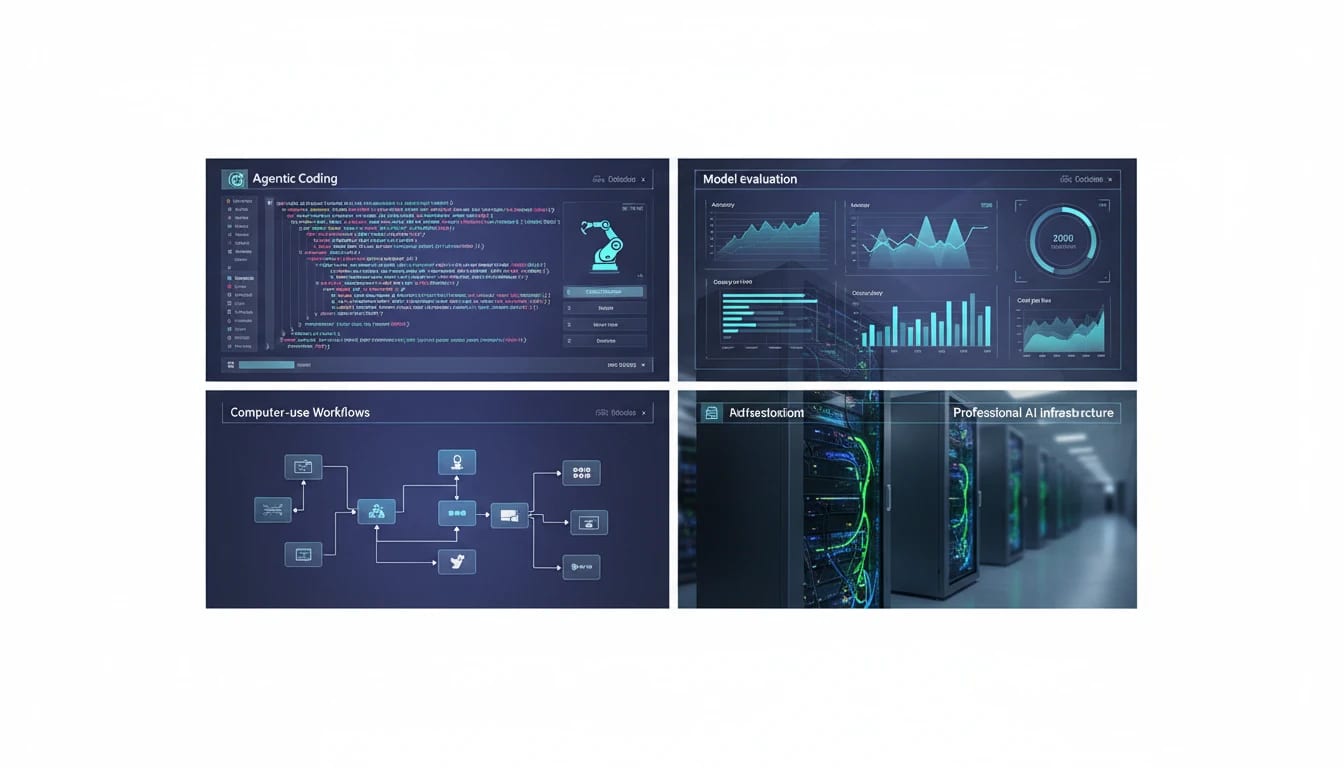
GPT-5.5 pushes OpenAI toward agentic work, but teams still need a verification loop


OpenAI’s GPT-5.5 release emphasizes agentic coding, computer use, and knowledge work; the useful move is to benchmark it against real workflow checks.
Direct answer
OpenAI’s GPT-5.5 release is positioned around agentic coding, computer use, knowledge work, online research, data analysis, and moving across tools until a task is finished. OpenAI says GPT-5.5 and GPT-5.5 Pro became available in the API on April 24, 2026, after an initial rollout across ChatGPT and Codex surfaces. TechCrunch independently reports the release and quotes OpenAI leadership framing it as a step toward more agentic and intuitive computing.
Key takeaways
- GPT-5.5 is framed less as a chat-only model and more as an agentic work model for coding, research, documents, spreadsheets, and tool use.
- OpenAI’s announcement says GPT-5.5 matches GPT-5.4 per-token latency in real-world serving while completing some Codex tasks with fewer tokens.
- The API availability update matters for teams that want controlled evaluation instead of only testing inside ChatGPT or Codex.
- The release should be tested with task-level verification: plans, tool traces, tests, documents, and human approval gates.
Practical LinkLoot angle
The useful workflow is to treat GPT-5.5 as a candidate for delegated work, not as an automatic replacement for every prompt. Pick one recurring task—bug triage, spreadsheet analysis, release-note drafting, or research synthesis—and require the model to produce a plan, perform the work, list what it verified, and name what still needs a human check.
| Option | Best use | Limitation | Source |
|---|---|---|---|
| GPT-5.5 in ChatGPT/Codex | Fast evaluation of coding and knowledge-work tasks | UI tests may not reflect API behavior or automation limits | OpenAI announcement |
| GPT-5.5 API | Controlled workflow benchmarks and integration tests | Requires safety, cost, and latency checks in your environment | OpenAI announcement |
| Existing GPT-5.4 workflow | Stable baseline for cost and behavior comparison | May need more retries on long-horizon agentic tasks | OpenAI comparison |
A practical benchmark: give GPT-5.4 and GPT-5.5 the same messy issue, the same repo constraints, and the same acceptance checks. Compare not only final quality, but also number of tool calls, retries, test failures fixed, and unsupported assumptions left in the final answer.
What to verify before you act
Before routing production tasks to GPT-5.5, verify the exact surface you plan to use: ChatGPT, Codex, or API. Check whether the work requires browser use, shell access, document editing, or external connectors, because each surface may expose different tools and safeguards. Finally, measure cost per completed task rather than cost per token; a model that uses fewer retries can be cheaper even when headline pricing or token counts look less obvious.
Source check
The OpenAI announcement confirms the product positioning, API availability update, benchmark framing, and agentic-work focus. TechCrunch independently confirms the GPT-5.5 release and reports OpenAI’s “agentic and intuitive computing” framing. The article avoids unsupported claims about real-world superiority beyond the sources’ stated benchmarks and positioning.
OpenAI positions GPT-5.5 for agentic coding, computer use, knowledge work, research, data analysis, documents, and multi-step tool workflows.
For more implementation ideas, see LinkLoot’s guide to AI workflow automation.
Try the related loot
OpenClaw Codex Harness Launch Kit: Subscription Auth, Runtime Setup, Tool Search, and Migration Checklist