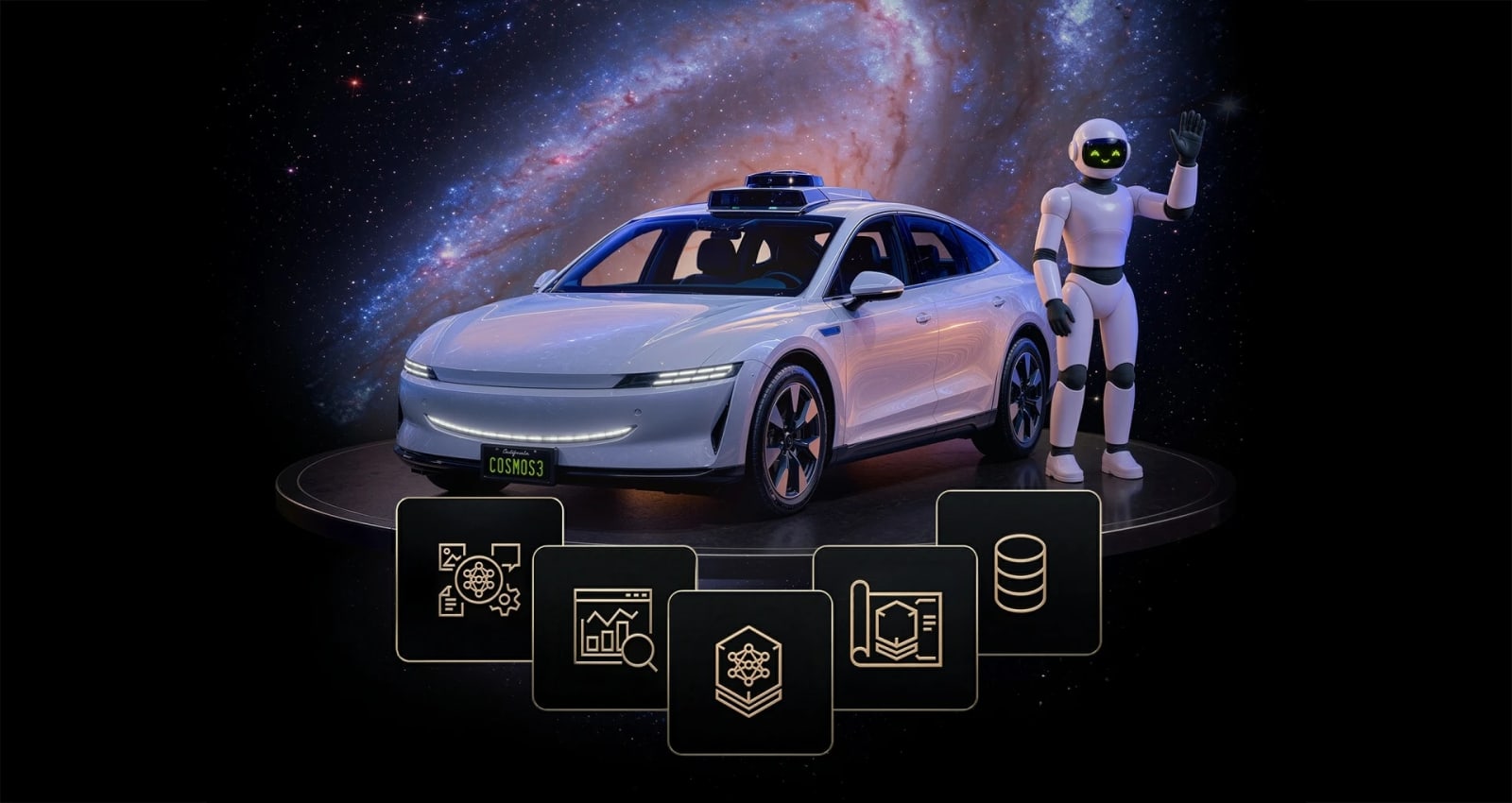
NVIDIA Cosmos 3 gives robotics teams an open world model stack to test


NVIDIA launched Cosmos 3, an open physical-AI world model family for reasoning, world generation, and action generation. The practical question is whether robotics and vision teams should test it as a synthetic-data and simulation layer before collecting more real-world data.
NVIDIA launched Cosmos 3 as an open world model family for physical AI. The release combines vision reasoning, world generation, and action prediction in one mixture-of-transformers architecture, with Cosmos 3 Super and Cosmos 3 Nano available now. For robotics, autonomous-driving, and industrial-vision teams, the useful angle is using Cosmos 3 to generate synthetic data, test edge cases, and prototype world-action pipelines before spending more on real-world data collection.
Key takeaways
- NVIDIA says Cosmos 3 unifies text, image, video, audio, and action processing for physical AI workflows.
- The launch includes Cosmos 3 Super for higher-quality generation and Cosmos 3 Nano for more efficient inference.
- Hugging Face lists model cards, licensing, Diffusers integration, post-training scripts, and synthetic-data resources.
- The arXiv report says the project releases code, model checkpoints, curated synthetic datasets, and evaluation benchmarks under OpenMDW-1.1.
- Teams should verify hardware needs, license fit, benchmark relevance, and safety limits before using generated data in training loops.
Practical LinkLoot angle
Cosmos 3 is worth testing if your AI workflow touches physical environments: robots, autonomous vehicles, smart spaces, warehouse safety, or video-based inspection. A practical pilot is narrow: pick one scenario, generate edge-case video or action data, compare it with your current simulator or data augmentation pipeline, then measure whether downstream perception or policy tests improve. The model is most useful when it reduces the cost of finding rare cases, not when it replaces real-world validation.
| Workflow slot | Cosmos 3 role | What to compare | Source |
|---|---|---|---|
| Synthetic data | Generate scenario videos and action-conditioned examples | Existing simulator, captured video, or scripted augmentation | NVIDIA Newsroom |
| Robotics policy testing | Explore action prediction and world-action model behavior | Current policy evaluation suite | arXiv report |
| Vision AI edge cases | Create unusual warehouse, factory, or road-scene variants | Manual data labeling and replay data | Hugging Face |
| Prototype pipeline | Test Diffusers and post-training scripts before a larger build | Internal serving cost and GPU availability | WinBuzzer |
The decision is mainly about data economics. If your bottleneck is rare physical scenarios, Cosmos 3 may be a useful generation and simulation layer. If your bottleneck is deployment safety, fleet data quality, or regulatory validation, generated data is only a supplement.
What to verify before you act
Check which variant fits your hardware: NVIDIA positions Nano for efficient inference and Super for larger-scale generation and research. Review the OpenMDW-1.1 license directly before using model outputs or weights in commercial training flows. Benchmark against your own environment, because vendor leaderboards may not match your camera angles, robot morphology, task distribution, or safety thresholds. Keep real-world validation in the loop for anything that affects people, vehicles, robots, or production equipment.
Source check
NVIDIA’s newsroom announcement confirms the Cosmos 3 launch, the mixture-of-transformers architecture, the Super and Nano variants, the Cosmos Coalition, and the forward-looking caveats around feature availability. NVIDIA’s Hugging Face post confirms model availability, Diffusers integration, post-training scripts, and synthetic-data resources. The arXiv report confirms the omnimodal world-model framing and says code, checkpoints, datasets, and benchmarks are released under OpenMDW-1.1. WinBuzzer independently reports the physical-AI launch scope and highlights the OpenMDW packaging angle for robotics teams.
For broader agent and automation context, see LinkLoot’s guide to AI workflow automation.
Cosmos 3 is NVIDIA’s open physical-AI world model family for vision reasoning, world generation, and action generation.
Share your own knowledge as loot
Request access to the guided creator beta and get feedback on your first submission.