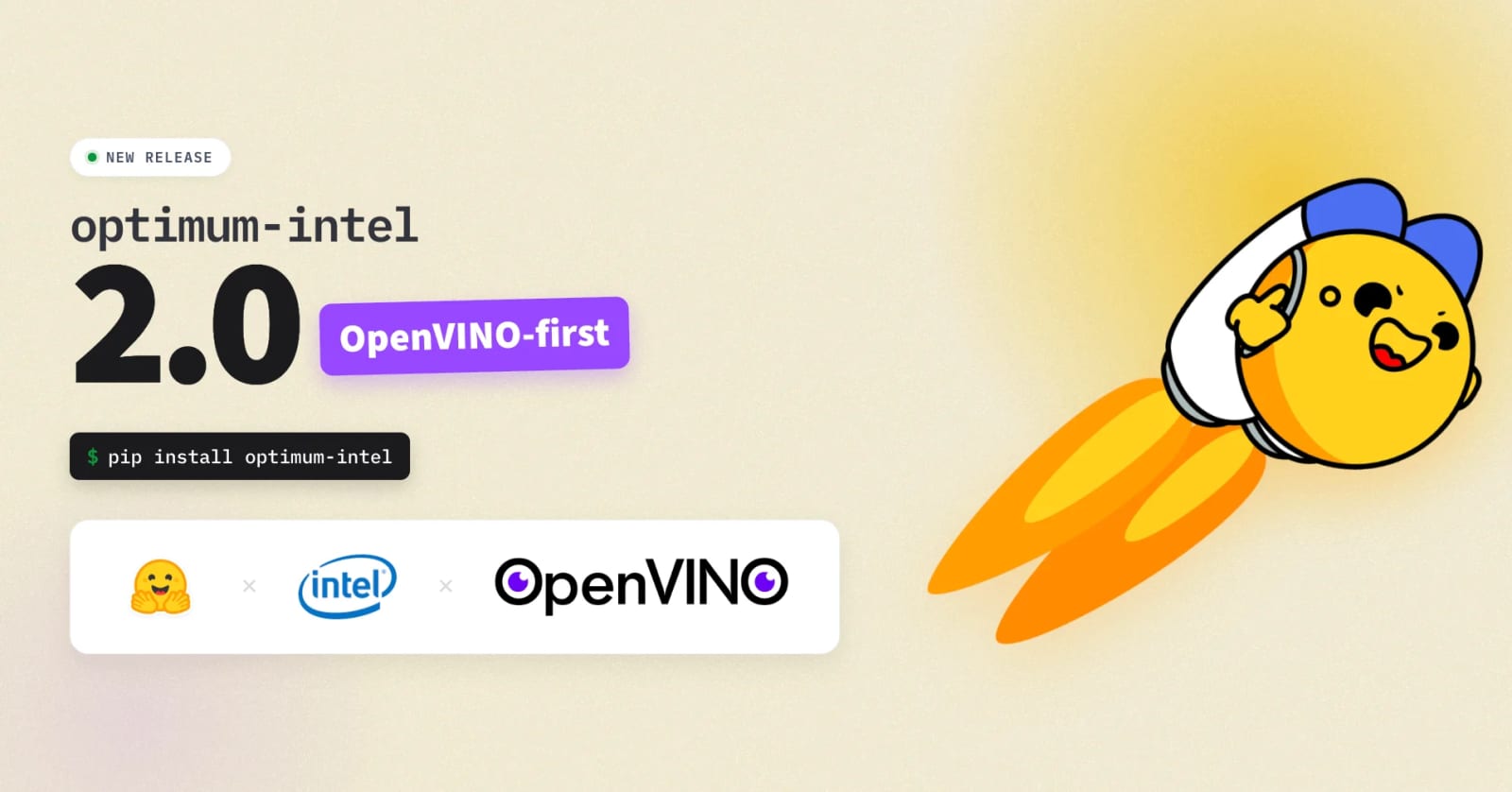
Optimum Intel 2.0 Makes OpenVINO the Default Path for Local Open Models


Hugging Face's Optimum Intel 2.0 shifts the library to an OpenVINO-first toolkit, simplifying installs and focusing local inference, export, and quantization workflows on Intel CPUs, Arc GPUs, and Core Ultra NPUs.
Optimum Intel 2.0 is a major Hugging Face library update that makes OpenVINO the primary path for running open models on Intel hardware. The release removes older INC and IPEX integrations, drops the ONNX dependency from package requirements, and installs OpenVINO plus NNCF by default. The practical result is a simpler export, quantization, and inference workflow for Intel CPUs, Arc GPUs, and Core Ultra NPUs.
Key takeaways
- Optimum Intel is now positioned as an OpenVINO-first toolkit instead of a wrapper around several Intel optimization backends.
- INC and IPEX support was removed after earlier deprecation; users who depend on those integrations should stay on the 1.27 line.
- OpenVINO and NNCF are installed by default, so the package no longer requires users to remember separate extras for the main deployment path.
- The release targets current open-model deployment needs: export from the Hugging Face Hub, quantization/compression, and local inference on Intel hardware.
- OpenVINO's own docs still matter for hardware setup, runtime behavior, model conversion, and troubleshooting.
Practical LinkLoot angle
This is useful if you build local AI workflows where cloud cost, latency, or data handling make remote inference a poor default. Optimum Intel 2.0 narrows the decision: if the deployment target is Intel hardware and the model can run through OpenVINO, start there instead of comparing several older backend paths.
| Tool path | Best use | Limitation | Source |
|---|---|---|---|
| Optimum Intel 2.0 | Exporting and running Hugging Face models through OpenVINO on Intel CPUs, GPUs, and NPUs | Breaking change for INC/IPEX users | Hugging Face Blog |
| OpenVINO docs | Hardware setup, model conversion, runtime configuration, and troubleshooting | Requires checking device and model support before deployment | OpenVINO documentation |
| Generic Transformers runtime | Fast experimentation across model families | May not deliver the same Intel-specific optimization path | Package comparison |
For a small team, the highest-value test is boring: pick one model already used in production or a repeatable internal workflow, export it to OpenVINO IR, run the same prompt or inference batch on the target device, and compare latency, memory, quality, and maintenance cost against the current runtime.
What to verify before you act
Check whether your model architecture is supported by the OpenVINO path you intend to use, especially for newer multimodal, hybrid-attention, recurrent, or speculative-decoding setups. Confirm whether your project needs INC or IPEX; if it does, the primary source says the 1.27 line is the compatibility lane. Verify the exact package version from PyPI or your lockfile before changing production builds, and test quantized outputs against a known evaluation set instead of assuming smaller models preserve behavior.
Quick migration checklist
- Freeze the current inference stack and benchmark one representative workload.
- Install Optimum Intel 2.0 in a clean environment and export the model to OpenVINO IR.
- Compare uncompressed and quantized runs on the same Intel target device.
- Update deployment docs with hardware assumptions, fallback runtime, and version pins.
Hugging Face made it OpenVINO-first, removed INC and IPEX integrations, dropped ONNX from package requirements, and installs OpenVINO plus NNCF by default.
For more local and low-cost tooling choices, keep this beside LinkLoot's guide to free AI tools and compare each option by hardware fit, lockfile stability, evaluation coverage, and fallback path.
Share your own knowledge as loot
Request access to the guided creator beta and get feedback on your first submission.