Agentic Workflow Injection: What GitHub Actions Teams Should Audit Now


A new arXiv study names Agentic Workflow Injection as a GitHub Actions risk where issue, pull request, or comment text can steer AI-assisted workflows into unsafe behavior. The practical fix starts with trust boundaries, deterministic preprocessing, scoped tokens, and human approval on write operations.
A May 2026 arXiv paper defines Agentic Workflow Injection as a GitHub Actions risk where untrusted issue bodies, pull request text, or comments become input to an AI-assisted workflow and influence tools or downstream scripts. The authors report a scan of 13,392 agentic workflows across 10,792 repositories, with 496 confirmed exploitable cases under their threat model. Treat the numbers as research findings to verify, but the defensive lesson is immediate: agentic CI should be reviewed like both prompt infrastructure and privileged automation.
Key takeaways
- The paper names two patterns: Prompt-to-Agent, where untrusted repository text reaches the agent prompt boundary, and Prompt-to-Script, where agent-derived output influences later scripts.
- The highest-risk workflows mix untrusted event context with write-capable tokens, repository mutation, comments, labels, releases, or shell execution.
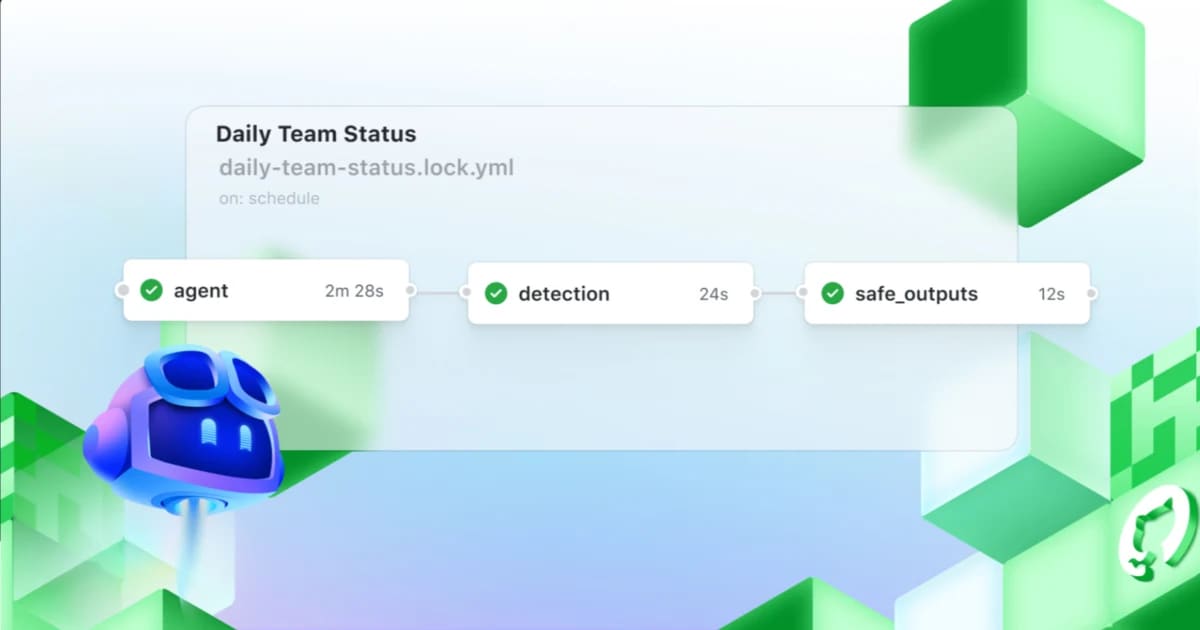
- GitHub's own Agentic Workflows docs show a safer pattern: deterministic steps collect structured data, then an AI agent reads prepared artifacts and safe output jobs handle post-processing.
- Teams should audit triggers, token scopes, prompt assembly, generated artifacts, and any job that acts on model output.
- This is not only a model problem. The control surface is the workflow: permissions, event filters, artifact boundaries, approvals, and logging.
Practical LinkLoot angle
If you run AI agents in CI, start by drawing a line between data the workflow may read and actions the workflow may take. A useful first pass is to treat pull request text, issue comments, branch names, release notes, and uploaded artifacts as hostile input until a deterministic step normalizes or filters them.
| Area | What to check | Safer pattern | Limitation |
|---|---|---|---|
| Event input | Issue bodies, PR descriptions, comments, labels | Convert to structured files with deterministic preprocessing | Filtering can miss semantic attacks |
| Agent prompt | Direct interpolation of untrusted text | Quote input as data and include source boundaries | Prompt wording is not a security control by itself |
| Token scope | GITHUB_TOKEN, PATs, cloud credentials | Least privilege per job, no write token in read-only analysis | Some tasks need staged approval |
| Agent output | Generated scripts, commands, release notes | Post-process with deterministic safe-output jobs | Human review still matters for high-impact writes |
For teams building AI workflow automation, pair this audit with the LinkLoot guide to AI workflow automation.
What to verify before you act
The arXiv paper is the primary source for the AWI definition, the dataset size, and the reported vulnerability counts. Verify whether the authors have released tool artifacts, whether the affected workflow classes match your own CI usage, and whether any claimed precision metric maps to your repository layout.
GitHub's DeterministicOps documentation is not a vulnerability advisory, but it gives a concrete design pattern for separating deterministic data preparation from AI reasoning and safe post-processing. OWASP's GenAI red-teaming material is useful for test planning because it frames prompt injection, downstream impact, human over-trust, and multi-component AI interactions as areas to probe before production use.
It is a workflow-level injection risk where untrusted GitHub event text influences an AI agent or a later workflow step with security impact.
Try the related loot
UI-TARS Desktop is a serious local computer-use agent — if you lock down the setup