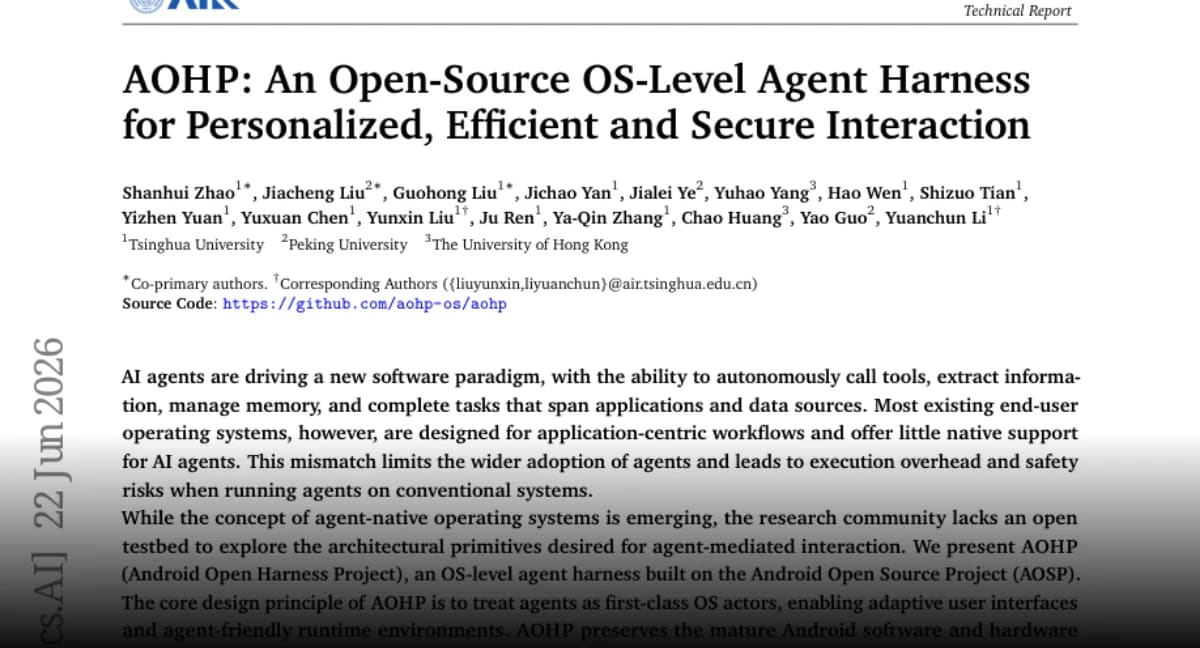
AOHP proposes an Android-based OS harness for AI agents


AOHP is a new arXiv and Hugging Face trending paper that treats AI agents as first-class OS actors inside an Android Open Source Project based harness.
Direct answer
AOHP, short for Android Open Harness Project, is a research prototype that modifies the Android Open Source Project so AI agents can act as first-class OS actors. The paper argues that app-centric operating systems create overhead and safety risks for agents, then proposes personalized service composition, efficient agent interfaces, and secure information flow as OS-level mechanisms. The authors report preliminary gains of 21.12% task completion, 51.55% lower token cost, and security-policy compliance in their evaluation.
Key takeaways
- AOHP is framed as an open testbed for agent-native operating-system research, not a production mobile OS.
- The core idea is to move some agent support into the operating system instead of forcing agents to infer everything from app screens.
- The paper focuses on service composition, structured interfaces, and information-flow controls.
- Hugging Face surfaced the paper in its papers feed, giving it early research-discovery momentum.
- The GitHub repository explicitly warns that AOHP is an early-stage research prototype and is not ready for production or security-critical workloads.
Practical LinkLoot angle
AOHP matters because it points to a likely next layer in agent tooling: less brittle screen control and more OS-mediated task execution. That does not mean you should deploy it. It means builders should watch the pattern and ask whether their current agent stack is fighting the operating system.
| Approach | Best use | Limitation | What AOHP changes |
|---|---|---|---|
| Screen/UI automation | Fast experiments across existing apps | Brittle selectors, visual ambiguity, permission risk | Pushes agent interfaces deeper into the OS |
| Browser automation | Web workflows and SaaS tasks | Mostly browser-bound | Does not solve native app coordination |
| API-first agents | Reliable structured actions | Only works where APIs exist | AOHP explores OS-level service composition |
| AOHP-style harness | Research on agent-native OS primitives | Early prototype, not production-ready | Treats agents as first-class OS actors |
The useful takeaway for workflow builders is to separate today's implementation from tomorrow's architecture. Use browser/API automation where it is stable now, but track OS-level harness work for mobile, desktop, and device workflows that need better permission boundaries and lower interaction cost.
What to verify before you act
Read the arXiv paper before relying on the reported numbers, especially the benchmark tasks, baseline setup, and security-policy definition. Check the GitHub repository state before experimenting; the repository says the project is early stage and not suitable for production or security-critical use. If you build on any AOHP ideas, verify licensing, Android build requirements, device compatibility, and whether sensitive user data can be isolated in your threat model.
Source check
- arXiv confirms the paper title, authors, abstract, date, claimed mechanisms, and preliminary evaluation results.
- Hugging Face confirms the paper page, discovery context, and links to the arXiv/GitHub resources.
- GitHub confirms the public AOHP repository and its early-stage production-readiness warning.
AOHP is the Android Open Harness Project, an Android-based research harness that treats AI agents as first-class OS actors.
For adjacent workflow patterns, see LinkLoot's guide to AI workflow automation.
Try the related loot
Give OpenClaw Agents Pre-Verified Web Actions with Actionbook