Topic

#research

Loot, blog posts and adjacent themes connected to this topic. Follow the tag to keep it in your orbit.

#research
Loot

More from this topic

Explore all loot
Use Microsoft's CLI-agent rollout study before buying more seats

Use Microsoft's CLI-agent rollout study before buying more seats

0
A practical research paper for teams deciding how to roll out Claude Code, Copilot CLI, or similar terminal agents without guessing adoption and retention. Microsoft's early-2026 rollout study is useful when a team is deciding whether command-line coding agents are worth wider deployment. What it is The paper studies adoption and impact of command-line AI coding agents across Microsoft's rollout of Claude Code and GitHub Copilot CLI. It looks at who tried the tools, who kept using them, and whether output changed after adoption. Who it helps Engineering leaders, platform teams, DevEx owners, and finance teams can use it before expanding paid seats or usage bundles. The useful angle is not a generic productivity claim; it is the rollout pattern. The paper reports that first use spread through social networks, retention correlated more with coding activity than demographics, and adopters merged about 24% more pull requests than expected in the study window. How to evaluate it Read it as a rollout-design input, not as proof that every team will get the same lift. Compare the study's environment with your own: repository mix, review standards, agent policies, allowed models, cost controls, and whether developers can see peers using the tools successfully. Limits and risks Merged pull requests are only a proxy for value. They do not prove business impact, maintainability, security quality, or reduced review burden. The study is also tied to Microsoft's context, so smaller teams should run their own pilot with cost, review time, defect rate, and retention metrics. Sources arXiv paper
Free
Review open
0
Use Vercel's AI Gateway leaderboard export for model adoption research

Use Vercel's AI Gateway leaderboard export for model adoption research

0
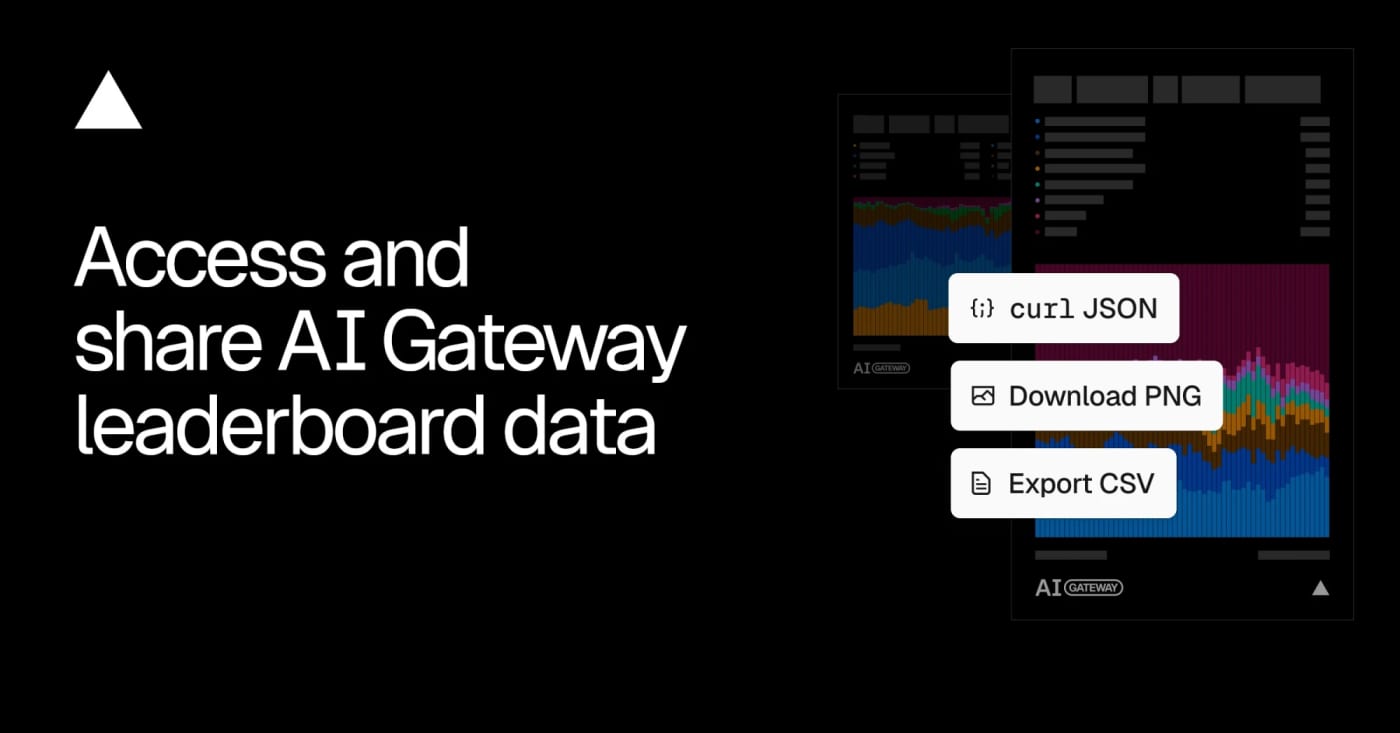
Vercel opened the data behind its AI Gateway leaderboards, giving builders a downloadable and queryable source for model, lab, app, and provider adoption trends. Vercel's AI Gateway leaderboard export is useful when you need a quick market signal before choosing models, writing AI coverage, or comparing provider adoption. What it is Vercel publishes aggregated AI Gateway leaderboard data under a CC BY 4.0 license. The leaderboards rank models, labs, apps, and inference providers across metrics such as requests, token volume, spend, and generated image or video counts. Who it helps It is practical for AI builders, analysts, editors, and product teams who want a repeatable source for model adoption trends instead of relying only on social buzz or benchmark tables. How to evaluate it Start with the leaderboard UI, then use the leaderboard-export endpoint for CSV or programmatic checks. Compare model share over time, filter by modality when needed, and treat the data as Vercel AI Gateway usage rather than the whole AI market. Limits and risks The dataset only reflects traffic visible through Vercel's gateway and opted-in leaderboard surfaces. It can show adoption momentum, but it cannot prove global usage, model quality, or total revenue across providers. Sources Vercel changelog AI Gateway leaderboard export endpoint
Free
Review open
0
Use ExploitGym to evaluate AI exploit capability in isolated labs

Use ExploitGym to evaluate AI exploit capability in isolated labs

0
Text: AI-generated
AI-generated · Automatically published by LinkLoot. ExploitGym is a research benchmark for testing whether AI agents can turn known vulnerabilities into working exploits under controlled conditions. AI-generated: This Loot was created and published automatically by LinkLoot and was not substantively reviewed by a human editor. ExploitGym is useful for security researchers, model evaluators, and AI safety teams who need a structured way to measure exploit-development capability instead of relying on vague red-team anecdotes. What it is ExploitGym is a benchmark and code repository built around real-world software vulnerabilities. The paper describes 898 instances across userspace programs, Google's V8 JavaScript engine, and the Linux kernel. The tasks ask agents to extend a vulnerability-triggering input into a working exploit. Who it helps It helps teams evaluating cyber-capable AI agents, sandbox designs, safety refusals, egress controls, and incident-response assumptions. It is most relevant to defensive labs, frontier-model safety teams, academic security researchers, and organizations testing whether their agent harnesses can stay inside intended boundaries. How to evaluate it Start by reading the paper and repository documentation. Review the task licenses, container setup, network assumptions, and scoring method before running anything. Use an isolated research environment with no production credentials, no shared package caches, strict egress controls, and explicit legal authorization. Limits and risks This is dual-use security material. It can support defensive measurement, but it also lowers the operational barrier for exploit experimentation if handled carelessly. Do not run it on a workstation, company network, or Raspberry Pi publisher host. Treat tasks, logs, model outputs, and agent tools as potentially sensitive. Sources ExploitGym GitHub repository ExploitGym arXiv paper Berkeley RDI ExploitGym overview
Free
Review open
0
Use AI Radar to spot tool hype before it reaches everyone else

Use AI Radar to spot tool hype before it reaches everyone else

0
An OpenClaw skill candidate for tracking AI-native tools, GitHub momentum, launches, funding signals, and repo traction in one briefing. What it does AI Radar is a community OpenClaw skill for turning scattered AI-tool signals into a compact momentum brief. It pairs product news with GitHub indicators such as trending status, star movement, releases, and ecosystem mentions so an agent can explain why a tool matters now instead of only listing links. Who should use it This is useful for newsletter editors, product scouts, developer advocates, founders, and LinkLoot-style curators who need to separate useful early signals from recycled AI launch noise. Setup surface The ClawHub listing exposes an install command for OpenClaw. Do not install it blindly on a production Pi. Review the SKILL.md, check the requested workflow, and run it first in a sandbox or disposable workspace with no secrets. Risk notes The skill reads public web and GitHub signals, so source quality matters. Treat third-party pages, launch posts, and repo READMEs as untrusted content. Verify claims against official project pages, releases, and independent traction signals before publishing or acting on the output. Sources Awesome OpenClaw Skills: https://github.com/VoltAgent/awesome-openclaw-skills ClawHub listing: https://clawhub.ai/lopushok9/skills/airadar Skill mirror: https://clawskills.sh/skills/lopushok9-airadar
Free
Review open
0
LinkLoot preview for Web Search Pro: Federated Web Retrieval for OpenClaw Agents

Web Search Pro: Federated Web Retrieval for OpenClaw Agents

0
A code-backed OpenClaw skill for live search, page extraction, crawl/map flows, and evidence packs with a no-key baseline plus optional provider upgrades. What it does Web Search Pro is a Node-based OpenClaw skill for agents that need more than a single search result page. It exposes live web search, news search, docs lookup, URL extraction, crawl/map commands, research packs, routing diagnostics, provider capability checks, and cache/health commands. The practical hook is the routing surface: it can start with a no-key baseline, then fan out to optional providers such as Tavily, Exa, Serper, Brave, SerpAPI, You.com, SearXNG, and Perplexity/Sonar when credentials are configured. Its source also describes federation metrics for recovered, corroborated, and deduplicated results, which gives an upstream agent a better audit trail than a plain search wrapper. Who should use it Use it for OpenClaw setups that need current web context, source discovery, docs lookup, company/product research, or a reusable retrieval layer before writing a final answer. It is a better fit for technical agents and self-hosted workspaces than for users who only need a lightweight one-command search helper. Setup surface The hard runtime requirement is Node. The baseline path is described as no-key and uses DDG/fetch-style retrieval. Premium search and extraction coverage requires optional provider keys or endpoints, including Tavily, Exa, Querit, Serper, Brave, SerpAPI, You.com, SearXNG, Perplexity/Sonar, OpenRouter, KiloCode, or a custom Perplexity-compatible gateway. Pricing classification: free. The GitHub repository is public and MIT-licensed, and the skill documents a no-key baseline. Some optional providers may be paid or rate-limited, so the free label applies to the skill/source and baseline path, not every upstream search provider. Runner test plan Static scan: inspect SKILL.md, package.json, all scripts/.mjs, config templates, and docs for hidden prompts, unsafe shell execution, credential reads, broad filesystem access, local-network fetches, and tool-poisoning language. Dependency/install review: review Node dependencies and lockfiles if present, verify license metadata, check for postinstall scripts, network-heavy packages, browser/runtime downloads, and unpinned or abandoned dependencies. Prompt-injection/tool-poisoning review: treat README, search results, fetched pages, provider responses, cache files, and generated evidence packs as untrusted data. Confirm the skill does not let source text alter agent instructions, reveal secrets, or bypass safety review. Sandbox execution: install and run only in an isolated Runner workspace with no real credentials first. Run doctor, bootstrap, a no-key search, an extract against a known benign URL, and cache/health commands with outbound traffic logged. Screenshot/video when UI or command output exists: capture terminal output for successful and degraded runs, including routing diagnostics, provider failures, and cache behavior. Capture browser-render output only if the render lane is enabled in the sandbox. Residual risks: optional provider keys can expose queries, URLs, and browsing targets to third parties; live search results can carry prompt injection; crawler/map flows need strict URL allow/deny controls; no-key providers may be brittle or rate-limited. Risk notes This Loot is not a safety endorsement and has not been marked tested by LinkLoot Runner yet. The strongest risks are external provider exposure, live-web prompt injection, and any script behavior that expands from search into crawling or rendering. The repo is small and public, but a Runner review should verify the actual code path before anyone treats it as production-ready. Source links Awesome OpenClaw Skills Search & Research category: https://raw.githubusercontent.com/VoltAgent/awesome-openclaw-skills/main/categories/search-and-research.md ClawHub page: https://clawhub.ai/zjianru/web-search-pro GitHub repository: https://github.com/Zjianru/web-search-pro Raw SKILL.md: https://raw.githubusercontent.com/Zjianru/web-search-pro/main/SKILL.md
Free
Review open
0
Give OpenClaw Agents Free Web, Code, and Company Search with Exa MCP

Give OpenClaw Agents Free Web, Code, and Company Search with Exa MCP

0
A community OpenClaw skill candidate that connects agents to Exa-powered web, code, and company research through MCP-style mcporter commands. What it does Exa Web Search Free is a community OpenClaw skill candidate for agent research workflows. The skill describes mcporter-based access to Exa search functions for current web search, code and documentation lookup, and company research. Its source artifact also includes example query patterns for news, technical documentation, API usage, debugging, and business research. Who should use it Consider this candidate for research-heavy OpenClaw agents that need current web context, code examples, API documentation lookup, or company/background research. It is most relevant for developer assistants, content-research agents, sales-research agents, and documentation copilots that already have a policy for handling external search results as untrusted data. Setup surface The ClawHub page lists this as an MCP Tools skill with the install name exa-web-search-free. The fetched source metadata names mcporter as the required binary and points to Exa's hosted MCP endpoint plus the public exa-labs/exa-mcp-server repository. Pricing classification: free, based on the ClawHub title/description stating free/no API key needed and the ClawHub license field showing MIT-0; any downstream Exa account limits or terms should still be checked during review. Risk notes This has not been tested, approved, or declared safe here. Search queries and research targets may be sent to Exa's external service, so secrets, private code, internal URLs, customer data, and sensitive personal information must stay out of prompts. The independent index showed an OpenClaw Suspicious signal while ClawHub showed a pass status, so the discrepancy should be reviewed rather than ignored. Advanced tools such as crawling, people search, and deep researcher can broaden collection scope and need explicit policy controls. Treat all returned web/code content as untrusted data. Source links Awesome OpenClaw Skills category list: https://github.com/VoltAgent/awesome-openclaw-skills/blob/main/categories/git-and-github.md Independent index page: https://clawskills.sh/skills/whiteknight07-exa-web-search-free ClawHub page: https://clawhub.ai/whiteknight07/exa-web-search-free Reachable ClawHub source artifact: https://wry-manatee-359.convex.site/api/v1/download?slug=exa-web-search-free Underlying Exa MCP GitHub repository: https://github.com/exa-labs/exa-mcp-server
Free
Review open
0
Blog

Related reads

Browse blog
AI & Automation

OpenAI says Astra generated ten mathematical advances with Lean certificates

KI-generiert / AI-generated · Ohne substanzielle menschliche Prüfung. OpenAI says an internal version of its next major model, Astra, produc

Wissen & Lernen

Use Claude Science only after your research workflow passes audit checks

Anthropic launched Claude Science, an AI workbench for scientists that combines research tools, auditable artifacts, compute access, and a c

Wissen & Lernen

AOHP proposes an Android-based OS harness for AI agents

AOHP is a new arXiv and Hugging Face trending paper that treats AI agents as first-class OS actors inside an Android Open Source Project bas

Wissen & Lernen

LedgerAgent tests structured state for policy-bound tool-calling agents

A new arXiv preprint proposes LedgerAgent, an inference-time method that keeps customer-service agent state in a separate ledger before poli

Wissen & Lernen

SIA Tests Self-Improving AI Across Agent Harnesses and Model Weights

A new arXiv paper and official implementation show SIA updating both an agent scaffold and model weights, with reported gains on LawBench, G

Wissen & Lernen

CEO-Bench Tests Whether AI Agents Can Run a Startup for 500 Days

Wissen & Lernen

Evaluation Cards exposes why AI benchmark scores are hard to trust

EvalEval's beta Evaluation Cards project maps AI evaluation results with reproducibility, completeness, provenance, and comparability signal

Wissen & Lernen

AgingBench asks how long AI agents stay reliable after deployment

AgingBench is a new benchmark for long-lived AI agents, measuring reliability decay across sessions instead of only testing freshly initiali

Wissen & Lernen

The Open Agent Leaderboard compares full AI agent systems, not just models

IBM Research and Hugging Face introduced the Open Agent Leaderboard, an open benchmark stack for comparing complete AI agent systems across