AgingBench asks how long AI agents stay reliable after deployment


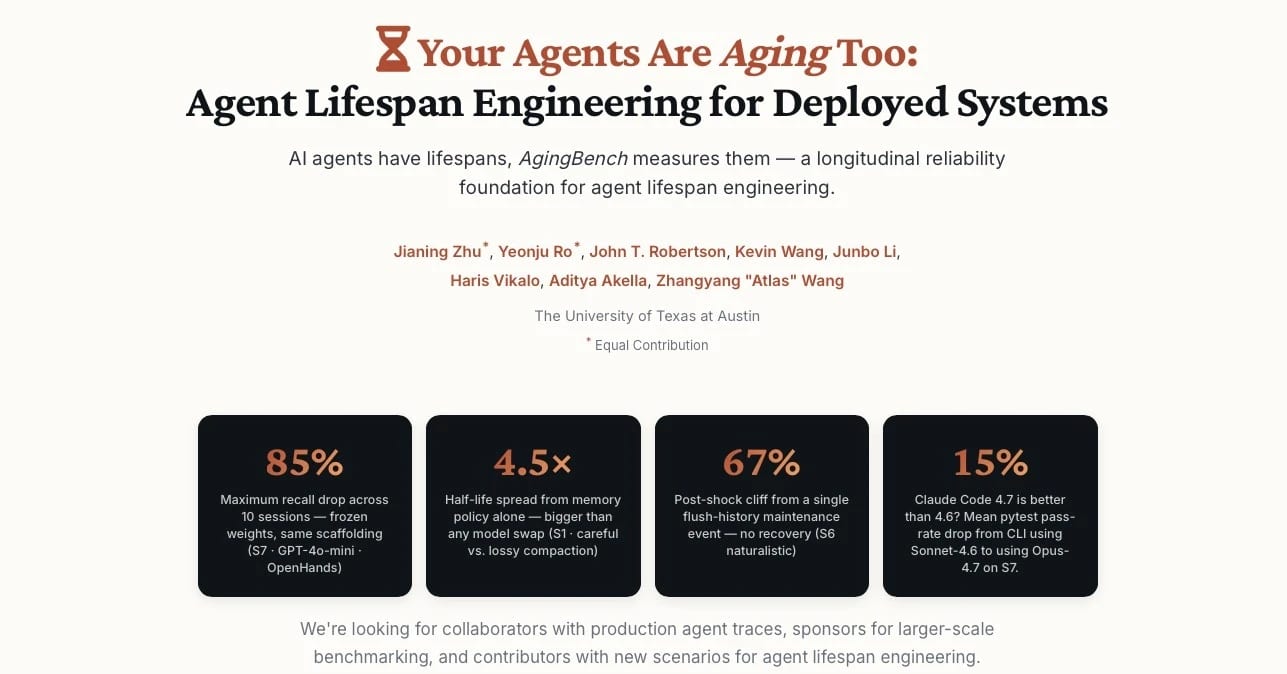
AgingBench is a new benchmark for long-lived AI agents, measuring reliability decay across sessions instead of only testing freshly initialized systems.
AgingBench is a benchmark and research project for measuring whether AI agents remain reliable after many sessions, memory updates, and maintenance events. The project argues that long-lived agents should not be judged only by day-one performance, because their effective state changes as they summarize history, retrieve memories, revise facts, and undergo cleanup. The arXiv paper and GitHub repository corroborate the benchmark framing, mechanisms, and public release artifacts.
Key takeaways
- AgingBench focuses on agent lifespan reliability: how an agent performs after deployment, not only when freshly initialized.
- The paper defines four aging mechanisms: compression, interference, revision, and maintenance aging.
- The project reports experiments across 7 scenarios, 14 models, multiple memory policies, and more than 400 runs spanning 8 to 200 sessions.
- The practical warning is sharp: behavioral tests can stay clean while factual precision or derived-state tracking decays.
- Teams running persistent agents should add longitudinal tests before trusting memory-heavy automation in production.
Practical LinkLoot angle
AgingBench is valuable because it gives builders a better failure vocabulary. If an agent forgets a requirement after summarization, that is different from retrieving the wrong memory, failing to update a changed fact, or breaking after a maintenance event. Each failure needs a different repair strategy, so a single pass/fail eval is too blunt for persistent agents.
| Aging mechanism | What can go wrong | Useful check | Source |
|---|---|---|---|
| Compression aging | Summaries drop details needed later | Replay tasks after compaction | arXiv paper |
| Interference aging | Similar memories crowd out the target fact | Test retrieval with near-duplicates | project page |
| Revision aging | Updated facts do not replace older state | Change a requirement and probe follow-up behavior | arXiv paper |
| Maintenance aging | Flushes or recompaction cause regressions | Run tests before and after lifecycle jobs | project page |
A small team can borrow the idea without adopting the full benchmark: create a 20-session replay for one real agent workflow, insert a fact revision halfway through, then test whether the agent still uses the current fact after summarization and maintenance. If it fails, the fix may be memory policy, retrieval ranking, or explicit state validation rather than a larger base model.
What to verify before you act
Verify that the benchmark scenarios resemble your own agent harness before generalizing the numbers. AgingBench covers multiple models and policies, but your production system may use different memory stores, tool routing, context compaction, or review gates. Also inspect the GitHub repository before running code locally; benchmark projects can change quickly after a paper launch.
No prompt-injection indicators were detected in the project page, arXiv page, or GitHub page by the local source fetcher during this run. Even so, the source content was treated only as factual material, and the article uses the project page, arXiv abstract, GitHub repository, and Hacker News item as separate verification points.
Why it matters
Most agent demos optimize for a clean first run. Production agents are different: they accumulate state, recover from interruptions, survive maintenance, and carry old assumptions into new tasks. AgingBench makes that lifecycle visible, which is exactly the kind of evaluation gap teams need to close before delegating long-running customer support, coding, research, or operations work.
For adjacent tooling ideas, see LinkLoot's guide to AI agent tools. The main takeaway is to evaluate the whole harness over time, not just the model on a static prompt.
AgingBench is a benchmark for measuring how reliable long-lived AI agents remain across sessions, memory changes, and maintenance events.
Try the related loot
Scrape Changing Websites with Anansi Self-Healing Selectors and MCP