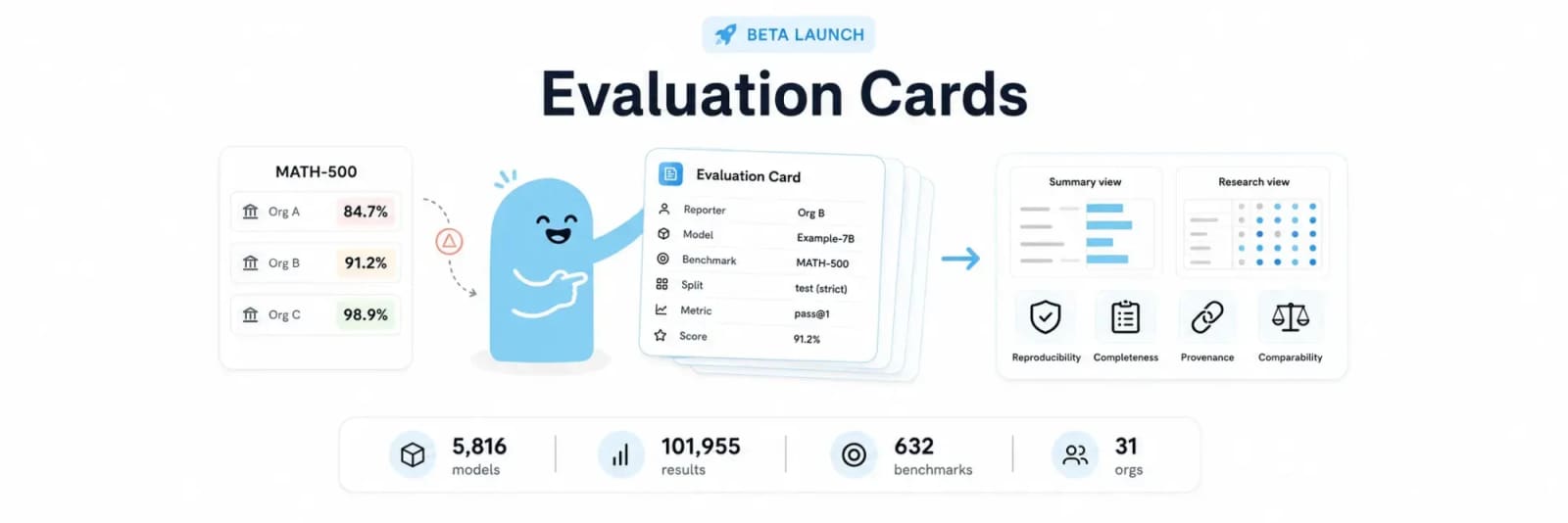
Evaluation Cards exposes why AI benchmark scores are hard to trust


EvalEval's beta Evaluation Cards project maps AI evaluation results with reproducibility, completeness, provenance, and comparability signals.
EvalEval beta-launched Evaluation Cards, an open-source layer for inspecting AI evaluation results through reproducibility, completeness, provenance, and comparability signals. The launch post says the system covers 101,955 reported results across 638 benchmarks, 31 organizations, and 5,816 models as of June 9, 2026. For anyone comparing model claims, the value is not another leaderboard; it is a way to see whether a score has enough context to mean what the headline suggests.
Key takeaways
- Evaluation Cards combines run data, benchmark metadata, and model metadata into a more inspectable evaluation record.
- The project highlights four signals: reproducibility, completeness, provenance, and comparability.
- EvalEval reports that many evaluation records lack fields needed to reproduce results, including generation settings such as temperature and max tokens.
- The independent EvalEval site confirms the project and describes the coalition as a research community focused on evaluation infrastructure.
- The Every Eval Ever repository provides the underlying shared schema and data-organization approach for standardized evaluation reporting.
Practical LinkLoot angle
Use Evaluation Cards as a due-diligence layer before trusting a benchmark table in a model launch post. If a vendor claims a model wins on a benchmark, check whether the setup, reporter, scoring method, and comparable runs are visible.
| Check | Why it matters | What to look for | Source |
|---|---|---|---|
| Reproducibility | A score without settings is hard to rerun | Temperature, max tokens, prompt format, version | Hugging Face |
| Provenance | First-party and third-party claims carry different risk | Who ran the eval and who reproduced it | EvalEval |
| Comparability | Same benchmark name can hide different setups | Measurement target, split, scoring, configuration | Every Eval Ever |
This is useful for AI procurement, model routing, and internal evaluation work. A team choosing between API models should not copy a public score into a decision doc unless it can explain how the score was produced and whether it matches the intended workload.
What to verify before you act
Check whether the model, benchmark, and date you care about are covered in the current Evaluation Cards interface, because the launch is a beta and the corpus will change. Treat missing fields as a decision risk, not as proof that a model is bad. For high-stakes comparisons, use Evaluation Cards to identify gaps, then run a small workload-specific eval with your own prompts, data constraints, and acceptance criteria.
Source check
The Hugging Face launch post confirms the beta launch, the corpus size, the four interpretive signals, and the stated reproducibility gaps. The EvalEval Coalition site independently confirms the group and lists Evaluation Cards as current work. The Every Eval Ever repository corroborates the structured reporting foundation behind the project.
Evaluation Cards are structured records that help inspect AI benchmark results through reproducibility, completeness, provenance, and comparability signals.
For model-selection workflows, see LinkLoot's guide to AI agent tools.
Share your own knowledge as loot
Request access to the guided creator beta and get feedback on your first submission.