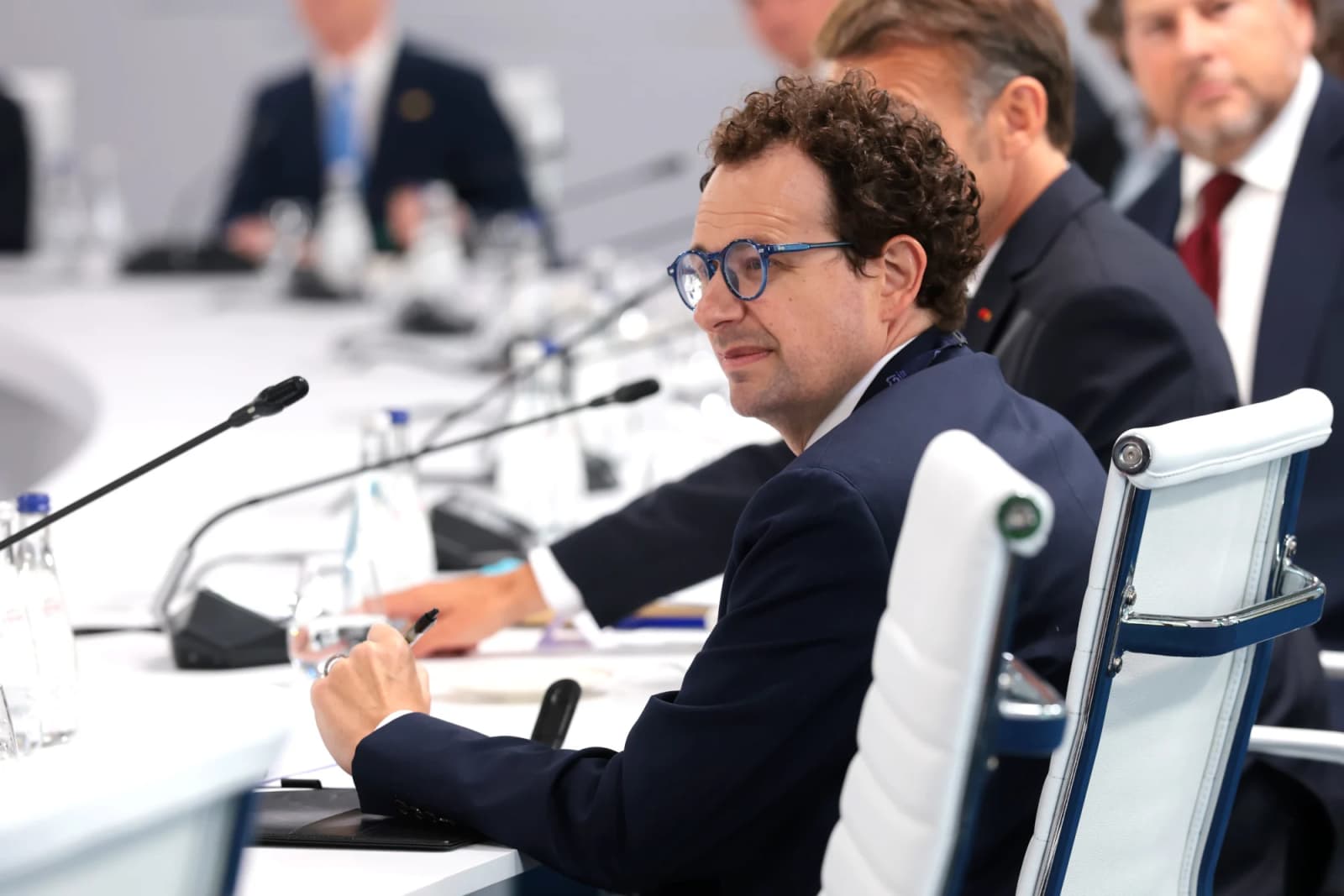
Amodei and Hassabis Push a U.S.-Led AI Coalition at the G7


Anthropic's Dario Amodei and Google DeepMind's Demis Hassabis reportedly used a closed-door G7 AI lunch to argue for U.S.-led global rules, frontier-model access standards, and coordinated chip controls.
The short version
Anthropic CEO Dario Amodei and Google DeepMind CEO Demis Hassabis reportedly pushed G7 leaders toward a U.S.-led coalition for global AI rules and standards during a closed-door AI lunch in Évian-les-Bains, France. CNBC reported the proposal through people familiar with the discussions, while official G7 material confirms that the working lunch focused on safe, rapid, and efficient AI adoption and included CEOs from Anthropic, Google DeepMind, OpenAI, Meta, Mistral, Cohere, Salesforce, and others. The practical signal is clear: frontier AI governance is shifting from broad principles to access rules, testing standards, chip controls, and security coordination.
Key takeaways
- Amodei and Hassabis reportedly argued for international AI cooperation with the U.S. taking the lead.
- CNBC's account says Amodei highlighted structured access to frontier models, chip and critical-component trade, and AI risks in cyber, bioterrorism, and intelligence.
- OpenAI's Sam Altman reportedly favored an international forum for testing standards, capability analysis, and cooperation among nations.
- The G7 AI lunch produced no binding rules, but it shows that AI labs now want to shape governance before governments define it alone.
- For builders, the immediate risk is not just regulation; it is model access changing through geopolitical decisions.
What happened at the G7 AI lunch
The meeting took place on June 17, 2026, during the G7 Evian Summit. Japan's Ministry of Foreign Affairs says the working lunch, titled "Ensuring Safe, Rapid, and Efficient AI Adoption," lasted about 110 minutes and included CEOs from Anthropic, Google DeepMind, OpenAI, Meta, Mistral, Cohere, Salesforce, Synthesia, Sakana AI, and other AI companies.
CNBC reported that Amodei and Hassabis used the lunch to propose international cooperation on AI with U.S. leadership. The Next Web, citing CNBC, added that Canadian Prime Minister Mark Carney agreed the U.S. could lead such a coalition, while the meeting remained a discussion rather than a negotiation with binding commitments.
The timing matters. The pitch came against a backdrop of anxiety over powerful frontier models, cybersecurity risks, and the recent U.S. restriction of Anthropic's Fable 5 and Mythos 5 access. That makes the coalition proposal less like a generic standards pitch and more like an attempt to define who controls frontier capability before ad hoc bans become the default.
Why it matters
This is the emerging AI governance stack: model evaluations, access tiers, chip supply chains, cyber-defense rules, and national-security exceptions. If a U.S.-led coalition forms, it could make AI deployment more predictable for allies. It could also turn "safety standards" into a gatekeeping layer that decides which countries, companies, and researchers can use the strongest models.
For AI builders and operators, the takeaway is operational:
| Governance layer | What could change | Builder impact |
|---|---|---|
| Frontier model access | Countries or user classes may need approval for top-tier models | Add fallback models and avoid single-provider lock-in |
| Model testing standards | Shared evaluation protocols could become procurement requirements | Track eval artifacts, model cards, and audit logs early |
| Chip and component trade | Compute access could be tied to coalition rules and China exclusions | Expect supply-chain compliance to matter more |
| Cybersecurity use | Defensive access may become vetted, logged, or restricted | Build clear customer identity and use-case verification |
| National-security overrides | Governments may force access changes faster than vendors can plan | Design workflows that degrade safely when a model disappears |
The useful LinkLoot angle: treat frontier AI like cloud infrastructure with political risk. The model endpoint is not the whole dependency. The real dependency is the policy regime around the endpoint. For stack planning, start with the AI agent tools guide and include governance risk in every vendor decision: /guides/ai-agent-tools.
The coalition tradeoff
A U.S.-led coalition could be useful if it creates trusted evaluation methods, shared incident reporting, and clearer rules for high-risk model access. That would help enterprises, governments, and security teams understand what they can deploy and under which conditions.
The risk is that the coalition becomes a standards cartel. If Washington leads rulemaking while U.S. labs dominate frontier model supply, international partners may see the framework as safety policy mixed with industrial policy. The Associated Press described the G7 AI discussion as happening amid tension over American tech dominance, which is the core political problem here.
The smartest version of the coalition would separate three things:
- safety tests that should be globally reusable,
- national-security controls that should be narrow and reviewable,
- market access rules that should not quietly freeze out smaller labs or allied countries.
What to verify before you act
Do not treat the G7 discussion as a new law or procurement requirement. No binding rule came out of the lunch. Treat it as an early signal that AI governance is becoming more operational and more geopolitical.
Before changing vendor strategy, check whether your critical models are exposed to export controls, trusted-access gates, region limits, or cybersecurity-use restrictions. Then document fallback behavior: which model takes over, what capabilities degrade, and which workflows require manual review when a frontier model is unavailable.
Source check
CNBC is the primary source for the reported closed-door proposal by Amodei and Hassabis. The Next Web repeats the CNBC-sourced details and adds a clear summary of the reported positions, including structured frontier-model access and chip trade controls.
Japan's Ministry of Foreign Affairs confirms the official G7 AI lunch, the timing, the "safe, rapid, and efficient AI adoption" theme, and the participation of CEOs from Anthropic, Google DeepMind, OpenAI, Meta, Mistral, Cohere, Salesforce, and other AI companies. Associated Press provides independent context on the G7 AI agenda, regulation pressure, and concerns about U.S. dominance.
What is not confirmed publicly: the full transcript of the closed-door lunch, exact wording from Amodei or Hassabis, and whether any government formally committed to a U.S.-led coalition.
No binding coalition was announced. CNBC reported that Amodei and Hassabis urged leaders toward a U.S.-led framework, but the lunch did not produce formal rules.
Bottom line
The G7 story is not just "AI CEOs met politicians." It is the moment AI labs openly tried to shape the rulebook for frontier capability, and they did it in a room with heads of state.
The next AI platform war may not be won only by better models. It may be won by whoever writes the access rules, evaluation standards, and supply-chain boundaries that everyone else has to obey.
Share your own knowledge as loot
Request access to the guided creator beta and get feedback on your first submission.