Gemma 4 12B Brings Local Multimodal Agent Workflows to Laptops


Google's Gemma 4 12B gives developers an open-weight, encoder-free multimodal model for local agent workflows on high-memory laptops, with LiteRT-LM serving, Hugging Face weights, and practical endpoint caveats.
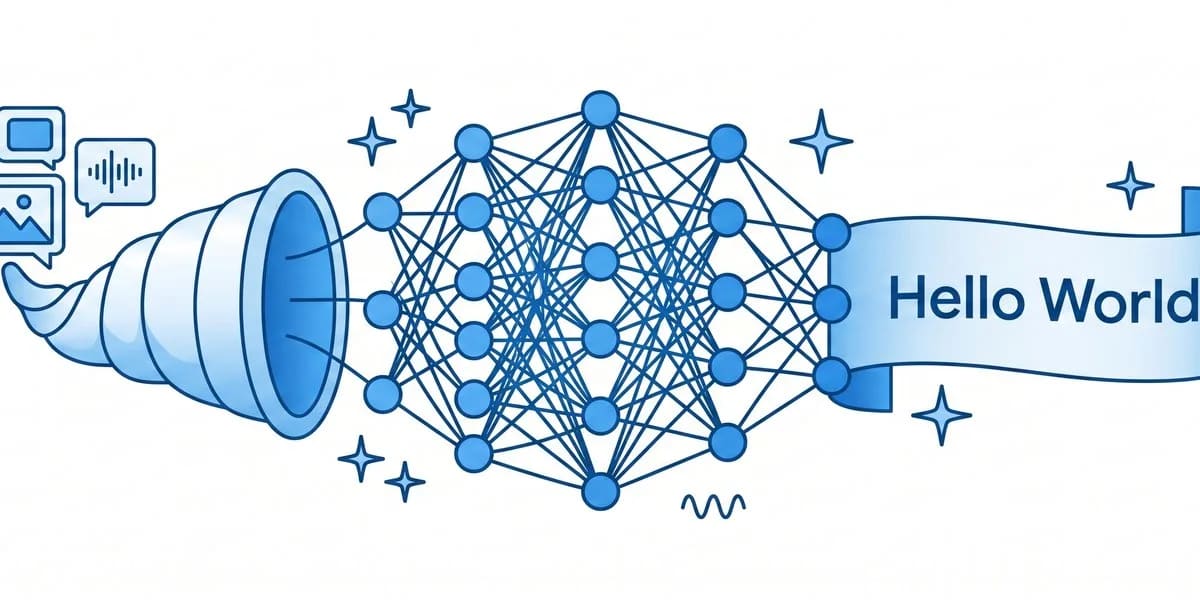
Google's Gemma 4 12B is an open-weight multimodal model aimed at local AI development on laptops with enough memory for serious inference. Google says the model uses a unified, encoder-free architecture, supports text, image, video, and native audio inputs, and can be served locally through LiteRT-LM as an OpenAI-compatible endpoint. The practical question is whether a local agent workflow benefits enough from privacy, latency, and offline execution to justify endpoint hardware and governance work.
Key takeaways
- Google positions Gemma 4 12B as the first medium-sized Gemma model with native audio input and a unified multimodal architecture.
- The developer guide says it can run locally on dedicated GPU laptops with 16GB VRAM or unified memory, but memory use still depends on tooling, context length, and precision.
- LiteRT-LM now includes a
servecommand so developers can expose Gemma 4 12B through a local, OpenAI-compatible API endpoint. - The Hugging Face model card lists Apache 2.0 licensing, Transformers support, about 11.96B BF16 parameters, and a
google/gemma-4-12Bmodel repo. - InfoWorld's independent coverage frames the release as useful for local agent workflows, while flagging enterprise hardware, security, logging, and compliance constraints.
Practical LinkLoot angle
Gemma 4 12B is useful when the workflow depends on local files, fast iteration, offline use, or keeping sensitive inputs off a hosted model API. A clean pilot is narrow: run the LiteRT-LM server on one supported laptop, connect one coding or automation tool to the local endpoint, and test a task that mixes local context with image, audio, or document inputs.
| Option | Best use | Limitation | Source |
|---|---|---|---|
| Gemma 4 12B local endpoint | Private multimodal agent experiments on a capable laptop | Needs enough VRAM or unified memory; local logging and policy controls are your job | Google Developer Blog, InfoWorld |
| Hosted frontier model API | Higher-capability reasoning, broad tool integrations, managed serving | Sends data to a provider and creates variable inference cost | LinkLoot workflow comparison |
| Smaller edge model | Mobile or low-power local tasks | Less room for multimodal reasoning and long context | Google AI docs |
For LinkLoot readers building AI workflows, the win is not "replace every cloud model." The better use is routing the right local tasks to a local model: file summarization, quick visual checks, speech transcription experiments, test-data generation, or agent prototypes that should not touch a paid hosted API until the workflow shape is proven.
What to verify before you act
Check hardware first. Google's developer guide mentions 16GB VRAM or unified memory for local use, and the Google AI docs warn that memory estimates can change with inference tools, quantization, context length, and runtime overhead.
Check model format and modality support next. The Hugging Face model card covers the main google/gemma-4-12B repo, while the LiteRT-LM path uses deployment-specific artifacts; the LiteRT-LM model card notes that current support can differ by modality and platform.
Check governance before giving a local agent file or script access. InfoWorld's coverage highlights the enterprise tradeoff: local inference can reduce cloud exposure, but it makes endpoint logging, drift tracking, approved model use, and sandboxing harder to enforce.
Source check
The Google Developer Blog confirms the encoder-free architecture, native audio milestone, local development target, macOS desktop apps, LiteRT-LM serving, and agent-harness examples. Google AI docs confirm the Gemma 4 family overview, context-window claims, architecture categories, memory-planning caveats, and QAT/quantization options. The Hugging Face model card confirms the model repo, Apache 2.0 license, Transformers support, parameter metadata, and listed capabilities. InfoWorld independently corroborates the local-agent framing and adds enterprise deployment concerns.
Google says it targets dedicated GPU laptops with 16GB VRAM or unified memory, but usable performance depends on runtime, quantization, context size, and workload.
For more implementation ideas, compare this with LinkLoot's guide to AI agent tools and AI workflow automation.
Try the related loot
This JS Agent Turns Any Website Into an AI Copilot