Use Gemma 4 on Cerebras when voice agents need real-time vision


Hugging Face and Cerebras have shown an open speech-to-speech stack using Gemma 4 31B on Cerebras Inference. The practical signal is clear: real-time voice and vision agents now have an open-weight path, but teams still need to verify latency, pricing, provider limits, and fallbacks before production use.
Hugging Face and Cerebras have confirmed a real-time speech-to-speech demo that runs Gemma 4 31B on Cerebras Inference. Confidence level: confirmed platform preview. The useful part is not a new model family; it is a faster open-weight path for voice, vision, and agent loops that need responses while a user is still engaged.
What changed
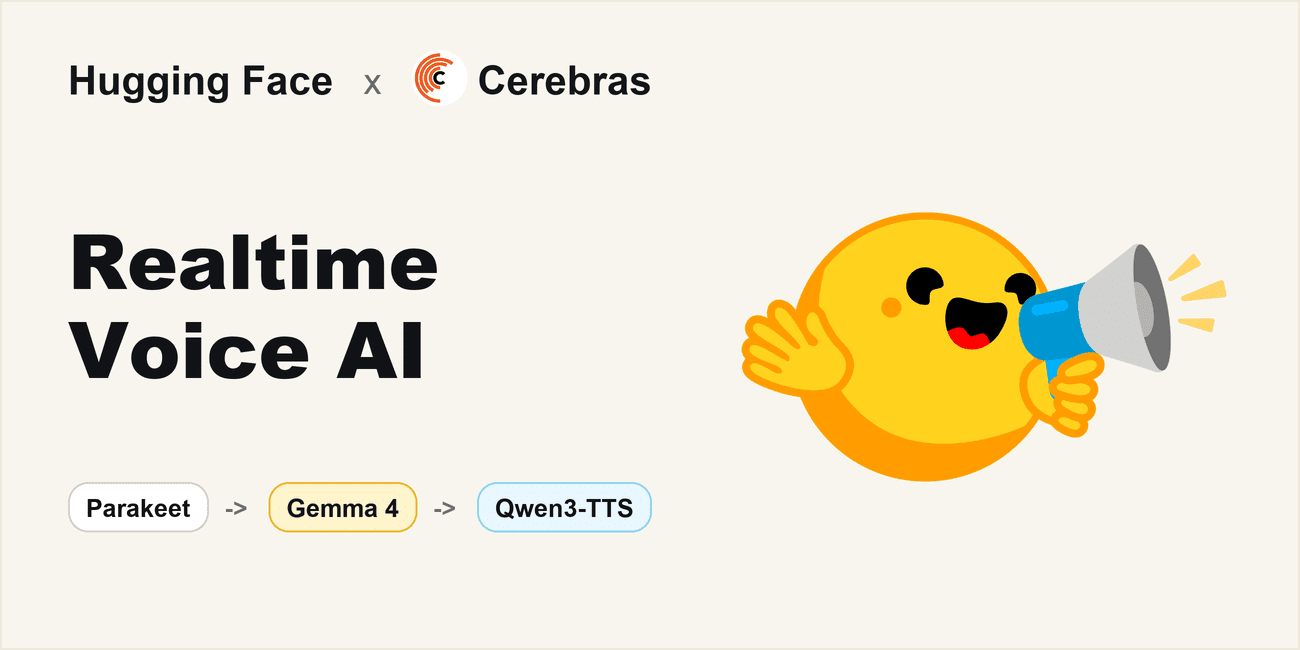
Hugging Face published an open, cascaded speech-to-speech architecture: speech recognition with NVIDIA Parakeet, Gemma 4 VLM inference on Cerebras, and text-to-speech with Alibaba's Qwen3TTS. The demo is available as a Hugging Face Space, with a repository linked from the article.
Cerebras says Gemma 4 31B is available on Cerebras Inference Cloud in public preview for a limited time. It describes the model as its first Google DeepMind model on the platform and its first Cerebras-hosted model that accepts images for multimodal workflows.
| Piece | Role in the stack | Access/status | Practical caveat |
|---|---|---|---|
| Gemma 4 31B | Vision-language reasoning | Cerebras public preview | Availability and pricing can change |
| NVIDIA Parakeet | Speech recognition | Open model component | ASR quality still depends on audio conditions |
| Qwen3TTS | Spoken response | Open model component | Voice quality and licensing need review |
| Hugging Face Space | Demo surface | Public demo | Not a production SLA |
Why this is early
This is early because the main deployment path is a public preview and a demo, not a mature production reference architecture. Hugging Face frames the stack as modular and open, which is useful, but builders still have to own orchestration, monitoring, fallbacks, and user-data controls.
The speed claim has independent context. Cerebras cites Artificial Analysis for Gemma 4 31B throughput, and Artificial Analysis tracks provider-level metrics for Gemma 4 31B across multiple API providers. Those figures can move over time, so use them as a benchmark signal, not a permanent contract.
Key takeaways
- Gemma 4 on Cerebras gives builders a fast open-weight option for multimodal voice and agent workflows.
- Hugging Face's demo is modular: ASR, vision-language inference, and TTS can be swapped.
- Cerebras positions Gemma 4 31B as a public preview, not a guaranteed long-term access tier.
- The strongest use cases are screenshot-to-insight, document QA, robot interaction, support assistants, and visual agent loops.
- Production teams still need latency tests, cost modeling, provider fallback, and privacy review.
Availability and access
Developers can inspect the Hugging Face Space and linked repository now. Gemma 4 31B on Cerebras is described as available on Cerebras Inference Cloud in public preview for a limited time.
Before you depend on it, check whether the exact multimodal endpoint is available to your account, what the token pricing is, and whether your use case fits the preview terms. For voice products, also test the full round trip: microphone input, ASR, model inference, TTS, streaming, retries, and interruption handling.
Practical LinkLoot angle
This is a good candidate for builders who care more about interaction latency than raw frontier-model intelligence. A voice agent that waits several seconds after every user turn feels broken even when the answer is correct. Fast medium models can win when the task is narrow, visual, and repeated.
Use it for a controlled prototype: one visual support workflow, one document-reading workflow, and one agentic UI-repair workflow. Compare it against your current stack on first-token latency, complete response time, failure recovery, cost per session, and whether the model can return structured output reliably.
For more agent evaluation patterns, pair this with LinkLoot's guide to AI workflow automation.
What to verify before you act
- Confirm the Cerebras preview terms, account access, pricing, and rate limits.
- Re-check Artificial Analysis or your own benchmark logs before quoting throughput numbers.
- Test ASR and TTS components with noisy audio, accents, interruptions, and long sessions.
- Review data handling for voice, screenshots, documents, and any user-identifying context.
- Add a fallback provider or a text-only mode before exposing the workflow to customers.
Source check
Confirmed by: Hugging Face documents the speech-to-speech architecture, demo, and repository. Cerebras confirms Gemma 4 31B availability on Cerebras Inference Cloud in public preview and describes the multimodal speed positioning.
Independent context: Artificial Analysis tracks Gemma 4 31B provider benchmarks and gives a way to compare Cerebras against other hosted providers. Treat live benchmark numbers as time-sensitive.
Cerebras describes Gemma 4 31B on its inference cloud as a public preview for a limited time, so verify account access and terms before planning production use.
Try the related loot
Scrape Changing Websites with Anansi Self-Healing Selectors and MCP