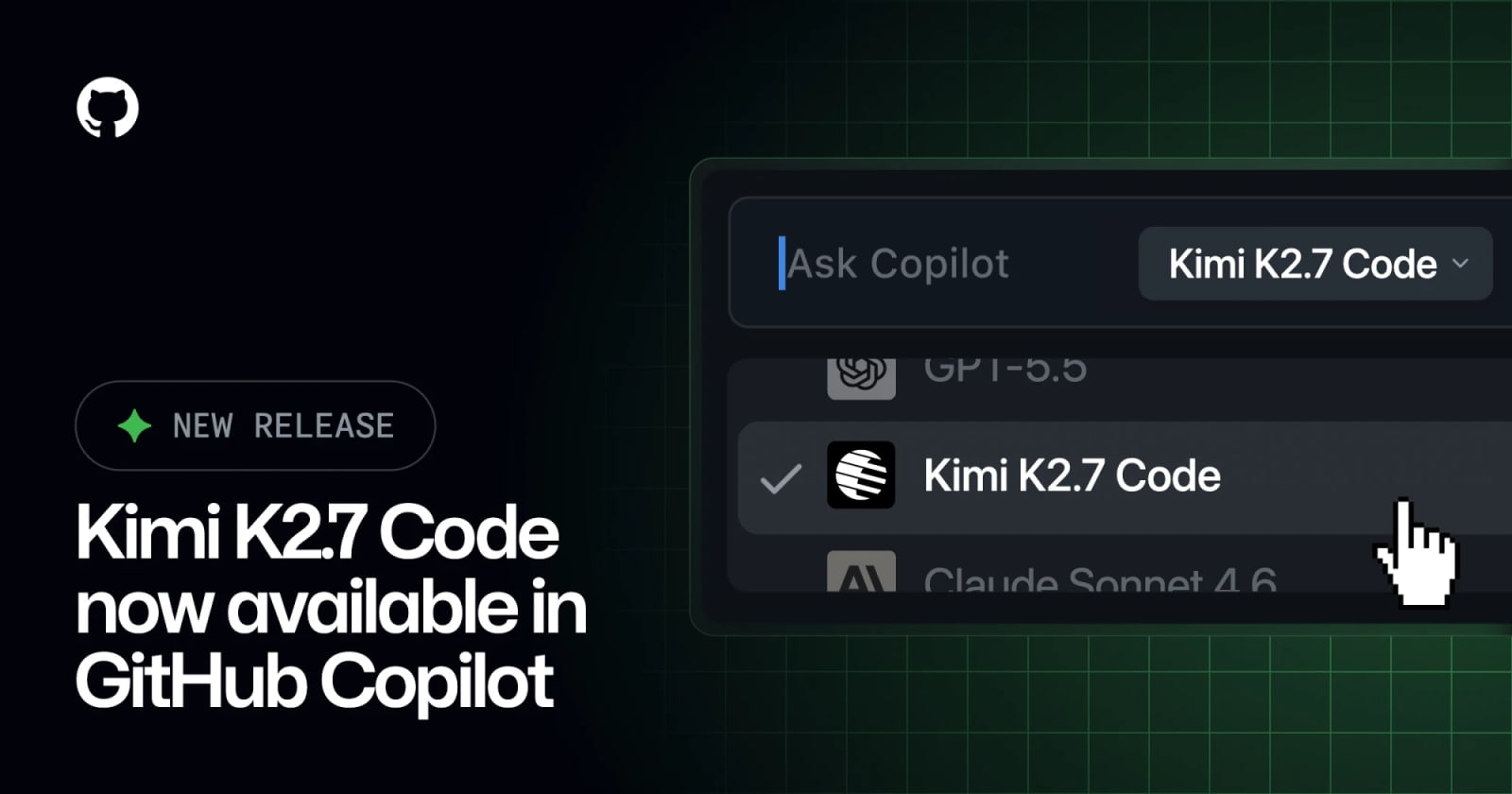
Try Kimi K2.7 Code in Copilot after your admin reviews open-weight risk


GitHub Copilot now offers Moonshot AI's Kimi K2.7 Code as its first selectable open-weight model, with gradual rollout and admin controls for business plans.
GitHub has confirmed that Kimi K2.7 Code is generally available in GitHub Copilot as a selectable model. Confidence level: confirmed for GitHub's rollout, gradual for account-level availability. It is the first open-weight model in the Copilot model picker, and GitHub says it is hosted on Microsoft Azure.
What changed
On July 1, 2026, GitHub added Moonshot AI's Kimi K2.7 Code to Copilot. The rollout begins with Copilot Pro, Pro+, and Max plans, with Business, Enterprise, and more surfaces planned over the following weeks. Supported surfaces include VS Code, Visual Studio, JetBrains, Xcode, Eclipse, Copilot CLI, GitHub.com, GitHub Mobile, the Copilot App, and the Copilot cloud agent.
Business and Enterprise access is off by default. GitHub says administrators must enable the Kimi K2.7 Code policy before organization members can select it.
| Item | What GitHub says | Practical use | Caveat |
|---|---|---|---|
| Model | Kimi K2.7 Code by Moonshot AI | Lower-cost coding model choice | Open-weight risk review needed |
| Hosting | GitHub on Microsoft Azure | Prompts are not routed to Moonshot-hosted inference by default | Still review Copilot data policies |
| Rollout | Pro, Pro+, Max first | Individual developers may see it before companies | Gradual account availability |
| Pricing | $0.95 input, $0.19 cached input, $4 output per 1M tokens | Cheaper than many frontier coding models | Usage-based billing applies |
Why this is early
The GitHub changelog confirms the release, and GitHub docs already list hosting and pricing details. The early part is not whether the model exists; it is whether your account, IDE, plan, and admin policy expose it today.
Tech Times frames the move as a notable open-weight model entering a major coding assistant. That is useful context, but procurement and compliance decisions should lean on GitHub's docs, your Copilot contract, and your own tests.
Key takeaways
- Kimi K2.7 Code is now a selectable GitHub Copilot model.
- It is GitHub Copilot's first open-weight model option.
- GitHub hosts the model on Microsoft Azure.
- Business and Enterprise admins must explicitly enable it.
- GitHub warns teams to review open-weight model risk and run their own evaluations.
Availability and access
Developers on Copilot Pro, Pro+, and Max should see a gradual rollout first. GitHub says Business, Enterprise, and more surfaces will expand over the coming weeks. You also need compatible client versions, such as VS Code 1.127.0 or later and Visual Studio 17.14.6 or later.
For companies, the important gate is policy. If administrators leave the Kimi K2.7 Code policy disabled, users will not be able to select it even when the model is otherwise available.
Practical LinkLoot angle
Treat Kimi K2.7 Code as a procurement and workflow test, not just a cheaper dropdown. Run it on low-risk coding tasks first: refactors, test generation, small bug fixes, and migration drafts. Compare acceptance rate, edit distance, latency, and review burden against your current Copilot default.
If your team is collecting coding assistants and agent tools, keep this beside LinkLoot's AI agent tools guide. The useful question is whether the lower price changes where you use AI, not whether every task should move to the newest model.
What to verify before you act
- Confirm the model appears in your Copilot model picker on your plan.
- Check whether Business or Enterprise admin policy enables Kimi K2.7 Code.
- Review GitHub's model-hosting note and open-weight risk warning.
- Recheck pricing in the Copilot billing docs before running high-volume jobs.
- Benchmark it on your own repositories before using it for sensitive or regulated work.
Source check
Confirmed by: GitHub's changelog, GitHub's model-hosting docs, and GitHub's Copilot model-pricing docs.
Independent context: Tech Times reports the same Copilot rollout and frames the open-weight angle. Use that as context only; the operational details should come from GitHub's official docs.
Yes, but rollout is gradual and plan-dependent. Business and Enterprise admins must enable it.
Try the related loot
Best provider for OpenClaw in 2026: what to buy, what to avoid, and what actually saves money