GPT-5.5-Cyber enters limited preview as OpenAI expands Trusted Access for defenders


OpenAI says GPT-5.5-Cyber is entering limited preview for critical-infrastructure defenders, while GPT-5.5 with Trusted Access for Cyber remains the recommended starting point for most authorized security workflows.
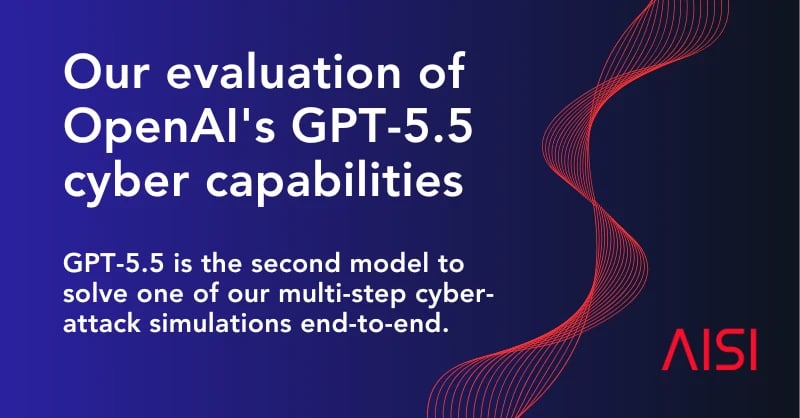
OpenAI says GPT-5.5-Cyber is now rolling out in limited preview for verified defenders responsible for critical infrastructure, while GPT-5.5 with Trusted Access for Cyber remains the default recommendation for most authorized defensive workflows. The company positions the cyber-specific variant as more permissive for specialized red-team and controlled validation tasks, not as the general model every security team should start with. Independent evaluation from the UK AI Security Institute also describes GPT-5.5 as one of the strongest cyber-capable models it has tested so far.
Key takeaways
- OpenAI is expanding its Trusted Access for Cyber program instead of opening the most permissive model tier to general users.
- GPT-5.5 with Trusted Access for Cyber is pitched for vulnerability triage, malware analysis, secure code review, detection engineering, and patch validation.
- GPT-5.5-Cyber is positioned for narrower, higher-risk authorized workflows such as red teaming and controlled exploit validation.
- The UK AI Security Institute says GPT-5.5 is among the strongest cyber models it has evaluated and reported a successful end-to-end solve on one of its multi-step simulations.
- The real story is the access model: stronger capability is being bundled with stronger verification, account controls, and scope limits.
| Access tier | What changes | Best fit |
|---|---|---|
| GPT-5.5 default | Standard safeguards | General development and knowledge work |
| GPT-5.5 with Trusted Access for Cyber | Lower refusal rate for verified defensive tasks | Most authorized blue-team workflows |
| GPT-5.5-Cyber | More permissive behavior with tighter controls | Specialized, approved security validation |
Why it matters
This is more useful as a workflow story than a model hype story. Security teams usually do not need unrestricted offensive behavior; they need faster authorized help on repetitive defensive tasks such as reproducing a published issue in a lab, validating patches, reviewing suspicious code paths, or translating findings into detection logic. OpenAI is clearly trying to separate those everyday defensive workflows from the smaller class of specialized tasks that need more permissive behavior.
That distinction matters if you are building a security operations or AppSec stack around frontier models. A team can now ask a practical question: is GPT-5.5 with Trusted Access enough for our normal review, triage, and validation loop, or do we have a narrow set of approved workflows that justify applying for the stricter GPT-5.5-Cyber tier?
What to verify before you act
Check whether your team can actually qualify for Trusted Access and whether your authentication setup already meets the stronger account-security requirements OpenAI names. You should also verify which tasks remain blocked even after approval, because the value depends less on benchmark headlines and more on whether the model can legally and safely assist with your exact in-house workflow. If you handle regulated or customer-sensitive environments, confirm logging, access governance, and review requirements before routing real security work through the service.
Practical comparison
A useful framing is to treat GPT-5.5-Cyber less like a mainstream assistant upgrade and more like a privileged lab tool. Most teams will likely get more operational value from the middle tier if it reduces refusals on legitimate defensive work without creating governance headaches. The specialized tier becomes interesting when your workflow includes approved exploit validation, controlled red teaming, or high-friction reproduction work that standard models still refuse.
No. OpenAI frames it as a limited-preview option for specialized, verified defenders rather than the default starting point.
If you are comparing agents and operational guardrails more broadly, LinkLoot’s guide to /guides/ai-agent-tools is the right next read.
For most teams, the strategic takeaway is simple: the useful shift is not just “a stronger model exists,” but that frontier cyber assistance is being productized through identity, scope, and access controls instead of a single open-ended switch.
Try the related loot
UI-TARS Desktop is a serious local computer-use agent — if you lock down the setup