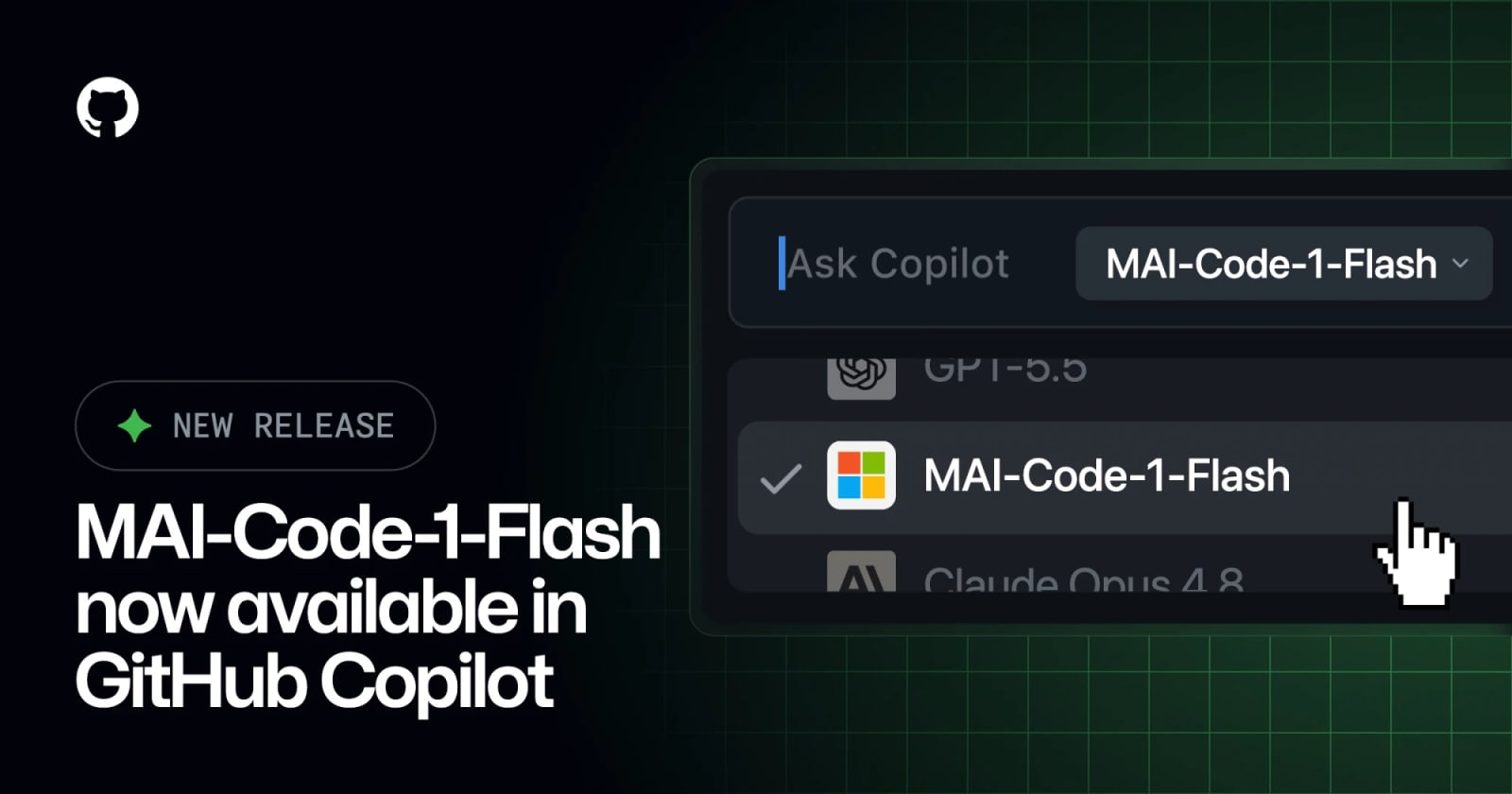
MAI-Code-1-Flash Reaches GitHub Copilot Business and Enterprise


GitHub says Microsoft's MAI-Code-1-Flash coding model is now generally available for Copilot Business and Enterprise, with admin policy controls and usage-based billing.
GitHub says MAI-Code-1-Flash is now generally available for GitHub Copilot Business and GitHub Copilot Enterprise. The model is Microsoft's in-house coding model, built for fast, low-latency coding assistance inside Copilot workflows. Administrators must enable the MAI-Code-1-Flash policy before users can access it, and GitHub says the model is billed at provider list pricing under usage-based billing.
Key takeaways
- MAI-Code-1-Flash has moved beyond individual Copilot plans into Business and Enterprise availability.
- GitHub positions the model for high-volume, iterative agentic coding where speed and efficiency matter.
- Enterprise and Business admins need to enable the policy before users can select the model.
- Billing is not a flat "free upgrade"; GitHub says provider list pricing applies under usage-based billing.
- GitHub's supported-models docs emphasize that model availability depends on plan and surface, such as GitHub.com or an IDE.
Practical LinkLoot angle
The rollout is less about raw benchmark drama and more about model routing. Teams can reserve larger models for planning, architecture, and risky reviews, then use a faster coding model for repeated edits, explanations, or lower-risk agent loops.
| Model choice | Best use | Limitation | Source |
|---|---|---|---|
| MAI-Code-1-Flash | Fast coding assistance and iterative Copilot agent work | Admin enablement and usage-based billing apply | GitHub Changelog |
| Larger frontier model | Complex design, deep debugging, risky refactors | Higher latency or cost profile may matter | GitHub model docs |
| Copilot auto/model picker | Let users choose by task and surface | Availability depends on plan and policy | GitHub model docs |
| Bring-your-own model provider | Tenant, region, or custom gateway needs | Requires separate provider setup and governance | GitHub docs |
For LinkLoot readers, the decision is not whether the model is universally better. The practical move is to define which Copilot tasks should use a low-latency model, then watch cost, acceptance rate, review quality, and developer time saved.
What to verify before you act
Check whether your organization has usage budgets, AI credit monitoring, and model policies ready before enabling broad access. Test the model on a small set of real tasks: code explanation, small fixes, repetitive refactors, and agent follow-up edits. Keep larger or more cautious models available for work that needs deeper reasoning, security review, or broad repository context.
Source check
GitHub's June 26 changelog confirms Business and Enterprise availability, admin enablement, the intended low-latency coding use case, and usage-based billing. Microsoft's model announcement provides primary context on MAI-Code-1-Flash as a Microsoft coding model. GitHub's supported-models documentation confirms that Copilot model availability varies by plan and product surface.
Yes. GitHub says it is generally available for those plans as of June 26, 2026.
For adjacent model-selection workflows, see LinkLoot's guide to AI agent tools.
Try the related loot
Build and inspect Microsoft Foundry agents directly in VS Code