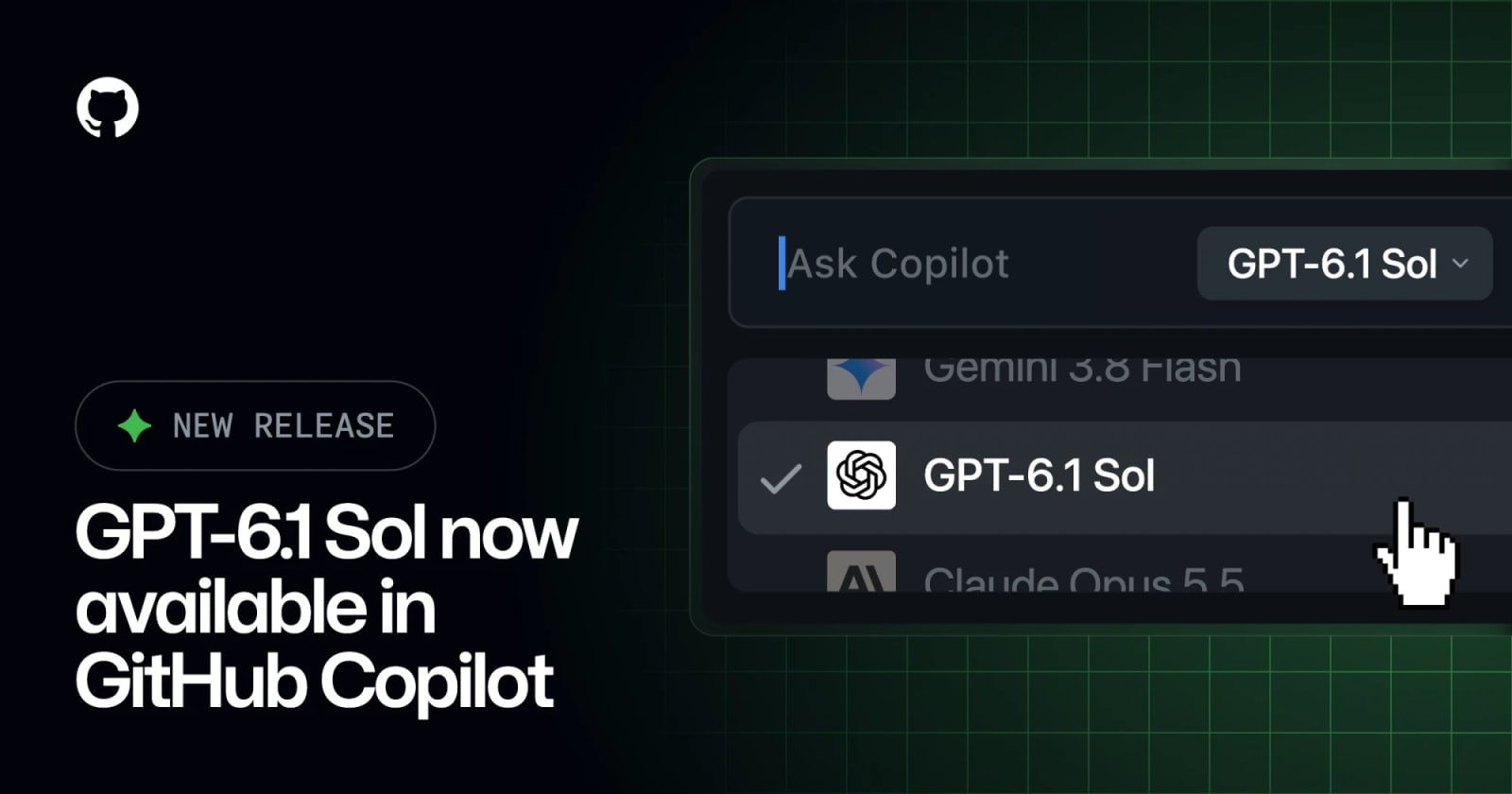
OpenAI releases GPT-6.1 Sol for complex coding at lower cost


GPT-6.1 Sol is available through the API and rolling out to GitHub Copilot’s eligible paid plans, with a million-token context window and published token pricing.
OpenAI’s GPT-6.1 Sol is documented as an API model for complex coding, computer use and professional work, with the company positioning it as near-Astra performance at lower cost. GitHub separately says it is rolling out in Copilot for agentic coding and terminal workflows. That puts the release in front of both API builders and a substantial existing developer audience.
GPT-6.1 Sol targets demanding coding and computer-use work
OpenAI describes Sol as a model for complex tasks rather than a general replacement claim: its documentation recommends comparing it with Astra on an organization’s own workloads to judge the quality-cost tradeoff. The page lists text and image input, text output, reasoning, tool calling through the Responses API, and a 1,050,000-token context window. Audio and video input are not supported.
The model supports reasoning effort settings from low through max, with medium as the default. Chat Completions works without tool calling; for tool use, OpenAI directs developers to Responses. That endpoint distinction matters for teams evaluating migration: integrations that depend on tool calls need to use the supported route.
Published API pricing gives teams a concrete comparison
OpenAI lists standard text-token pricing at $2 per million input tokens, $0.10 per million cached input tokens and $10 per million output tokens. Cache writes are listed at $2.50 per million. Requests above 272,000 input tokens have higher rates across the entire request; Fast mode is twice standard pricing, while Batch and Flex are listed at half price. Tool-specific fees may apply, so the token figures are not a complete estimate for workflows that use hosted tools.
OpenAI also documents US and EU data residency. Fast mode is unavailable with EU data residency. These details make workload testing more useful than comparing a single headline rate: prompt length, caching, tool calls, processing region and service mode all affect cost.
GitHub Copilot rollout reaches paid individual and business plans
GitHub says GPT-6.1 Sol is available to Copilot Pro+, Max, Business and Enterprise users, with a gradual rollout through the model picker. The announcement describes early testing as using fewer tokens and steps than earlier GPT-6 and GPT-5.6 models, but gives no benchmark or quantified result; treat that efficiency statement as GitHub’s qualitative report, not a reproducible performance guarantee.
Business and Enterprise administrators can govern access through Copilot’s model policy. New models are enabled by default unless an administrator has disabled the global default or explicitly disables this model. GitHub says usage is billed at provider list pricing under usage-based billing, so availability in Copilot does not imply inclusion at no additional cost.
Test the task and the bill, not just the model name
For API teams, a representative evaluation should include realistic context sizes, tool-call patterns and output lengths, then compare quality and total charges against the incumbent model. For Copilot organizations, admins should confirm model policy and rollout status, and developers should verify the usage-based billing terms that apply to their plan.
The practical change is access: GPT-6.1 Sol is an API-selectable model and is also entering GitHub Copilot’s paid tiers. Its exact advantage for any one workflow remains something to measure locally, especially where long prompts, tools or regional processing shape the bill.
Try the related loot
Give Coding Agents a Free UI Design and PR Finish Gate with UIZZE