
GPT-6 Sol and Luna bring two new OpenAI reasoning tiers to the API


OpenAI released GPT-6 Sol and GPT-6 Luna on September 22 for the Responses and Chat Completions APIs, while GitHub is rolling both models into Copilot with different plan eligibility.
OpenAI released GPT-6 Sol and GPT-6 Luna on September 22, adding two reasoning models to the Responses and Chat Completions APIs. The pair gives developers a higher-capability Sol tier and a lower-cost Luna tier, while GitHub is rolling both into Copilot with separate plan eligibility and gradual availability.
What GPT-6 Sol and GPT-6 Luna add
Both models accept text and image inputs and generate text through the Responses and Chat Completions APIs. OpenAI positions Sol for complex coding and agentic workflows, while Luna is designed for focused, high-volume work where latency and cost matter more than maximum capability.
The API changelog lists standard pricing for prompts with up to 272K input tokens at $2 per million input tokens and $10 per million output tokens for GPT-6 Sol. GPT-6 Luna is priced at $0.10 per million input tokens and $0.50 per million output tokens, with cached-input rates of $0.20 and $0.01 respectively. Longer prompts, cache writes, and other processing tiers use the separate pricing schedule.
That spread matters for agent builders. Sol is priced for tasks that justify deeper reasoning and multistep validation. Luna creates a cheaper default for routing, classification, short coding changes, and other high-volume calls, with the option to reserve Sol for difficult branches.
Where the models are available
The OpenAI model pages expose the identifiers gpt-6-sol and gpt-6-luna for API use. The release is therefore an API availability change, not a promise that every ChatGPT or Codex surface has the same model picker on the same day.
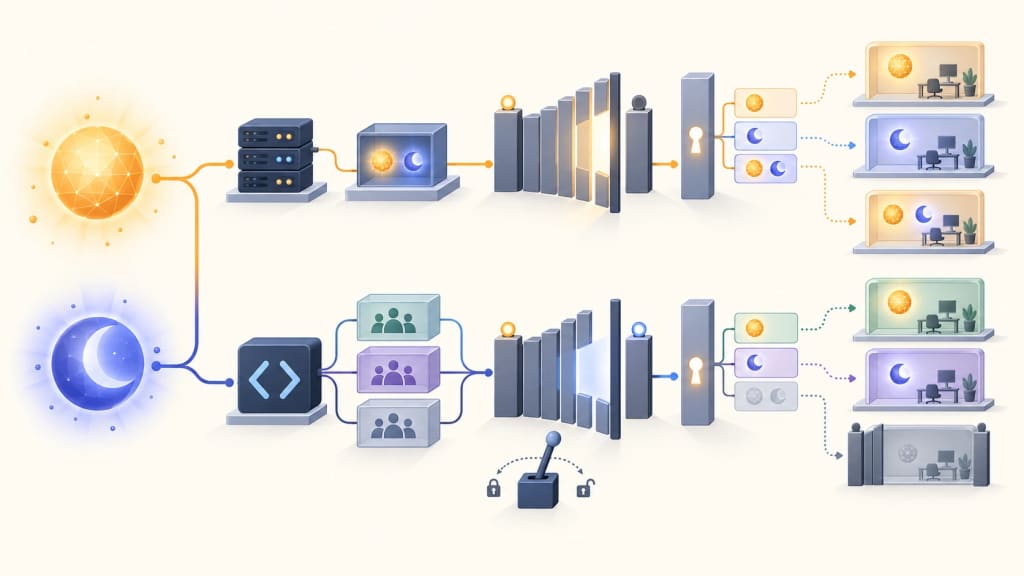
GitHub’s independent Copilot announcement confirms a second distribution path. GPT-6 Sol is listed for Copilot Pro+, Max, Business, and Enterprise plans. GPT-6 Luna is listed for Pro, Pro+, Max, Business, and Enterprise. GitHub says the rollout is gradual, and Business and Enterprise administrators can control access through Copilot model policies.
For teams, that means two checks before changing a production workflow: confirm that the model appears for the relevant OpenAI project or Copilot tenant, then verify the applicable billing or plan rules. A model name in documentation does not remove those rollout and entitlement boundaries.
A practical routing pattern for developers
The two-tier release supports a simple cost-and-capability split:
- Route routine, latency-sensitive, or high-volume work to GPT-6 Luna.
- Escalate complex coding, long-horizon agent tasks, and work that benefits from stronger validation to GPT-6 Sol.
- Record model IDs and pricing assumptions in configuration rather than hard-coding a single default into every workflow.
- Re-test tool calling, structured outputs, vision inputs, and failure handling before moving an existing GPT-5.6 integration to production.
The API announcement describes text and image inputs with text generation. It does not establish native video, audio, or image generation for these two models, so multimodal pipelines should keep those capabilities on the appropriate specialized model path.
What to verify before switching
OpenAI’s catalog and pricing pages remain the authoritative places to check context limits, reasoning controls, cached-input treatment, and any later snapshot changes. GitHub’s Copilot documentation is authoritative for plan access and administrator controls. Availability can differ between direct API use and Copilot even when both surfaces expose the same model family.
For a broader workflow guide, see LinkLoot’s AI workflow automation guide. The immediate next step for developers is a small traffic split: measure quality, latency, tool-call reliability, and actual token cost on representative tasks before making Sol or Luna the default.
Sources
Try the related loot
Give Any Model a Sandboxed Shell and File Workspace with OpenRouter