OpenAI brings GPT-6 Sol and Luna to ChatGPT Work, Codex, and API


OpenAI has released GPT-6 Sol and GPT-6 Luna as faster, lower-cost members of the GPT-6 family, with staged access across ChatGPT Work, Codex, and the API.
OpenAI has released GPT-6 Sol and GPT-6 Luna, extending the GPT-6 family beyond the higher-end Astra model. The two models are rolling out to Plus, Pro, Business, Enterprise, and Edu users in ChatGPT Work and Codex, while OpenAI's API documentation lists them for developers choosing between capability, speed, and cost.
GPT-6 Sol and Luna split the workload
Sol is positioned for more demanding work such as coding and complex tasks. Luna targets focused, high-volume jobs where latency and operating cost matter more than maximum reasoning depth. OpenAI's model catalog describes the pair as text-and-image-input models that generate text through the Responses and Chat Completions APIs.
That division matters for teams that currently route every request to a frontier model. A coding agent may use Sol for implementation and debugging, then send document extraction, classification, or short-form transformations to Luna. The useful change is a clearer cost and capability ladder inside the same generation, not a new interface feature that requires rebuilding an application.
Access is staged across ChatGPT, Codex, and the API
The current ChatGPT and Codex changelog says Sol and Luna are rolling out to Plus, Pro, Business, Enterprise, and Edu users. In ChatGPT, the changelog places them in Work and Codex rather than regular Chat, so a subscription alone does not imply that every surface exposes both models immediately.
For developers, the API changelog lists the models as released, and the model catalog provides the official selection and migration surface. Availability can still depend on account, product surface, region, and API entitlement. Check the model picker or API catalog in the environment you actually use before changing production routing.
Lower cost changes the routing question
TechCrunch reports that OpenAI is emphasizing lower API pricing for the GPT-6 Sol and Luna tiers, with the company attributing the reduction to caching and inference improvements. The practical consequence is a new benchmark to run: compare total task cost and error-repair work, not just the per-token rate.
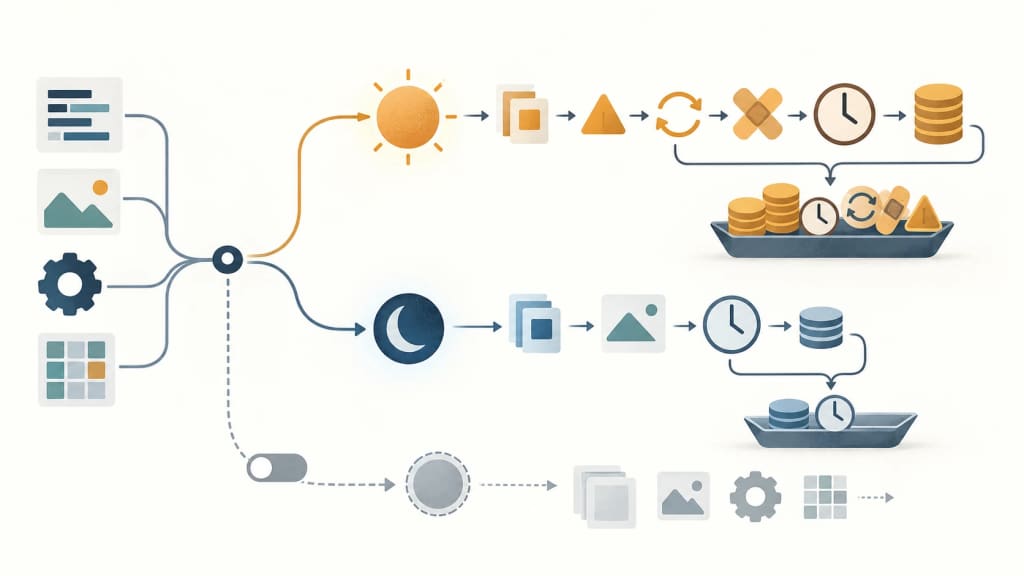
Teams should test Sol and Luna against representative prompts, tool calls, image inputs, structured outputs, and failure-recovery paths. Preserve a fallback model while rollout and capacity settle. For Codex users, compare completion quality and time-to-merge on real repositories; a faster model that needs fewer corrections may be cheaper even when its headline price is not the only variable.
What to verify before switching
- Confirm the model IDs, context limits, tool support, and pricing in the current API catalog.
- Check whether your ChatGPT plan exposes the models in Work or Codex, rather than assuming regular Chat access.
- Re-run evaluations that measure factual errors, coding regressions, latency, and retry volume.
- Keep the existing route available until the staged rollout reaches your account.
The next useful checkpoint is broad availability beyond Work and Codex, plus independently reproducible pricing and performance comparisons. Until then, GPT-6 Sol and Luna are best treated as newly released, staged options for production routing—not as a universal replacement for every GPT-6 surface.
For implementation patterns around model routing and agent workflows, see LinkLoot's AI workflow automation guide.
Sources
Try the related loot
Give Any Model a Sandboxed Shell and File Workspace with OpenRouter