OpenAI brings GPT-Live-1 to the API for full-duplex voice agents


OpenAI has released GPT-Live-1 in the API, letting developers build voice agents that listen and speak at the same time while delegating reasoning and tools to another model or backend.
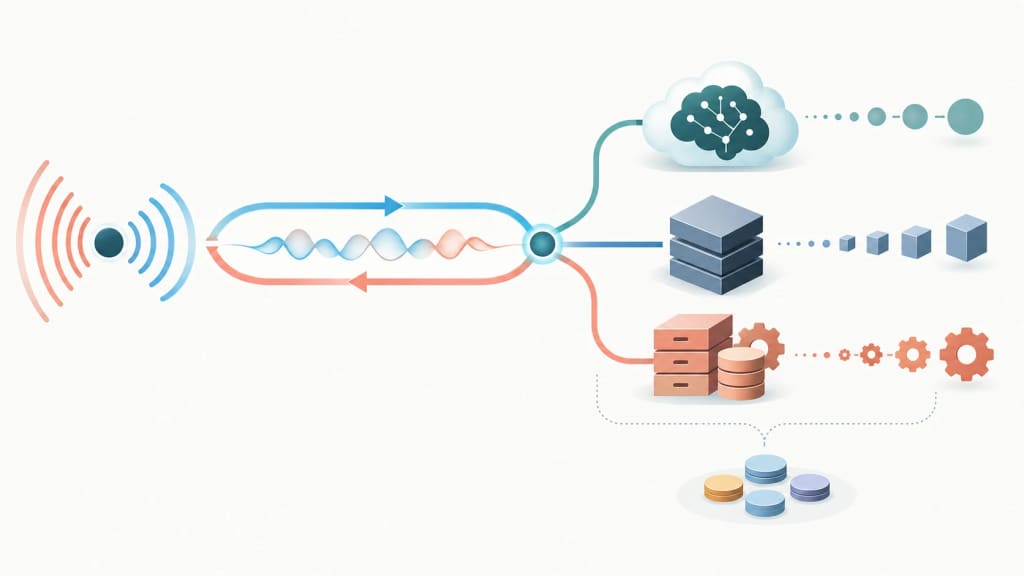
OpenAI has released GPT-Live-1 in the API for real-time, full-duplex voice applications. The model can listen while it speaks, handle interruptions and backchannels, and pass deeper reasoning or tool use to a backend model, an agent framework, or a developer-controlled service.
That changes the implementation boundary for voice agents. Developers can use GPT-Live-1 to manage the live conversation instead of building a separate turn detector, dialogue controller, and handoff layer around a conventional speech pipeline.
GPT-Live-1 keeps the conversation active
OpenAI describes GPT-Live-1 as a model for natural voice interactions in applications and business workflows. It is designed to process incoming audio while generating speech, so a user can interrupt, clarify, or change direction without waiting for a complete request-response cycle.
The model is not a replacement for every backend component. OpenAI says GPT-Live-1 can delegate deeper reasoning and actions to the models and tools it is paired with. That makes the API useful as a conversational front end for support agents, phone systems, accessibility features, education products, and hands-free workflows where timing matters as much as answer quality.
The API separates voice control from reasoning
The delegation model gives teams a choice: keep reasoning inside OpenAI's stack, connect a selected backend model, or route actions to their own agent layer. The practical advantage is architectural. A voice session can remain responsive while longer-running work continues elsewhere.
OpenAI lists GPT-Live-1 at $0.05 per minute for voice sessions, billed per second. Backend Responses calls and tool usage are billed separately, so the headline rate is not a complete cost estimate for an agent that performs searches, account lookups, or other actions.
Microsoft Foundry is adding a second access path
Microsoft's Azure AI Foundry team describes GPT-Live-1 as a full-duplex model for continuous voice interaction and says it will be available in Foundry Models within the following week. That gives enterprise developers another distribution route, although the rollout timing and regional availability should be checked in the Foundry catalog before planning production work.
The Microsoft integration also reinforces the model's intended use: conversational applications that combine voice with text, images, tools, or other models. It does not remove the need to design interruption handling, identity checks, logging, consent, and fallback behavior for real users.
What developers should verify before shipping
Start with the API model page and confirm the supported transport, session limits, and current regional access. Then measure end-to-end cost with the backend model and tools included. For customer-facing voice agents, test barge-in behavior, silence detection, escalation to a human, and how the system handles sensitive account actions.
GPT-Live-1 is now an API building block for continuous voice—not a single-call speech endpoint. The next practical milestone is wider availability across managed clouds and clearer production guidance for long-running sessions.
Sources and methodology
OpenAI's September 10 announcement is the primary source for the API release, interaction model, delegation design, and session pricing. Microsoft Foundry's independent platform documentation corroborates the full-duplex behavior and describes its planned distribution path. Pricing and availability can change by endpoint, region, and backend usage.
Try the related loot
Give OpenClaw Agents 1,000+ Paid Data APIs with Glasser