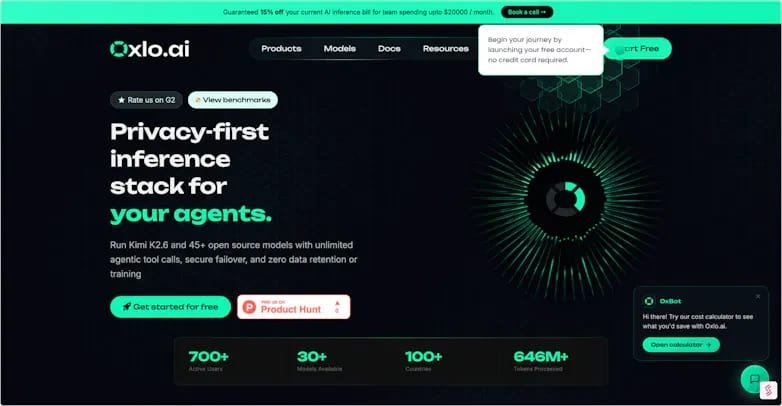
Oxlo.ai Tests Request-Based Pricing for Multi-Model AI Inference


Oxlo.ai is pitching an OpenAI-compatible inference API with request-based monthly plans, 40+ models, and a Product Hunt launch signal; teams should test latency, limits, privacy claims, and real workload math before switching.
Oxlo.ai is a developer-focused AI inference service that sells access to multiple models through fixed monthly request limits instead of token-based billing. Its official pricing page lists a free tier, an $80/month Pro plan, and a $350/month Premium plan, with request caps, token caps, latency targets, and support levels varying by plan. Product Hunt shows Oxlo.ai launching today with an AI infrastructure pitch, so the useful question is not whether the discount is real, but whether request-based pricing fits your agent workload.
Key takeaways
- Oxlo.ai positions itself as an OpenAI-compatible API for 40+ models, including text, code, vision, audio, embeddings, and image generation options.
- Pricing is request-based: the plan defines daily request limits, context/output caps, and priority rather than charging per input and output token.
- The official pricing page lists Free at 60 requests/day, Pro at 1,000 requests/day, and Premium at 5,000 requests/day.
- Product Hunt adds a timely launch signal and maker comments about explicit per-request model selection, fixed subscriptions, and a launch-day discount code.
- The model is attractive for long-context and agent workloads, but only if latency, context limits, model availability, and privacy requirements hold under your real traffic.
Practical LinkLoot angle
Oxlo.ai is worth a small benchmark if your agent costs are hard to forecast because one user action can trigger several model calls, retries, tool calls, or long-context prompts. Request-based pricing can simplify budgeting, but it can also hide operational tradeoffs: daily limits, queueing, latency, model quality, and context caps matter as much as the monthly price.
| Option | Best use | Limitation | Source |
|---|---|---|---|
| Oxlo.ai Free | Quick API compatibility check and small prototypes | 60 requests/day, lowest priority, smaller context/output caps | Oxlo.ai pricing |
| Oxlo.ai Pro | Development and prototyping across optimized models | $80/month, 1,000 requests/day, not positioned as production-grade inference | Oxlo.ai pricing |
| Oxlo.ai Premium | Production-style testing for long-context or multi-model agents | $350/month, 5,000 requests/day, still needs latency and model-quality validation | Oxlo.ai pricing |
| Token-based providers | Fine-grained usage billing and broad ecosystem maturity | Costs rise with long prompts, long outputs, retries, and tool-heavy chains | Oxlo.ai comparison claims |
A useful test is narrow: replay one week of real agent traces against your current provider and Oxlo.ai, then compare cost, latency, error rates, model fit, and output review time. For broader workflow planning, pair that test with LinkLoot's guide to AI workflow automation: /guides/ai-workflow-automation.
What to verify before you act
Check the pricing page at checkout, not only the Product Hunt comments. The launch page mentions a 10% Product Hunt code, but promotions can expire quickly and should not drive an infrastructure migration.
Verify the hard limits that affect your workload: requests per day, burst limits, input/output token caps, queueing behavior after caps, model availability by plan, and whether the models you need are included on the tier you would actually buy. Oxlo.ai's page says pricing is independent of prompt length, but context caps still limit very large prompts.
Test privacy and retention claims against your own compliance bar. Oxlo.ai states that it does not sell data or train on prompts, and Product Hunt maker replies say zero data retention applies to the edge layer, but teams handling customer, health, finance, legal, or regulated data should review the policy and get written terms before sending production traffic.
Oxlo.ai is an AI inference API that offers access to multiple models through fixed monthly request-based plans.
Try the related loot
This JS Agent Turns Any Website Into an AI Copilot