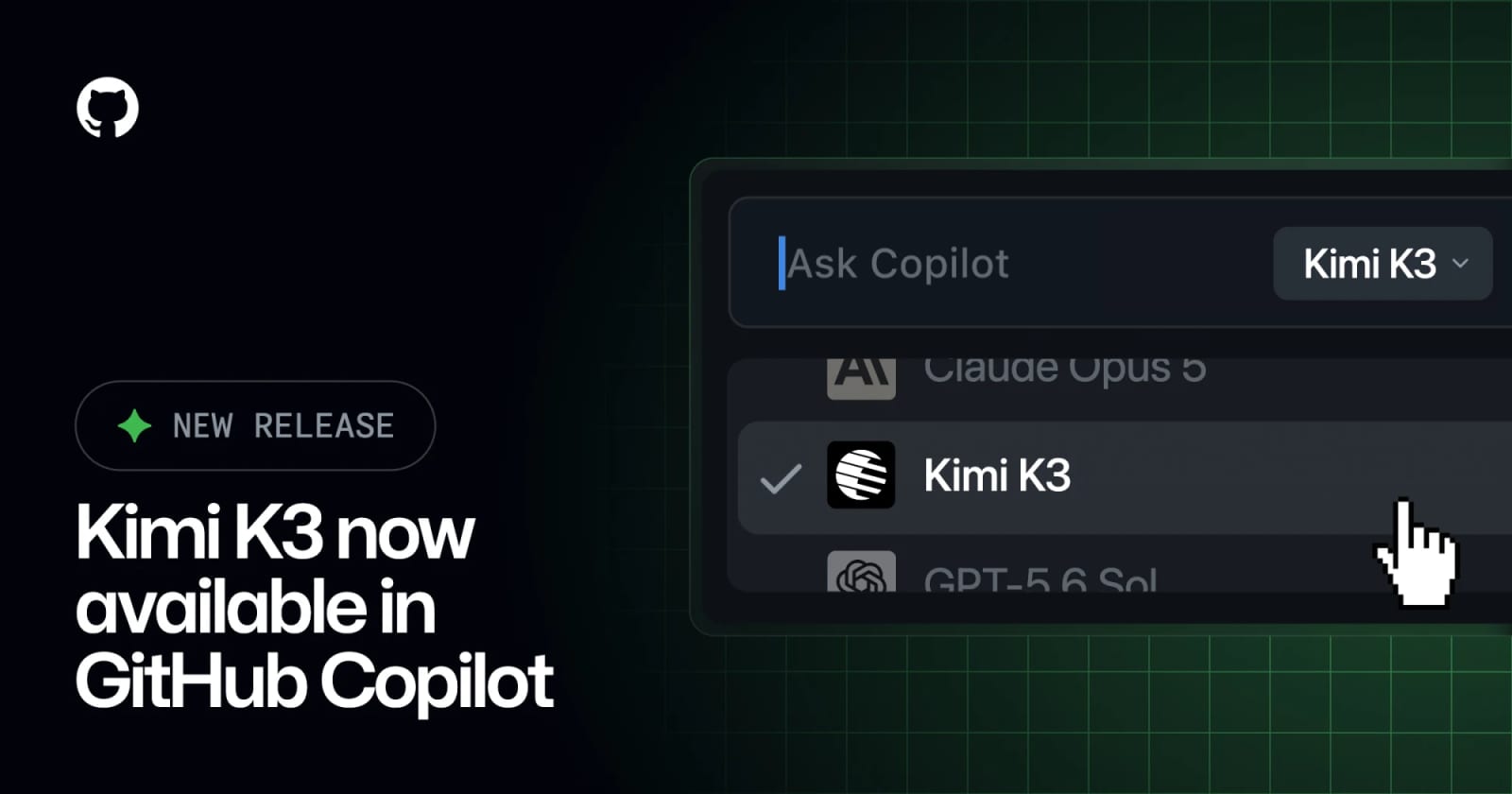
Kimi K3 reaches GitHub Copilot with admin-gated rollout


GitHub has started rolling out Moonshot AI’s open-weight Kimi K3 model in Copilot, with usage-based billing, broad client support, and a required admin policy for Business and Enterprise organizations.
GitHub says Kimi K3 is now generally available in GitHub Copilot, giving developers another frontier coding model inside the same model picker they already use across IDEs, mobile, the CLI, github.com, and the Copilot app. The rollout matters because Kimi K3 is open-weight, hosted by GitHub on Fireworks AI, and billed under usage-based pricing rather than bundled as a flat, invisible model choice.
GitHub’s changelog also notes a same-day pause tied to a GitHub Actions incident and a later resumption of rollout. That makes this a practical availability story, not just a model-listing update: teams should expect gradual rollout behavior and should check whether their organization has enabled the model before building workflows around it.
Key takeaways
- GitHub announced Kimi K3 general availability in Copilot on August 6, 2026.
- The model is rolling out to Copilot Pro, Pro+, Max, Business, and Enterprise plans across major Copilot surfaces.
- Business and Enterprise admins must enable the Kimi K3 policy before members can select it.
- GitHub lists provider pricing under usage-based billing, including separate cached-input pricing.
- The source page records a temporary rollout pause related to GitHub Actions and a later resumption.
Kimi K3 enters the Copilot model picker
GitHub describes Kimi K3 as an open-weight model with frontier-level agentic coding capabilities. The model is not only appearing in one editor integration: GitHub says users will be able to select it in Visual Studio Code, Visual Studio, JetBrains, Xcode, Eclipse, Copilot CLI, the Copilot cloud agent, the GitHub Copilot app, GitHub Mobile, and github.com.
That breadth is the main news. A model added only to one lab’s playground is useful, but a model added to Copilot changes the default environment for many developers who already route code review, edits, CLI sessions, and pull-request work through GitHub’s agent tools.
Pricing and rollout are part of the decision
GitHub says Kimi K3 is billed at provider list pricing under usage-based billing. The changelog’s editor note lists $3 per million input tokens, $15 per million output tokens, and $0.30 per million cached input tokens during the rollout update.
That makes Kimi K3 a cost-planning item for teams using Copilot’s multi-model workflow. Developers may see a new model choice, but administrators and budget owners need to treat it as a governed capability: model selection can affect spend, review depth, and whether work runs through a model their organization has approved.
Enterprise access is intentionally gated
For Copilot Business and Copilot Enterprise, Kimi K3 is off by default. GitHub says administrators must enable a Kimi K3 policy in Copilot settings before users in the organization can select the model. If the policy remains off, the model remains unavailable to that organization.
GitHub also recommends that administrators review open-weight models against their own security, compliance, and data-governance requirements before enabling them. That caveat is important because “available in Copilot” does not automatically mean “approved for every regulated repository.”
Why this changes developer workflow
Kimi K3’s Copilot availability gives teams another high-capability coding model inside the same surfaces where they already manage code generation, agent sessions, and reviews. It also continues the shift from one default Copilot model toward a governed model portfolio, where developers choose between models based on task type, latency, price, and organizational policy.
For individual users, the next step is simple: check the Copilot model picker as rollout reaches the account. For organizations, the near-term action is administrative: review the Kimi K3 policy, usage-based billing impact, and whether open-weight model governance fits internal requirements.
Source check
- GitHub changelog confirms the August 6 rollout, supported Copilot surfaces, pricing notes, rollout pause/resumption notes, and Business/Enterprise admin gating.
- GitHub Copilot supported models documentation lists Kimi K3 among supported Copilot models.
- Moonshot AI Kimi K3 repository provides the model-side artifact and model description.
- Developers Digest coverage independently reports the GitHub Copilot availability, pricing, and rollout context.
Try the related loot
Give Any Model a Sandboxed Shell and File Workspace with OpenRouter