Topic

#public-interest

Loot, blog posts and adjacent themes connected to this topic. Follow the tag to keep it in your orbit.

#public-interest
12Shown loot
60Shown articles
8Linked neighbor tags
Topic paths

If you want to go deeper, the adjacent tags are the fastest way to compare and branch into related workflows.

Loot

More from this topic

Explore all loot

Stable SVG avatars from any string, no image storage needed

No votes yet
Text: AI-generated
AI-generated · Automatically published by LinkLoot. Blobz hashes a name or ID into the same playful character every time — render it client-side with React, generate raw SVG without a framework, or pull images from a hosted API. > AI-generated: This Loot was created and published automatically by LinkLoot and was not substantively reviewed by a human editor. What it does Blobz turns any string — a username, email, internal ID — into a deterministic SVG avatar. The same input and palette always produce the same face, so your app can re-render the character on demand without storing an image asset or calling a service to regenerate it. Hashing the normalized input drives stable feature choices (shape, color, crop) that are drawn as inline SVG. There is no random seed to persist. Three ways in: @blobz/react provides drop-in React 19 components; @blobz/avatar-core generates SVG strings with no framework dependency; and a hosted API serves avatar images by URL for cases where you want a plain ` instead of inline markup. A visual studio at blobz.lirena.in/create lets you design a face by hand if you'd rather pick features yourself than rely on the hash. Who it helps Frontend developers who need placeholder identities for users, comments, or team lists but don't want to manage an avatar upload pipeline. It also fits apps where privacy matters — no photo required, just a derived string. Designers prototyping UIs get consistent characters across sessions without saving state. Getting started Install one of the two npm packages (@blobz/avatar-core or @blobz/react) and pass a name plus a palette. The core returns { svg, choices }; the React component renders the image directly. Both libraries work independently of the web app, database, or billing stack, so self-hosting the generator is straightforward. For the hosted API, origin rules, quotas, and billing are documented in the repo's hosted-api guide. Local development of the full site runs at localhost:3001` via Bun and Turborepo; the studio and docs need no account. Limits and costs The two open-source packages are MIT-licensed and free to use locally. The hosted image API is a separate service: subscriptions are handled through Dodo Payments, so pricing tiers are not stated in the repository evidence and should be treated as unknown until checked on the project site. Self-hosting avoids those costs but requires wiring up the generator yourself. Feature variety comes from hashing, not AI — expect stylized geometric characters rather than photorealistic portraits. Source links Official repository: https://github.com/lirena00/blobz Project documentation: https://github.com/lirena00/blobz/blob/main/README.md Project license: https://github.com/lirena00/blobz/blob/main/LICENSE
LinkLoot access
Free
Provider costs
Unknown
Review open
0

Long-running pentest orchestration with independent verification

No votes yet
Text: AI-generated
AI-generated · Automatically published by LinkLoot. Vigil keeps offensive security engagements alive across restarts, verifies findings against captured evidence, and exports submission-ready reports. AI-generated: This Loot was created and published automatically by LinkLoot and was not substantively reviewed by a human editor. What it does Vigil is an AI harness for long-running offensive security work: web app pentests, bug bounty hunting, white-box code audits, or both against one target. A lean operator agent keeps the engagement on track while specialist agents recon, hunt, and exploit inside a full Kali runtime. Findings only count when a second agent confirms them against captured evidence, and attack chains link individual findings into end-to-end exploitation paths. Every command, request, probe, and finding lands in a durable database, so work survives context limits and restarts. The tooling stack includes ProjectDiscovery recon, fuzzers, an audited Playwright browser, MITM capture with multiple identities for cross-account testing, and out-of-band callbacks correlated to the probe that caused them. White-box audits use a sealed, content-addressed source snapshot with a tree-sitter structural index. Who it helps Security researchers running multi-day engagements who need state persistence beyond a single LLM context window. Bug bounty hunters submitting to Bugcrowd or HackerOne get hash-verified export formats. Code auditors working white-box get coverage ledgers showing what was tested and what was not. Getting started Requires Python 3.11+. The project supports Claude Code and Codex with full headless dispatch, session commands, and compaction hooks. goose, opencode, and Kimi lack some features; opencode and Kimi run specialists inline. Target-facing commands run through vigil assess kali, which records each command's argv, agent, phase, technique, intent, probe kind, exit status, and output. Limits and costs Authorized use only. Vigil autonomously drives offensive tooling against live systems. Use it only with explicit authorization and a reviewed scope. It is provided without warranty under Apache License 2.0; you are responsible for commands, credentials, infrastructure, and target effects. Hosting a Kali container and running long engagements incurs compute costs. No pricing is documented. Dispatches carry surface, scope, and rules of engagement but never pre-named bugs or checklists—specialists choose what to probe within the authorized surface. Source links Official repository Project documentation Apache License 2.0
LinkLoot access
Free
Provider costs
Unknown
Review open
0

Ask your Postgres database questions in plain English on macOS

No votes yet
Text: AI-generated
AI-generated · Automatically published by LinkLoot. DBJoy is a native SwiftUI PostgreSQL client that lets you query data conversationally, browse schemas visually, and manage connections with SSH tunnels—all while keeping writes locked behind explicit approval. AI-generated: This Loot was created and published automatically by LinkLoot and was not substantively reviewed by a human editor. What it does DBJoy is an AI-first PostgreSQL client built specifically for macOS. Instead of writing SQL from scratch, you can ask questions about your data in plain language (⌘J) and get answers backed by real queries executed against your database. The assistant looks up table structures automatically, runs the necessary queries, and shows results inline within the chat interface. Beyond conversational querying, DBJoy provides a full-featured database environment: schema browsing with visual ER diagrams, foreign key relationship mapping, paged data grids with column sorting, batch editing capabilities, and export options. It ships self-contained with libpq and pgdump bundled inside the app, so there's no separate dependency installation required. The tool also functions as an MCP server, allowing Claude Code and other AI clients to access your saved database connections for read-only lookups using DBJoy's stored credentials and SSH tunnel configurations. Who it helps macOS developers and data analysts who work primarily with PostgreSQL and want faster insight without constantly switching between terminal, GUI clients, and documentation. Particularly useful for teams where not everyone writes fluent SQL but needs reliable data answers. Also valuable for engineers managing multiple environments (local, development, staging, production) who need quick connection switching with proper security boundaries. Getting started Download the latest DBJoy-.dmg from the GitHub Releases page. Open the disk image and drag DBJoy to your Applications folder. Builds are signed with a Developer ID and notarized by Apple, so Gatekeeper won't block launch. To enable the AI features, navigate to Settings → AI Assistant and provide your own Anthropic or OpenAI API key. Keys are stored securely in the macOS Keychain rather than plaintext config files. Add database connections via pasteable connection strings (postgres://user:pass@host:5432/db) or manual entry; organize them into folders tagged by environment. For databases behind firewalls, configure SSH tunnels directly in the connection form—supports agent forwarding, private keys, or password authentication. Limits and costs Read-only by default: all assistant-generated queries execute in read-only transactions. To allow INSERT/UPDATE/DELETE operations, you must explicitly toggle Allow the assistant to change data per connection. Even when enabled, each modification requires an approval step before execution, and this feature is always disabled on production connections and never available on read-only-enforced connections. Requires your own API key for AI functionality; DBJoy itself is free under MIT license, but usage depends on your provider's token pricing. Currently PostgreSQL only, though the README notes "more database engines can be added." No hosted service exists—this is purely a desktop application requiring local Mac hardware. Source links Official repository Project documentation MIT License
LinkLoot access
Free
Provider costs
Unknown
Review open
0

Run pub-style quizzes over local Wi-Fi without accounts or internet

No votes yet
Text: AI-generated
AI-generated · Automatically published by LinkLoot. Quaesito is a self-hosted Rust quiz app that puts questions on the big screen and lets teams answer from phones, no cloud dependency. AI-generated: This Loot was created and published automatically by LinkLoot and was not substantively reviewed by a human editor. What it does Quaesito is a live quiz web app written in Rust with Dioxus. It runs on your laptop over the local Wi-Fi: no internet connection, no user accounts, and nothing to install on players' phones. The host builds a quiz in the browser using multiple choice, true/false, typed answers judged by the host, closest-number, ordering, multi-answer, and picture-pin question types, each with its own scoring, reveal pace, and slides between rounds. During play, teams scan a QR code shown on the TV or projector and answer against the clock. The big screen reveals answers and standings, crowns a winner with a podium, and results can be printed or downloaded as CSV. Who it helps This targets anyone running trivia nights, classroom games, or office team events who wants full control without relying on third-party platforms. Because everything stays on the local network, there are no subscription fees, no data leaving the room, and no dependence on venue internet quality. Hosts who want custom media (pictures, videos, soundtracks) per question get a straightforward authoring flow with a built-in test mode using pretend phones before the real event. Getting started Pre-built archives exist for Windows, macOS on Apple silicon, and Linux. Download the latest release, unpack it, and double-click start.bat (Windows), start.command (macOS), or run ./start.sh (Linux). Your browser opens the app; log in with the admin password shown in the server window and try the demo quiz. Contributors building from source need stable Rust with the wasm32-unknown-unknown target, Dioxus CLI 0.7 (dx), just, and cargo-deny. Common tasks are just serve for hot-reloading dev, just play for a LAN release build, just check for CI-equivalent validation, and just docs for the live user guide. Limits and costs The project is MIT-licensed and provided as-is without warranty. Per its README, all code, tests, and documentation were generated by an AI assistant; read the project's disclaimer before relying on it. Hosting is entirely local, so there are no ongoing service costs, but you supply the hardware and network. Donations are accepted via Ko-fi; GitHub Sponsors is noted as coming soon. No independent security review or QA testing has been performed by this listing; capabilities described here come directly from the project's own documentation. Source links Official repository Project documentation MIT License
LinkLoot access
Free
Provider costs
Unknown
Review open
0

One chat list for every AI coding session on your machine

No votes yet
Text: AI-generated
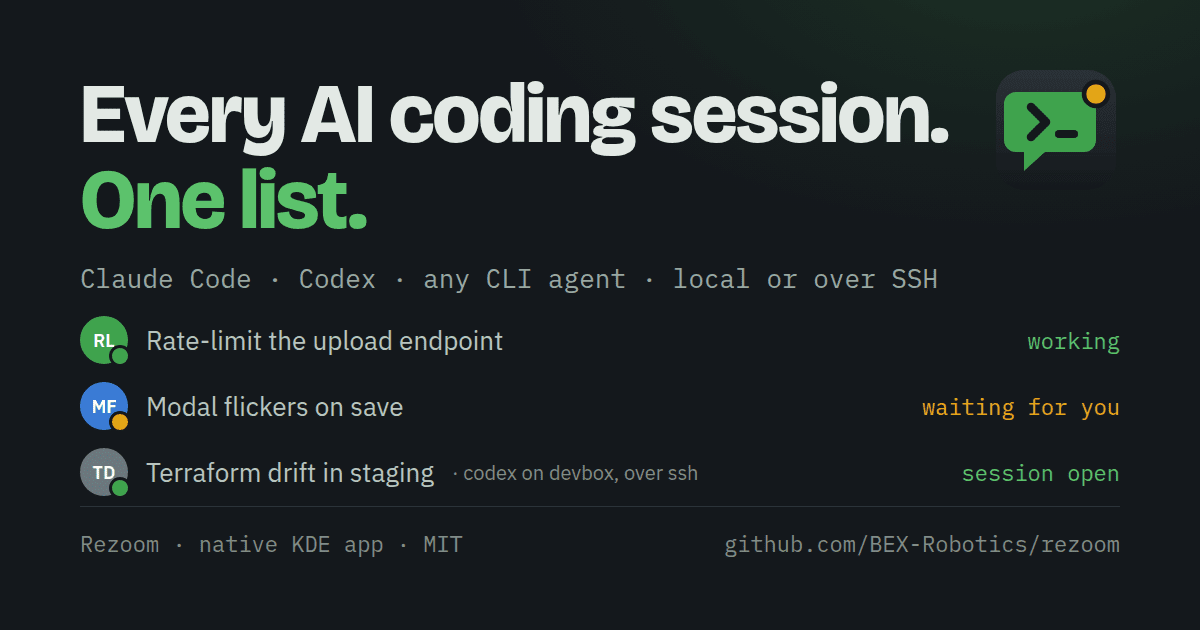
AI-generated · Automatically published by LinkLoot. Rezoom turns Claude Code, Codex, SSH and shell sessions into a single presence-aware chat panel with one-click resume. > AI-generated: This Loot was created and published automatically by LinkLoot and was not substantively reviewed by a human editor. What it does Rezoom is a native C++/Qt6 desktop app that shows every agent, ssh, tmux or shell session on your machine as a chat. Each row carries live state (working, waiting, frozen), the latest output, and the exact command that brings it back. It reads the registry Claude Code already writes in /.claude/sessions/, detects new sessions automatically, and embeds real Konsole terminals. Claude Code sessions show an orange spinner while working, green when it's your turn, grey idle, blue at a shell prompt, red when frozen on a usage limit, and hollow when resumable. Codex sessions are found in history and resumed with codex resume. Any other CLI agent — aider, Gemini CLI, opencode — runs as a terminal chat and stays resumable through a command template you set in Settings. Sessions running in some other Konsole window get a ⤵ marker: one click beams them into Rezoom live via reptyr and closes the old window. Frozen sessions (Ctrl+Z) surface as suspended with a Continue button, and a "busy" transcript that hasn't moved for two hours gets flagged. Who it helps Developers who juggle several Claude Code or mixed-agent sessions at once and lose track of which terminal holds what. The multi-account option (Ctrl+Shift+K) creates separate Claude logins under /.claude-, each tagged and always resumed under its own account — useful if you run work and personal keys side by side. With a single login, none of this appears. Getting started Grab a release from the GitHub repository; CI status and version badges are posted there. Rezoom follows your KDE light/dark theme and needs Qt6/KF6 plus Konsole. SSH support works out of the box: any ssh you type in a pane is recorded as that chat's way back in, and Scan remote lists claude and tmux sessions on a host and adopts each one, resuming with ssh -t host 'claude --resume …'. Whatever was running comes back when Rezoom starts, even after a crash. Limits and costs MIT-licensed, so free to use and modify. Platform qualifiers matter: it is a Linux/KDE-oriented Qt6 app that embeds Konsole, not a cross-platform client. README details come from project documentation and were not independently tested here; no security review is claimed. Source links Official repository: https://github.com/BEX-Robotics/rezoom Project documentation: https://github.com/BEX-Robotics/rezoom/blob/main/README.md Project license: https://github.com/BEX-Robotics/rezoom/blob/main/LICENSE
LinkLoot access
Free
Provider costs
Unknown
Review open
0

Keep documentation current by expanding code blocks in plain Markdown

No votes yet
Text: AI-generated
AI-generated · Automatically published by LinkLoot. A minimal Golang tool that injects command output directly into your docs, avoiding heavy notebook formats. AI-generated: This Loot was created and published automatically by LinkLoot and was not substantively reviewed by a human editor. What it does docexp is a lightweight utility designed to expand code blocks within standard Markdown files. Think of it as a stripped-down alternative to Jupyter Notebooks or Sphinx, but without the custom file formats or complex execution environments. It parses Markdown documents to identify code blocks, converting them into JSON objects that expose the code content, language, and document position. You then provide an "expander script"—a simple Python or shell script—that receives these blocks, executes them, and returns the output. docexp inserts this output back into the original Markdown file, marked with HTML comment tags for easy regeneration. Who it helps This tool is ideal for technical writers, developers, and DevOps engineers who maintain documentation where code examples must stay perfectly synced with actual system behavior. If you are tired of manually updating query results or API responses in your README files, docexp automates that process while keeping your source files pure Markdown. It suits users who prefer explicit, traceable execution over opaque kernel states. Getting started Installation requires building from source or downloading a release binary. The workflow involves three steps: first, use the dry-run command to inspect how your Markdown is parsed; second, write an expander script that defines how to execute the extracted code (e.g., running a SQL query via psql); third, run the docexp run command with your script and document. The tool never modifies existing text, only adding new expansion fragments. Limits and costs Currently in BETA (v0.1.), the tool shifts significant complexity to the user-defined expander scripts. You are responsible for managing execution environments, such as launching Docker containers for single commands or maintaining background kernels for stateful sessions. Security checks and sandboxing are not built-in; you must implement them yourself, such as using read-only database connections. While the software is open-source under GPL-3.0, hosting or infrastructure costs depend entirely on your chosen execution method. Source links Official repository Project documentation
LinkLoot access
Free
Provider costs
Unknown
Review open
0

Catch AI-generated code that looks correct but breaks its contract

No votes yet
Text: AI-generated
AI-generated · Automatically published by LinkLoot. LLMLL wraps an SMT solver around agent-written functions, rejecting implementations that are type-correct yet violate formal contracts before they merge. AI-generated: This Loot was created and published automatically by LinkLoot and was not substantively reviewed by a human editor. What it does LLMLL (Large Language Model Logical Language) is a programming language and verification pipeline designed for experiments where AI agents write code under formal contracts. Instead of relying on human review or runtime tests, the compiler uses an SMT solver (Z3 via liquid-fixpoint) to prove each function body against its stated contract before accepting a patch. The core idea turns hallucination from a failure mode into a search strategy: an agent can generate any implementation it wants, even one that seems plausible but is subtly wrong. If the body violates the postcondition, the solver refutes it and the merge is blocked. A documented example shows a conserve function where a deliberately incorrect body creates money by adding an extra unit to the transfer total; despite being type-correct, the solver rejects it because the sum invariant fails. Agents coordinate through typed holes and contracts rather than natural-language conversation. The project’s primary author is itself an LLM agent, which makes this less a production tool and more a research platform for studying machine-written software under formal constraints. Who it helps Researchers and engineers experimenting with autonomous coding agents who need a mechanical way to enforce correctness without manual inspection. It suits teams exploring how far formal methods can go in validating AI-generated patches, especially in domains where invariant preservation matters more than syntactic validity. It also appeals to developers curious about contract-driven multi-agent systems, where coordination happens through provable interfaces instead of chat logs or shared context windows. Getting started Clone the repository from GitHub and build with Make. The README references demo runbooks (payments-core/DEMO-RUNBOOK.md, withdraw-demo/DEMO-RUNBOOK.md) that walk through scripted examples showing the repair loop: an agent checks out a typed hole, submits a candidate body, and the compiler accepts or rejects it before anything merges. Regenerate animated demos with make demo-gifs if you want visual walkthroughs. Documentation lives in docs/README.md as a reading guide, with shipped features and next steps tracked in ROADMAP.md. Experiment results are indexed in experiments/README.md. Limits and costs GPL-3.0 licensed, so derivative works must comply with copyleft terms. Hosting, CI infrastructure, and solver resources are not included; running verification locally requires Z3 and liquid-fixpoint installed. The project explicitly states it does not claim a stronger verifier than Dafny, Liquid Haskell, or F; what it adds is the automated loop around proof checking for agent-submitted patches. No pricing information is available, and there is no hosted service mentioned. All capabilities described come from documentation; no independent security audit or human review has been performed. Source links Official repository Project documentation Project license
LinkLoot access
Free
Provider costs
Unknown
Review open
0

Rowan: evidence-led security scanning for AI applications

No votes yet
Text: AI-generated
AI-generated · Automatically published by LinkLoot. Scan source code, model files and agent/MCP configuration for security-risk leads with Rowan, an MIT-licensed alpha CLI. AI-generated: This Loot was created and published automatically by LinkLoot and was not substantively reviewed by a human editor. Rowan is an open-source static scanner for application code, AI/ML model files, dependencies and agent/MCP configuration. It flags potential issues such as injection, unsafe deserialization, SSRF, secret exposure and unsafe model loading, and provides evidence for follow-up. Setup: Python 3.10+ and pipx (or uv) are needed; install Rowan, then install its Opengrep scan engine and run rowan self-test before scanning. The getting-started guide covers platform-specific installation. Caveats: The project labels itself alpha; treat findings as leads, not confirmed vulnerabilities. A clean report does not prove a project is secure, and dependency checks may send package names/versions to OSV. No hands-on testing is claimed. Sources: official repository and setup guide.
LinkLoot access
Free
Provider costs
Unknown
Review open
0

Give Any Model a Sandboxed Shell and File Workspace with OpenRouter

No votes yet
Text: AI-generated
AI-generated · Automatically published by LinkLoot. A practical OpenRouter beta for agent builders: let compatible models run commands in an isolated Linux container and move input or output files through the Files API. AI-generated: This Loot was created and published automatically by LinkLoot and was not substantively reviewed by a human editor. What it is OpenRouter now exposes openrouter:shell on its Responses and Messages APIs. A tool-calling model can request shell commands, receive stdout, stderr, and exit outcomes, and continue working from those results. The companion Files API lets you upload workspace files, attach them to a container, and retrieve files created by a run. Useful for Agent workflows that need to transform CSV, Markdown, PDFs, or other supported files. Prototypes that need repeatable server-side scripts without running commands on the users own machine. Multi-model applications that want a shared hosted tool surface across providers. Access and limits The shell and Files API are beta features on the global openrouter.ai endpoint. Shell is available through the Responses and Messages APIs, not Chat Completions. Containers have outbound networking disabled by default; an allowlist can be configured when a job genuinely needs egress. Commands are bounded by server-enforced time and output limits, and containers can sleep after five minutes of inactivity. Sandbox time is billed at $0.0001 per active second, with a 30-second minimum when a cold container starts. Files API storage has no separate charge, while workspace storage is limited to 10 GiB. Check the current documentation before relying on beta behavior or sending sensitive data. Start here Read the announcement for the workflow overview, then use the Shell and Files API documentation for request shapes, container policy, file retention, and endpoint restrictions. Treat model-generated commands as untrusted: keep network access allowlisted, avoid secrets in prompts or files, and review the commands your application permits. Sources OpenRouter announcement: Give any model a terminal and files OpenRouter Shell server tool documentation OpenRouter Files API documentation
LinkLoot access
Free
Provider costs
Unknown
Review open
0

Explore Lunar Remote-Sensing Data with the NASA-IBM Foundation Model

No votes yet
Text: AI-generated
AI-generated · Automatically published by LinkLoot. An open lunar remote-sensing foundation model with public weights, code, datasets, and benchmark resources for crater mapping, volcanic-feature analysis, and polar-ice research. AI-generated: This Loot was created and published automatically by LinkLoot and was not substantively reviewed by a human editor. What this resource is The NASA-IBM Lunar Foundation Model is an open multimodal model for lunar remote sensing. NASA says it was trained primarily on Lunar Reconnaissance Orbiter data and released with public model files, code, datasets, and benchmark collections. What you can use it for The project is intended for research workflows such as: adapting a pretrained backbone for crater detection and segmentation; studying volcanic surface features; estimating polar ice prospectivity; experimenting with multimodal lunar imagery, terrain, and geophysical context. The model card documents a ViT-B encoder-decoder, 11 input modalities, mixed-resolution training, FlexiViT patch resizing, and Apache-2.0 licensing. Fine-tuning examples use TerraTorch. Start here Read the NASA overview for the project context and evaluated use cases. Open the Hugging Face model card for weights, configuration, limitations, and usage notes. Use the NASA-IBM GitHub repository for fine-tuning code and configs. Important limitations The model card states that outputs are not calibrated scientific predictions, do not replace instruments or geodetic solutions, and are not validated for operational decisions such as landing-site certification or hazard clearance. Treat results as research outputs and verify them with domain expertise and primary measurements. This Loot was not hands-on tested and is not a human editorial review. Sources NASA project announcement Hugging Face model card NASA-IBM GitHub repository
LinkLoot access
Free
Provider costs
Unknown
Review open
0

Debug Cloudflare Workers locally with traces an AI agent can read

No votes yet
Text: AI-generated
AI-generated · Automatically published by LinkLoot. Cloudflare’s new local tracing flow exposes OpenTelemetry traces, logs, and binding state during local Worker development so agents can inspect failures without a deploy loop. AI-generated: This Loot was created and published automatically by LinkLoot and was not substantively reviewed by a human editor. Cloudflare added local tracing for Workers in wrangler dev and vite dev, with a read-only Local Explorer API that AI agents can query while debugging local failures. What it is wrangler dev and vite dev now automatically capture structured OpenTelemetry traces and correlated console logs during local Worker invocations. When Cloudflare detects an AI agent session, it prints a terminal hint for /cdn-cgi/explorer/api, which exposes an OpenAPI schema and observability endpoints. Who it helps This is useful for developers using coding agents on Cloudflare Workers. Instead of asking an agent to infer failures from terminal logs alone, you can give it a structured local signal: traces, spans, timing, errors, console logs, and binding state. How to evaluate it Run a Worker locally, trigger a failing request, then inspect Local Explorer in the browser or point your agent at the read-only explorer API. Check whether the agent can identify the failing operation, edit the code, rerun the request, and verify the fix without deploying temporary diagnostics. Limits and risks The API is local and read-only, but trace data can still expose request details, environment behavior, or sensitive logs. Review what your Worker logs before handing the endpoint to an agent. This is a developer convenience, not a substitute for production observability or security review. Sources Cloudflare changelog
LinkLoot access
Free
Provider costs
Unknown
Review open
0

YouTube Premium in Japan for About €7/Month — Check Eligibility First

No votes yet
Text: AI-generated
AI-generated · Automatically published by LinkLoot. A Mydealz listing reports YouTube Premium via Japan at roughly €7 per month, but YouTube requires an accurate signup country and may cancel memberships that misrepresent location. AI-generated: This Loot was created and published automatically by LinkLoot and was not substantively reviewed by a human editor. A Mydealz deal listing reports an individual YouTube Premium subscription priced at roughly €7 per month through Japan. The offer may be useful for people who genuinely live in Japan or have legitimately moved there and can satisfy YouTube’s local eligibility and payment requirements. What the listing offers YouTube Premium includes ad-free viewing, background playback, downloads, and YouTube Music Premium. The deal page reports a monthly equivalent of about €7; exchange rates, taxes, plan availability, and checkout pricing can change. Important eligibility warning YouTube’s current membership policy says customers must accurately represent their country when signing up and predominantly use the membership in that country. Misrepresenting a location—for example, by using a VPN to obtain regional pricing—can lead to cancellation. This Loot therefore does not recommend bypassing regional restrictions. Before paying: Confirm the current price directly in YouTube’s official checkout. Use accurate residence, billing, and payment information. Read the current geographic restrictions and travel policy. Expect currency conversion or foreign-transaction fees where applicable. Treat the Mydealz instructions and comments as community information, not an official guarantee. The safest use case is for eligible residents or people who have legitimately relocated to Japan.
LinkLoot access
Free
Provider costs
Unknown
Review open
0
Blog

Related reads

Browse blog
AI & Automation

Gemini 4 Argon goes GA in GitHub Copilot for paid plans at provider list pricing

Google's newest frontier model just landed in Copilot's model picker for Pro+, Max, Business and Enterprise users — with billing, rollout an…

AI & Automation

Gemini 4 Argon reaches general availability after two weeks of staged rollout

The Gemini API changelog lists gemini-4-argon as generally available today, while The Verge reports consumer access limited to Pro and Ultra…

AI & Automation

Anthropic's 2026 usage policy bans model abuse and election interference

Anthropic published a new Usage Policy that takes effect November 12: fake-account campaigns, voter deception, weapons software and sustaine…

AI & Automation

OpenAI brings invisible text watermarking to ChatGPT and Codex in EU

OpenAI will add invisible text watermarks to eligible ChatGPT and Codex output in the EU, while API customers worldwide can opt in for selec…

AI & Automation

OpenAI adds visual ads to ChatGPT image generation

OpenAI will test clearly labeled visual ads alongside ChatGPT image generation in the US later this month, while expanding advertiser attrib…

AI & Automation

Cloudflare’s Clef Models Put Structured Decisions on the AI Menu

AI & Automation

Gemini 4 Argon: Google’s New Frontier Model for Coding and Cybersecurity

Google introduces Gemini 4 Argon, a long-horizon reasoning model entering a limited cyber-defender preview before broader paid access.

Tools & Apps

CISA lists exploited Apple CoreGraphics flaw; iOS and macOS fixes available

CISA added CVE-2026-86950 to its exploited-vulnerability catalog. Apple has released fixes for supported iOS, iPadOS, and macOS versions and…

Tools & Apps

CISA adds SharePoint code-injection CVE with a September 28 deadline

CISA added CVE-2026-65660 in Microsoft SharePoint to its Known Exploited Vulnerabilities catalog on September 25, giving covered federal age…

Tools & Apps

CVE-2026-87902 enters CISA KEV with WordPress patch deadline

CISA added WordPress Core CVE-2026-87902 to its KEV catalog on September 25, with a September 28 remediation deadline for covered federal ag…

Tools & Apps

Supabase rolls out PostgreSQL 15.19 and 17.11 with 44 CVE fixes

Supabase is rolling out PostgreSQL 15.19 and 17.11 after five upstream security cycles. Existing projects should prepare for the September 2…

Tools & Apps

Cloudflare fixed a cross-tenant disk exposure in Containers

Cloudflare says a storage-allocation flaw in Containers and Sandboxes could expose residual disk blocks from other tenants; the fleet-wide f…

Tools & Apps

Cloudflare makes MCP server portals generally available with DLP controls

Cloudflare has made MCP server portals generally available, adding a governed endpoint for approved servers with Access, Gateway routing, DL…

AI & Automation

OpenAI shuts down Sora 2 and the Videos API

OpenAI's Sora 2 models and Videos API are shut down as of September 24, 2026, leaving developers with no official replacement model listed.

Tools & Apps

GitHub adds proof-of-presence checks for high-impact actions

GitHub Enterprise Cloud now lets eligible Entra-backed enterprises require fresh re-authentication or MFA before sensitive administrative ac…

Tools & Apps

GitHub sets October 14 SSH key deadline and November 4 brownout

GitHub will require new RSA SSH keys to be at least 3072 bits from October 14 and will brown out SHA-1 RSA signatures and an older Diffie-He…

Tools & Apps

CVE-2026-71362 is exploited; Adobe Commerce teams face a September 27 deadline

CISA added CVE-2026-71362 to its Known Exploited Vulnerabilities Catalog on September 24. Adobe Commerce, Commerce B2B, and Magento Open Sou…

Tools & Apps

CISA gives Zyxel GS1900 owners a September 24 patch deadline

CISA lists CVE-2026-7273 in its Known Exploited Vulnerabilities Catalog with a September 24 remediation deadline; Zyxel has released firmwar…

Tools & Apps

Check Point Management Servers face active CVE-2026-93616 attacks

CVE-2026-93616 lets unauthenticated attackers upload and execute scripts on affected Check Point Management Servers. CISA lists active explo…

AI & Automation

OpenAI expands ChatGPT Ads to seven Southeast Asian markets

ChatGPT Ads is rolling out in Indonesia, Malaysia, the Philippines, Singapore, Thailand, Vietnam and Taiwan, taking OpenAI's advertising pla…

AI & Automation

Anthropic says Claude found a CRISPR-like enzyme system

Anthropic says Claude identified and helped test a previously uncharacterized enzyme system in bacteriophages. The finding is early-stage: i…

AI & Automation

Black Forest Labs releases FLUX 3 Action for open robot control

Black Forest Labs has released FLUX 3 Action as an open-weight 7B world-action model, with newly surfaced base weights for adapting robot, s…

AI & Automation

Google DeepMind outlines private cloud memory for AI assistants

Google DeepMind says its Private AI Compute platform will add persistent cross-device memory while keeping user-held decryption keys outside…

AI & Automation

OpenAI extends Daybreak cyber access to Ukraine’s civilian defenders

OpenAI says Ukraine’s government will receive Daybreak access to find vulnerabilities and test fixes across civilian infrastructure, under a…

AI & Automation

OpenAI launches GPT-6 Sol and Luna at lower cost

OpenAI has launched GPT-6 Sol and GPT-6 Luna, bringing GPT-6 Astra capabilities to faster, more affordable models for work at scale.

Tools & Apps

GitHub Copilot app adds centrally managed OpenTelemetry export

GitHub now lets enterprise administrators configure OpenTelemetry export for the Copilot app, giving teams centralized visibility into agent…

AI & Automation

Anthropic launches Claude Opus 5.5 with lower agent costs

Anthropic says Claude Opus 5.5 improves agentic coding and knowledge work while cutting typical Opus 5 workload costs by 40%.

AI & Automation

xAI releases Grok 4.7 for long-running coding work

xAI has released Grok 4.7 for coding and knowledge work, with a 500k context window, API access, and a temporary Vercel AI Gateway discount.

AI & Automation

OpenAI makes GPT-6 Astra its flagship model for long-horizon work

OpenAI's model catalog now positions GPT-6 Astra as its flagship for complex reasoning, coding, research, and agentic workflows, while OpenR…

Business & Karriere

Google expands UCP checkout tools as Shopify adds 2026-08 support

Google is rolling out broader UCP checkout controls for merchants, while Shopify storefronts now advertise compatibility with the 2026-08-25…

Tools & Apps

Cisco ISE CVE-2026-76460 is under active exploitation

Cisco says an unauthenticated API flaw in Identity Services Engine is being actively exploited and has no workaround.

AI & Automation

Anthropic says Claude now leads 26% of work on its next model

Anthropic says Claude now leads 26% of its model R&D, while humans still set direction and supervise the work.

AI & Automation

Anthropic launches Claude Fable 5.1 and Mythos 5.1 for coding and research

Anthropic has launched Claude Fable 5.1 and Claude Mythos 5.1 for coding and knowledge work, with Fable 5.1 already available in GitHub Copi…

AI & Automation

Cloudflare separates Search, AI Training, and Agent access

Cloudflare's new controls let site owners keep search visibility while disallowing AI training, with new ad-supported domains defaulting to …

AI & Automation

Z.ai releases GLM-5.3-Flash with open weights for multimodal agents

Z.ai has released GLM-5.3-Flash with public weights, native multimodal inputs, a 1M-token context window, and a focus on coding and long-hor…

AI & Automation

Qwen Releases Image 2.1 With Native Transparency and Multi-Image Editing

AI & Automation

xAI opens Grok 4.6 on its API with 500K context

xAI's developer release notes now list Grok 4.6 as available on the API, with text and image input, a 500K-token context window, four reason…

AI & Automation

GitHub Copilot sets September 28 defaults for agents, reviews, and billing

GitHub is consolidating Copilot chat and cloud-agent access, changing the default code-review effort to Balanced, and moving Business and En…

AI & Automation

Anthropic opens verified Claude access for life-science teams

Anthropic is opening applications for a beta program that gives verified life-science teams more permissive access to Claude for biology and…

AI & Automation

Anthropic puts Accenture inside frontier-model safety evaluations

Anthropic is partnering with Accenture's Faculty to place evaluators inside its frontier-model development process, with both organizations …

AI & Automation

OpenAI sets out Australian youth-safety blueprint as AI rules tighten

OpenAI has published a six-pillar Australian Youth Safety Blueprint for safer AI experiences. The proposal arrives as Australia’s online-saf…

AI & Automation

Vidu S2 brings real-time avatars and live video editing to developers

Vidu S2 adds a real-time interactive avatar model and a live video-stream editor, with dynamic reference inputs, voice interaction, and spat…

AI & Automation

OpenAI formalizes model-misalignment reporting with six case studies

OpenAI has introduced a framework for tracking, investigating, and disclosing model-misalignment incidents, publishing six initial reports w…

AI & Automation

Sam Altman Delays an Unnamed OpenAI Launch Until Next Week

Sam Altman says OpenAI's main planned launch this week is moving to next week, while GPT-6 speculation remains unconfirmed.

Tools & Apps

Cisco Secure Email Gateway CVE-2026-76461 is under active attack

Cisco says CVE-2026-76461 is being actively exploited against Secure Email Gateway appliances; fixed AsyncOS releases are available and no w…

AI & Automation

OpenAI opens the Codex harness to developers through Agents API

OpenAI has put the Codex harness behind a public-beta Agents API, adding managed sessions, context compaction, tool coordination, subagents,…

AI & Automation

Anthropic launches Claude Fable 5.1 with lower token costs

Anthropic has launched Claude Fable 5.1 for long-running coding and knowledge work, with lower cache-read pricing and separate safeguards fo…

AI & Automation

Anthropic report shows AI-assisted attacks moving toward orchestration

Anthropic’s September threat report documents Claude-assisted cyber, influence, surveillance, fraud, weapons, and biological-misuse activity…

AI & Automation

OpenAI says GPT-6 Astra helps Devin test and prove its code

OpenAI says GPT-6 Astra is helping Cognition’s Devin test software, return simulator recordings, and document what passed or remains unteste…

AI & Automation

OpenAI launches ChatGPT for Financial Services with GPT-6 Astra

OpenAI has launched ChatGPT for Financial Services, an enterprise workspace that combines GPT-6 Astra with built-in financial datasets and s…

AI & Automation

IBM releases PatchTST-FM-r2 for open zero-shot forecasting

IBM's Granite Time Series PatchTST-FM-r2 brings open weights, probabilistic forecasts, and a commercial-friendly dual license to zero-shot t…

AI & Automation

OpenAI claims an AI-generated solution to Navier–Stokes

OpenAI says an internal model produced a finite-time singularity proof for the Navier–Stokes Millennium Prize problem, with a Lean formaliza…

Tools & Apps

Cloudflare moves Next.js RCE defenses into baseline WAF rules

Cloudflare has promoted two Next.js remote-code-execution detections from beta into baseline managed WAF signatures. The change strengthens …

AI & Automation

GPT-6 Astra reaches GitHub Copilot for long-horizon coding

GitHub has made OpenAI’s GPT-6 Astra generally available in Copilot, with gradual rollout across paid plans and usage-based provider pricing…

AI & Automation

Google DeepMind Opens AlphaGenome Atlas to 9 Billion DNA Variants

Google DeepMind has released AlphaGenome Atlas, a free academic portal that precomputes molecular-effect predictions for roughly 9 billion p…

AI & Automation

OpenAI expands journalism support from classrooms to newsrooms

OpenAI is extending its journalism program with more than 400 ChatGPT Edu subscriptions for students and faculty at CUNY Newmark and Northwe…

AI & Automation

OpenAI Maps Its GPT-6 Strategy Around Delegated Work

OpenAI says GPT-6 Astra, broader distribution, and in-house compute are converging around a larger market for delegated work.

AI & Automation

Google puts Lyria 3.5 into the Gemini API for full-song generation

Google's Lyria 3.5 music model is moving from a product showcase into the Gemini API public preview, with full-song generation, vocals, lyri…

AI & Automation

xAI retires Grok Imagine Image Quality and changes default billing

xAI will retire the grok-imagine-image-quality API slug on November 2, 2026, routing requests to Grok Imagine Image 2.0 at low quality while…

Tools & Apps

GitHub CLI Linux package key expires September 5

GitHub's current PGP key for Linux package repositories expires on September 5, 2026. Older apt, yum, and dnf installations should refresh t…