
Google expands UCP checkout tools as Shopify adds 2026-08 support


Google is rolling out broader UCP checkout controls for merchants, while Shopify storefronts now advertise compatibility with the 2026-08-25 protocol profile.
Google is expanding its merchant-facing Universal Commerce Protocol (UCP) rollout ahead of the 2026 holiday shopping season. The new update gives eligible retailers broader UCP checkout controls in Merchant Center, while Shopify storefronts now advertise compatibility with the UCP 2026-08-25 profile.
The two changes address different parts of the same integration path. Google is adding merchant controls and visibility on its shopping surfaces; Shopify is updating storefront discovery metadata so agents and platforms can negotiate the newer protocol version.
Google adds UCP controls in Merchant Center
Google says UCP-powered checkout already reaches hundreds of thousands of brands and retailers across Google. Its latest Merchant Center integration update adds cart transfer to a merchant site and enhanced checkout-flow testing for merchants using the UCP integration hub. Analytics support is listed as coming soon.
The rollout starts in the United States, with Australia and Canada expected to follow early next year. Google also says AI performance insights are now generally available to businesses in Australia, Canada, India, New Zealand, and the United States. Those insights compare a brand's visibility across AI Mode and AI Overviews with competing brands.
Shopify storefronts advertise the 2026-08-25 profile
Shopify's developer changelog records a narrower but important compatibility change: storefront discovery profiles at /.well-known/ucp now declare support for UCP version 2026-08-25. Platforms and agents that already implement UCP negotiation can use that profile when choosing a compatible version.
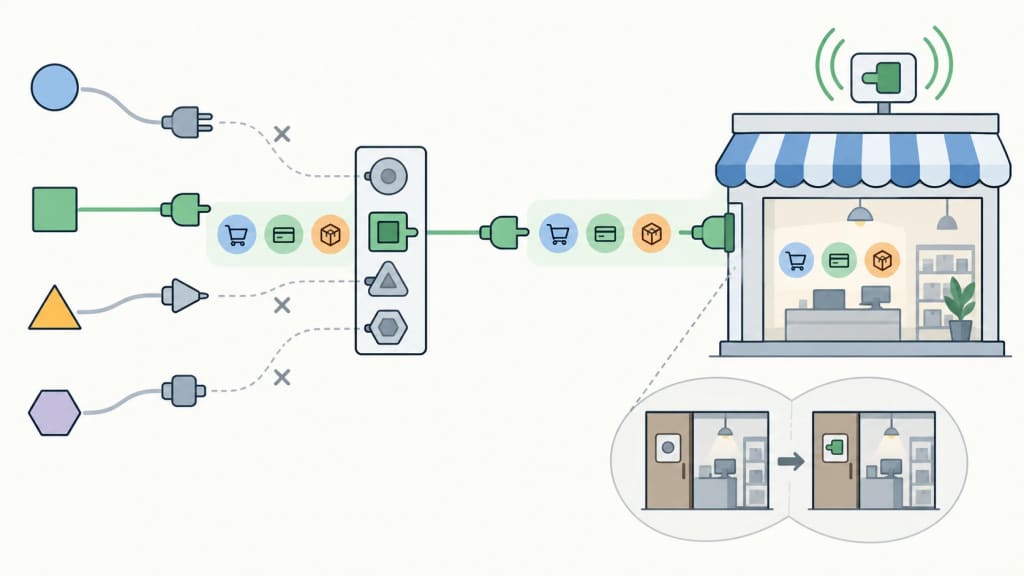
Shopify explicitly says the set of supported capabilities is unchanged and existing storefront integrations need no configuration update. This is protocol-version negotiation, not a new Shopify checkout feature. Developers building UCP clients should still follow the profile and negotiation rules in the current documentation.
What merchants and agent builders should check
Merchants using Google’s UCP-powered checkout should check whether the new cart-transfer and testing controls have reached their Merchant Center account and whether their market is included in the first rollout. The Google announcement describes gradual availability, so the feature list may differ by country and account.
Agent and platform developers should make version negotiation explicit rather than assuming that every storefront speaks the same UCP profile. Shopify’s update means a compatible client can recognize the 2026-08-25 profile, but it does not expand the capabilities available through that storefront.
The broader implication is operational: agentic commerce is moving from a protocol announcement into merchant tooling, compatibility metadata, checkout testing, and performance measurement. Retailers preparing for holiday traffic need to validate the complete path—product discovery, cart transfer, payment handoff, and post-click analytics—inside the regions and accounts where they actually operate.
Evidence and rollout limits
Google’s announcement is dated September 16, 2026 and describes staged regional availability. Shopify’s September changelog entry confirms the storefront-side protocol compatibility update and says no existing integration changes are required. Neither source claims that every merchant has immediate access to every UCP feature, so implementation teams should treat account and region availability as a deployment check.
Try the related loot
Give Any Model a Sandboxed Shell and File Workspace with OpenRouter