Cloudflare makes MCP server portals generally available with DLP controls


Cloudflare has made MCP server portals generally available, adding a governed endpoint for approved servers with Access, Gateway routing, DLP scanning, service tokens, and Logpush.
Cloudflare has moved MCP server portals from open beta to general availability for all Cloudflare customers. The feature places approved Model Context Protocol servers behind one governed endpoint, so teams can manage authentication, tool exposure, request visibility, and network controls in one place.
The release matters most to organizations connecting AI agents to several internal or third-party tools. Cloudflare’s portal can now combine Access authentication with Gateway routing, DLP scanning, service-token access, session management, and Logpush export. That turns an MCP connection from a collection of individually configured servers into an administrative surface.
Cloudflare’s portal turns multiple MCP servers into one endpoint
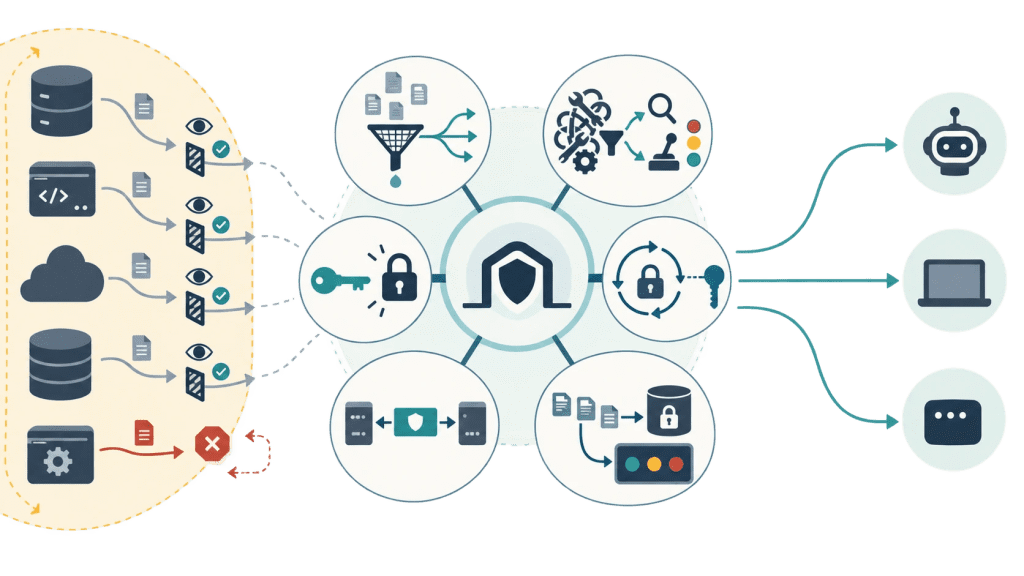
An MCP server portal centralizes multiple servers behind a single HTTP endpoint. Administrators choose which servers, tools, and prompts are exposed, while users authenticate through Cloudflare Access or an approved machine-to-machine path.
Cloudflare’s documentation says portals support stateless MCP 2026-07-28 clients and earlier 2025 Streamable HTTP clients. The portal negotiates protocol support independently for the client side and each upstream server, which lets a fleet migrate at different speeds. MCP News independently describes the same bridge behavior and notes that legacy SSE connections remain on the older protocol path.
This is useful for teams that cannot upgrade every agent host and tool server on the same day. It also gives administrators a single place to rename tools, narrow the available surface, and manage upstream OAuth flows.
The security and operations features now available
The GA changelog lists six additions or expanded capabilities from the open beta:
- Gateway routing: route portal traffic through Cloudflare Gateway for HTTP logging and data-loss-prevention scanning.
- Code Mode policies: reduce large tool definitions to controlled search-and-execute operations, with policy choices for whether Code Mode is optional, enabled by default, or required.
- Static OAuth credentials: support providers that do not offer Dynamic Client Registration.
- Session management: reconnect to servers and change authorizations from the portal.
- Service tokens: connect autonomous agents and machine-to-machine clients without a browser login.
- Logpush: export portal activity to external storage or a SIEM.
These controls do not make an upstream MCP server trustworthy by themselves. They provide enforcement and visibility around the connection. Teams still need to review each server’s ownership, tool permissions, data flows, credential scope, and behavior when a tool fails or returns unexpected content.
What teams should check before rollout
Start with an inventory of the MCP servers your agents already reach directly. Move one low-risk workflow behind a portal, then confirm that OAuth, service tokens, tool aliases, session recovery, and logging behave as expected for both browser-based and non-browser clients.
Pay special attention to Code Mode and DLP policy boundaries. Reducing the visible tool list can lower context use, but it changes how an agent discovers and calls tools. DLP inspection can also affect latency, supported transports, and the handling of sensitive payloads. Test those trade-offs with representative requests before enforcing a portal across production agents.
For a broader starting point on agent infrastructure, see LinkLoot’s AI agent tools guide.
Evidence
Cloudflare’s September 24 changelog is the primary source for the general-availability status and the feature list. Cloudflare’s updated documentation describes the endpoint model, OAuth flows, protocol compatibility, Code Mode, Gateway routing, and logging behavior. MCP News independently reports the protocol-bridging behavior introduced for Cloudflare portals and identifies the separate client/upstream negotiation as the practical compatibility detail.
The immediate implication is operational: organizations using MCP at scale can centralize access and monitoring, but they still need a per-server trust review before connecting sensitive data or write-capable tools.
Try the related loot
Audit OpenClaw Skills for Supply-Chain Risks Before Installing Them