OpenAI claims an AI-generated solution to Navier–Stokes


OpenAI says an internal model produced a finite-time singularity proof for the Navier–Stokes Millennium Prize problem, with a Lean formalization released for inspection.
OpenAI says an internal AI system produced a solution to the three-dimensional Navier–Stokes existence and smoothness problem, one of the Clay Mathematics Institute’s seven Millennium Prize problems. The company is releasing a mathematical write-up and a formal proof in Lean, but the claim remains an OpenAI announcement—not an awarded Clay prize or a result independently accepted by the mathematics community.
What OpenAI says the proof establishes
According to OpenAI, the result shows that the dynamics of the Navier–Stokes equations can develop a singularity in finite time. That corresponds to the blow-up side of the problem: finding smooth, finite-energy initial data for which a classical solution fails to remain smooth globally.
The announcement describes the proof as AI-generated and says the supporting formalization is written in Lean, a proof assistant that can mechanically check formal mathematical statements. A Lean artifact can make specific logical steps reproducible, but it does not by itself settle whether the formal statement matches the Clay problem’s exact hypotheses and intended formulation.
Why this is a major scientific claim
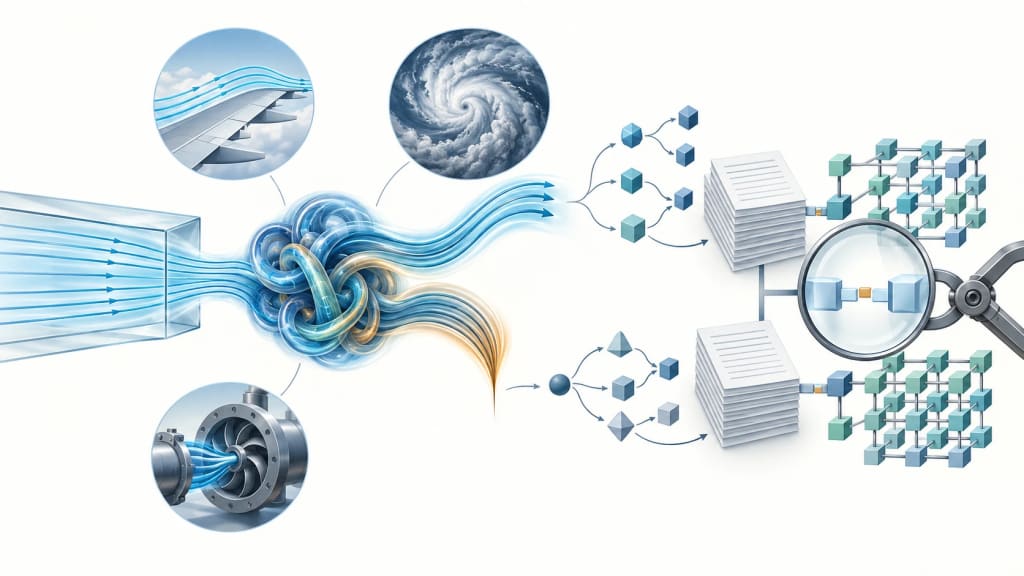
Navier–Stokes equations model fluid motion and sit behind questions in turbulence, aerodynamics, weather, and engineering simulation. The Clay problem asks whether smooth, incompressible three-dimensional flows stay smooth for all time—or whether a finite-time singularity can occur. A valid proof in either direction would earn the problem’s $1 million prize after the institute’s review process.
This is also a high-water mark for AI-assisted mathematical research. The reported workflow combines autonomous model reasoning, multiple agents, a human-readable proof narrative, and machine-checkable formal code. That combination could change how researchers search large proof spaces, provided experts can audit the assumptions and fill any gaps between formalization and the published problem statement.
Independent reporting adds a critical caveat
WIRED reports the same OpenAI claim and describes an authorship dispute involving mathematicians working on closely related fluid-dynamics research. That dispute matters to the story because scientific priority and access to unpublished work are separate from whether the released proof is correct.
The practical status is therefore precise: OpenAI has announced and published a purported solution; the proof is available for scrutiny; and independent mathematical validation, including review against the Clay formulation, is still the next milestone. Readers should not describe the Millennium Prize as awarded or the problem as institutionally closed until that process occurs.
What to watch next
The useful evidence will be the public proof’s exact assumptions, a line-by-line mathematical assessment, and confirmation that the Lean formalization covers the claimed theorem rather than a restricted or altered variant. The unresolved question is no longer whether an AI lab made the claim; it is whether the claim survives expert verification.
Sources and methodology
Try the related loot
Shorten URLs and manage feature requests with 1p.io API