IBM releases PatchTST-FM-r2 for open zero-shot forecasting


IBM's Granite Time Series PatchTST-FM-r2 brings open weights, probabilistic forecasts, and a commercial-friendly dual license to zero-shot time-series forecasting.
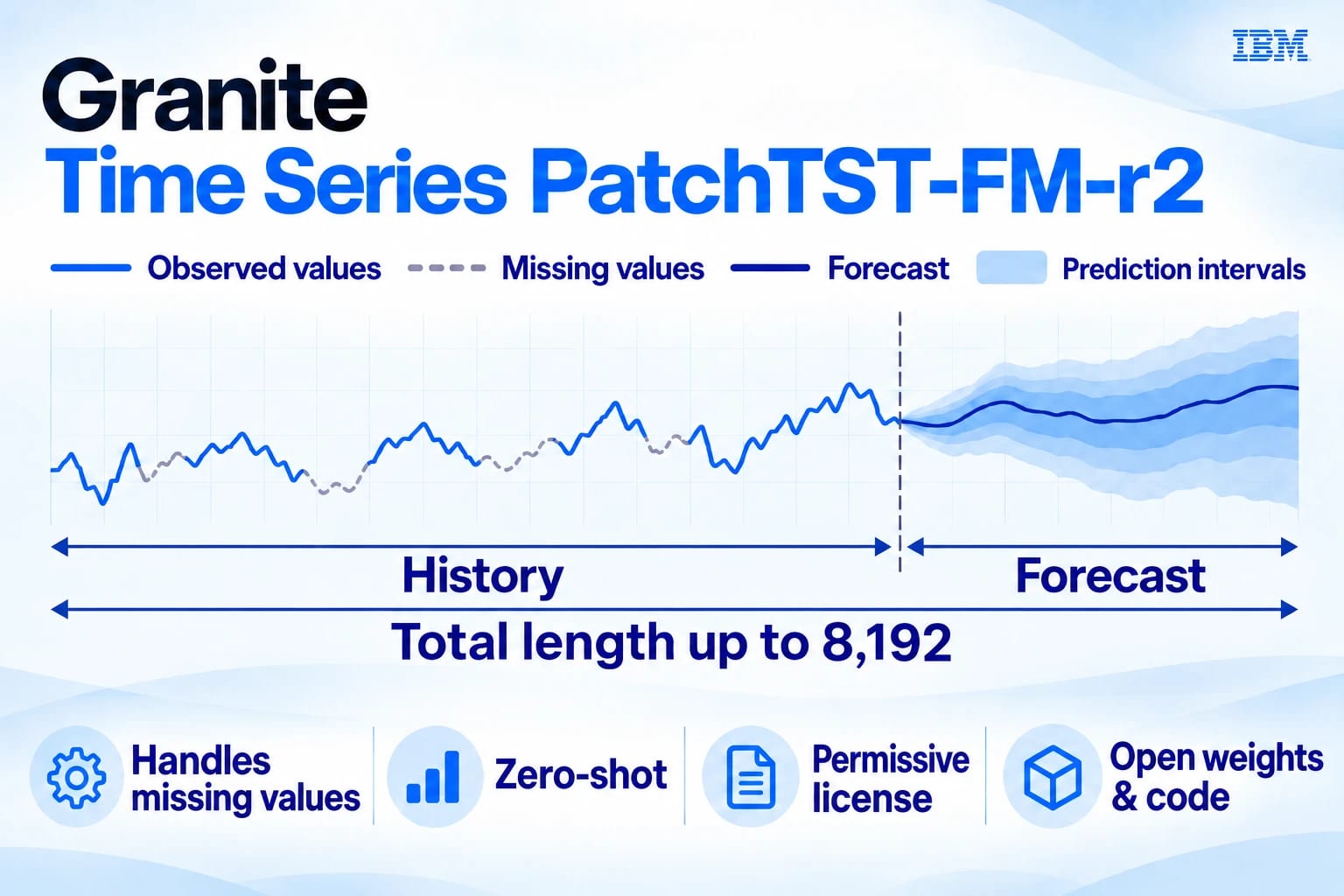
IBM has released Granite Time Series PatchTST-FM-r2, an approximately 385-million-parameter foundation model for zero-shot forecasting. The model is available with open weights, its inference pipeline, and reproducible benchmark code, while its Apache-2.0 and OpenMDW-1.0 dual license is designed to support commercial use.
The release targets demand, energy, traffic, telemetry, prices, and other regularly sampled time series. It does not require task-specific fine-tuning for the basic forecasting workflow: developers provide recent history and request a forecast, including uncertainty intervals.
What PatchTST-FM-r2 changes
PatchTST-FM-r2 replaces the earlier transformer block design with conformer-style blocks that combine multi-head self-attention and temporal convolution. Attention handles longer-range relationships between patches; convolution supplies a stronger local-temporal bias. IBM also reports overlapping patches with Hamming-window weighting, overlap-and-add forecasting, expanded normalization, and 30 backbone blocks rather than 20.
The model supports contexts up to 8,192 steps, flexible forecast lengths, point forecasts, and 99 quantile outputs. That last capability matters for production decisions: a forecast can expose a range of plausible outcomes instead of returning only one number.
IBM’s benchmark position and its limits
IBM reports that, as of September 8, 2026, PatchTST-FM-r2 ranks second among replicable zero-shot models on the GIFT-Eval leaderboard for both CRPS and MASE. It claims the top position in that comparison among models with permissive commercial-friendly licensing. When models allowed to train on benchmark data are included, IBM places r2 third for CRPS and fourth for MASE among replicable models.
Those figures are benchmark claims, not a guarantee for every workload. Teams should test against their own seasonal patterns, missing-data behavior, forecast horizon, and operational loss function. The documented training mix includes selected GIFT-Eval pretraining data, synthetic KernelSynth and CauKer sequences, and TSMixup data restricted away from the evaluation set; governance review is still required before deployment.
Open weights meet streaming deployment
The model is listed on the Hugging Face Hub as ibm-granite/granite-timeseries-patchtst-fm-r2, and IBM provides Python examples through its Granite-TSFM tooling. The release is therefore usable as a local or self-managed evaluation artifact rather than only as a hosted endpoint.
Confluent independently documents IBM Granite time-series models, including PatchTST-FM, as Early Access choices for anomaly detection and forecasting in Flink SQL. That integration is a separate access path and does not establish that every Confluent deployment exposes the new r2 checkpoint; the current Confluent page specifies Early Access and AWS availability.
For teams already operating Kafka or Flink, the practical split is clear: evaluate the open checkpoint directly for control over inference and licensing, or assess the managed Confluent path when streaming integration and operational simplicity matter more than self-hosting.
License and adoption checks
IBM says users may choose either Apache-2.0 or OpenMDW-1.0 for the model materials. “Commercial-friendly” is not a substitute for legal review: confirm which artifacts are covered, preserve notices, inspect the training-data terms, and validate the license treatment of any downstream modifications and deployment stack.
The next useful step is a small, leakage-aware comparison on representative series. Compare r2 with the incumbent model using the same context windows, horizons, missing-value handling, and cost budget. The release’s real significance will be measured by whether its open licensing and uncertainty outputs survive that workload-specific test.
Sources and methodology
Try the related loot
Run Fish Audio Drama 3 in Turkish on a Single 16 GB GPU