Topic

#open-weights

Loot, blog posts and adjacent themes connected to this topic. Follow the tag to keep it in your orbit.

#open-weights
Loot

More from this topic

Explore all loot
LinkLoot preview for Run the Kimi K3 Architecture Locally with a 0.18B Test Model

Run the Kimi K3 Architecture Locally with a 0.18B Test Model

0
A 0.18B-parameter Kimi K3 derivative that preserves the core layer types in a roughly 700 MB checkpoint for local architecture testing and development. Kimi-K3-0.18B is a tiny, MIT-licensed derivative of Moonshot AI’s 2.8T-parameter Kimi K3. It reduces the model to four layers, eight experts and 0.18B total parameters, with roughly 0.10B activated per token. The single model.safetensors checkpoint is about 0.69 GB, making the architecture accessible on ordinary development hardware. What it preserves The miniature model retains Kimi K3’s main layer types: dense and MoE feed-forward blocks, KDA linear attention, and an MLA full-attention layer. That makes it useful for testing loaders, integrations, architecture support and compression workflows without downloading or serving the full 2.8T model. Best use cases Validate Transformers compatibility and custom Kimi K3 model code Prototype inference, quantization or conversion workflows Inspect the MoE and attention implementation on limited hardware Build development tests around the Kimi K3 architecture Loading caveat The example loader requires trustremotecode=True, which executes repository-provided Python code. Review the model repository and pin a revision before running it in a sensitive environment. The model is not currently hosted by a Hugging Face inference provider.
Free
Review open
0
Run Poolside Laguna XS 2.1 for Local Agentic Coding Tests

Run Poolside Laguna XS 2.1 for Local Agentic Coding Tests

0
Poolside's 33B/3B-active open-weight coding model is worth bookmarking for local agent workflows, OpenRouter trials, and long-context coding benchmarks. Poolside Laguna XS 2.1 is a compact Mixture-of-Experts coding model built for agentic coding and long-horizon software work. Poolside says it has 33B total parameters, 3B active parameters per token, a 256K context window through its API and OpenRouter, and stronger results than Laguna XS.2 on SWE-bench Multilingual and terminal-style tasks. Use this as a practical evaluation target, not as a blind replacement for your current coding model. Good tests include repository navigation, multi-step bug fixes, shell-heavy tasks, tool-call formatting, and cost per completed change. The model is available as weights on Hugging Face and can also be tried through OpenRouter, including a free endpoint where availability and data-use terms should be checked before sending sensitive code. Useful checks before adopting it: Confirm the license and acceptable-use terms for your deployment. Compare BF16, FP8, NVFP4, INT4, and GGUF variants against your hardware budget. Preserve reasoning history when your harness supports it, because Poolside documents the model as reasoning-capable between tool calls. Test vLLM, SGLang, Transformers, TensorRT-LLM, Ollama, or llama.cpp support with your actual agent stack. Avoid sending proprietary code to free hosted endpoints unless the provider terms match your data policy. This is Loot rather than a blog post because the main value is direct use: model page, weights, hosted endpoint, and implementation notes.
Free
Review open
0
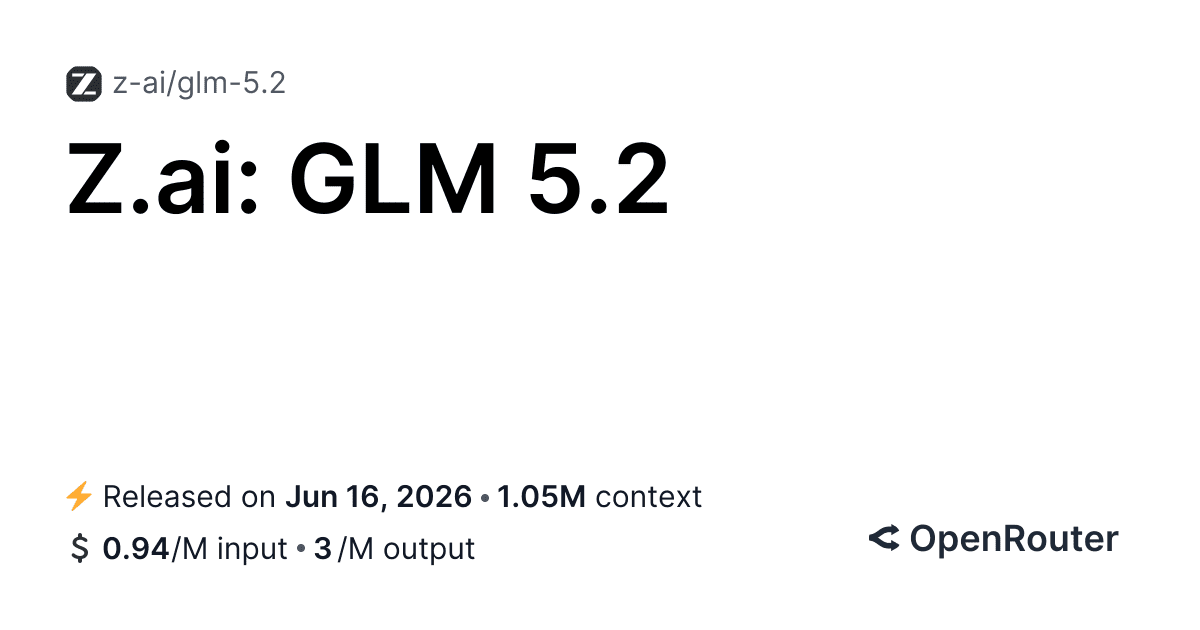
Try GLM-5.2 on a real long-context coding task

Try GLM-5.2 on a real long-context coding task

0
A practical starter kit for evaluating Z.ai GLM-5.2 with a repository audit, a bounded refactor, and a security-review sanity check before trusting it in production. Try GLM-5.2 on a real long-context coding task GLM-5.2 is useful to test when your normal coding model loses track of repository-wide context. The practical angle is not another generic chat prompt. Use it on one bounded engineering workflow where the 1M-token context, OpenAI-compatible API access, and open-weight deployment options can be compared against your current agent stack. What to test first Start with a repository you own. Give GLM-5.2 the project structure, key docs, test commands, and one clearly scoped task. Do not begin with production write access or secrets. Use this evaluation sequence: Ask for an architecture map and risk boundaries. Run one medium refactor that should not change public APIs. Require build, lint, and test verification. Ask for a short self-review that lists files changed, assumptions, and remaining risks. Compare the result with your current primary coding model on the same task. Copyable evaluation prompt Best fit Use case Why GLM-5.2 fits Caveat --- --- --- Repository-wide audit Z.ai documents a 1M-token context and long-horizon engineering focus. Validate claims on your own codebase, not only public benchmarks. Bounded refactor The model is positioned for multi-file agentic engineering tasks. Keep API, behavior, and dependency boundaries explicit. Local/open-weight experiments Hugging Face lists the model and serving options through vLLM, SGLang, Docker Model Runner, and quantization paths. Hardware, quantization, and provider quality will change results. Security review trial Semgrep reported strong IDOR-benchmark results for GLM-5.2 under its harness. One benchmark is not proof of general security-review superiority. Access paths to compare Z.ai API: fastest path to a direct vendor test. OpenRouter: useful when you already route model calls through one API gateway. Hugging Face weights: useful for local or private serving experiments. GitHub repository: useful for release notes, model links, and serving guidance. Safety checklist Use owned or authorized repositories only. Remove secrets and customer data from prompts and logs. Keep the task bounded to one change request. Require reproducible commands, not just a confident summary. Treat benchmark wins as signals, not guarantees. Review dependency changes and generated code before merge. Source links Z.ai GLM-5.2 docs: https://docs.z.ai/guides/llm/glm-5.2 Z.ai GLM-5.2 blog: https://z.ai/blog/glm-5.2 GitHub repository: https://github.com/zai-org/GLM-5 Hugging Face model: https://huggingface.co/zai-org/GLM-5.2 OpenRouter model page: https://openrouter.ai/z-ai/glm-5.2 Semgrep benchmark context: https://semgrep.dev/blog/2026/we-have-mythos-at-home-glm-52-beats-claude-in-our-cyber-benchmarks/
Free
Review open
0
Blog

Related reads

Browse blog