Black Forest Labs releases FLUX 3 Action for open robot control


Black Forest Labs has released FLUX 3 Action as an open-weight 7B world-action model, with newly surfaced base weights for adapting robot, simulator, and game-control policies.
Black Forest Labs has released FLUX 3 Action, an open-weight 7B world-action model that predicts robot actions together with future video frames. The newly surfaced flux-3-action-base repository provides the shared adaptation base and encoders used by the collection's robot policies, while the broader release also targets simulators and games.
FLUX 3 Action targets the control loop
The model takes visual observations, robot state, and a text instruction, then returns a short horizon of actions. BFL describes the architecture as a joint video-and-action predictor: it can model what the environment may look like next while producing commands in the embodiment's action space.
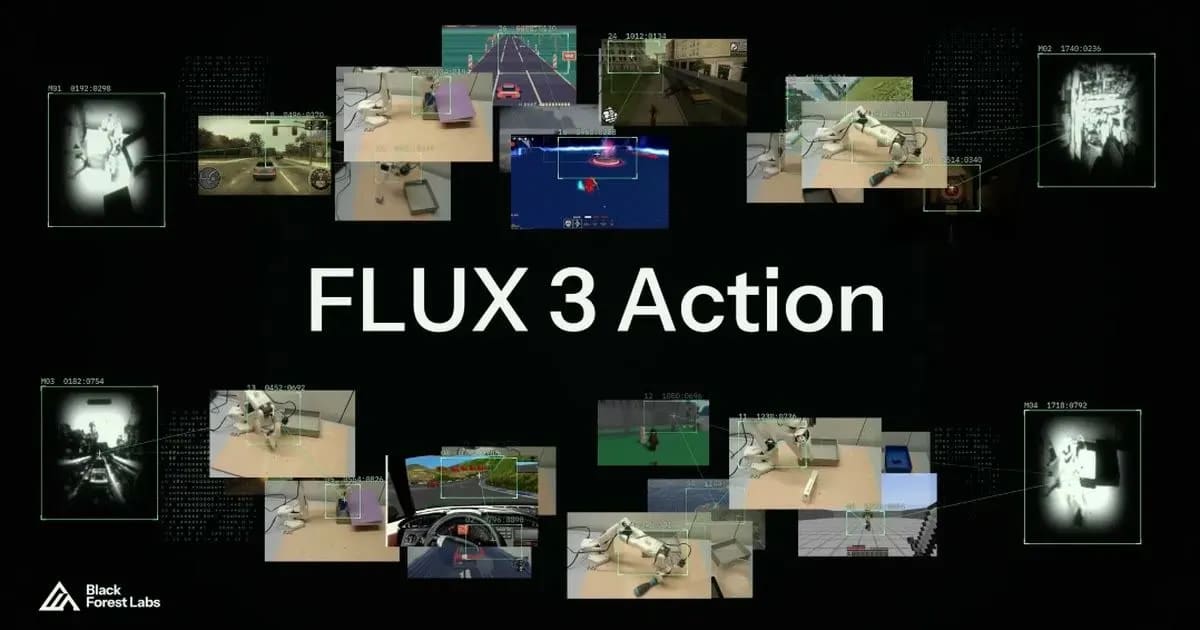
That design makes FLUX 3 Action different from an image generator with a robotics demo attached. It is intended to sit inside a repeated observe, predict, execute, and re-plan loop. The same model family can be adapted to a robot arm, a simulated drone, or a game with a defined action space.
Black Forest Labs reports a best RoboLab-120 success rate of 42.2% for its guidance-distilled checkpoint, and a 38.3% result for the single-step checkpoint in the comparison described on its research page. Those are vendor-reported benchmark results, not an independent evaluation. The page also claims lower compute cost and faster real-time factors than larger open policies in its test setup.
What the newly listed base weights contain
The Hugging Face model card clarifies an important implementation detail: flux-3-action-base is an adaptation component, not a complete robot policy. It contains the shared action trunk and frozen encoders used by the SO-101 and DROID policies. A new robot or simulator needs its own action head and fine-tuning recipe.
The card lists 457 tensors and identifies the text encoder as an unmodified Qwen3-VL-4B-Instruct copy. It also points users to ready-to-use policies and a fine-tuning path rather than presenting the base checkpoint as a turnkey controller.
That distinction matters for anyone evaluating the release. Downloading the base file alone does not produce a safe, general-purpose robot brain. The application must translate outputs into the target embodiment's action space and enforce velocity, force, workspace, and emergency-stop limits.
Open weights, practical access, and safety limits
The weights are published under the FLUX Kommunity License v1.0, while the copied text encoder retains its Apache-2.0 designation. The release includes code and documentation for adapting the model, and the associated LeRobot integration is aimed at running and fine-tuning policies with common robotics tooling.
The model card explicitly warns that FLUX 3 Action outputs joint targets without bounding joint velocity, force, or workspace. Any physical deployment therefore needs simulation or tightly controlled hardware validation, active human oversight, and a reachable hardware stop. These are operational requirements, not optional polish around the model.
For builders, the useful path is to start with the documented SO-101 or DROID policy, inspect the action representation, and only then adapt the base to a new embodiment. For games and simulators, the same workflow can be tested without exposing people or hardware to unbounded motor commands.
Evidence and access
The primary release page is Black Forest Labs' FLUX 3 Action report. The newly detected Hugging Face base model card corroborates the public artifact, its adaptation role, license notes, and deployment warnings. Readers should treat benchmark numbers as reported results until independent reproductions are available.
The next practical milestone is broader reproduction across embodiments: whether the base and fine-tuning recipe transfer cleanly beyond the released SO-101 and DROID policies will determine how useful FLUX 3 Action becomes outside the reference demos.
Try the related loot
Give Any Model a Sandboxed Shell and File Workspace with OpenRouter