
Anthropic opens verified Claude access for life-science teams


Anthropic is opening applications for a beta program that gives verified life-science teams more permissive access to Claude for biology and drug-discovery work, with separate grants for higher-risk projects.
Anthropic is opening applications for a beta Life Sciences Verification Program (LSVP) that gives verified teams access to Claude models with safeguards tuned for biology-related work. The program covers Claude Science, Claude.ai, Claude Code, and the API, and is aimed at academic labs, startups, pharmaceutical companies, and other life-science organizations.
The change is a controlled access policy, not a general removal of biology safeguards. Applicants must pass reviews of their research credentials, security standards, and ethical oversight. Anthropic says the program is already being used by dozens of early-access organizations and expects to enroll hundreds more in its first week.
Anthropic separates routine biology work from higher-risk projects
The LSVP has two grant levels. Standard Use is intended for most biology research and development, including drug discovery, clinical development, manufacturing, quality assurance, regulatory affairs, and diligence. It can cover an entire team, is renewed annually, and currently applies to Anthropic's Mythos 5.1, Opus 5, and Sonnet 5 models.
High-risk Use is an additional grant for work that remains blocked under Standard Use. It applies to a single research project, requires renewal every six months, and is currently available for Claude Opus 5 and Sonnet 5. Anthropic says Mythos high-risk access remains limited to a small group of entities while it works with the US government on broader availability.
That distinction matters for organizations planning real workflows. A team may receive broad Standard Use access for day-to-day work while needing a separate, project-specific approval for dual-use research. The program therefore changes the access path and review process as much as it changes the model behavior.
Monitoring replaces some real-time blocking for approved use
Anthropic says LSVP safeguards use offline monitoring to detect suspicious patterns across requests and sessions, rather than blocking every potentially risky request in real time. Approved organizations specify their intended use cases at a high level, and Anthropic monitors traffic against that scope. Organization administrators can be notified when activity appears unauthorized.
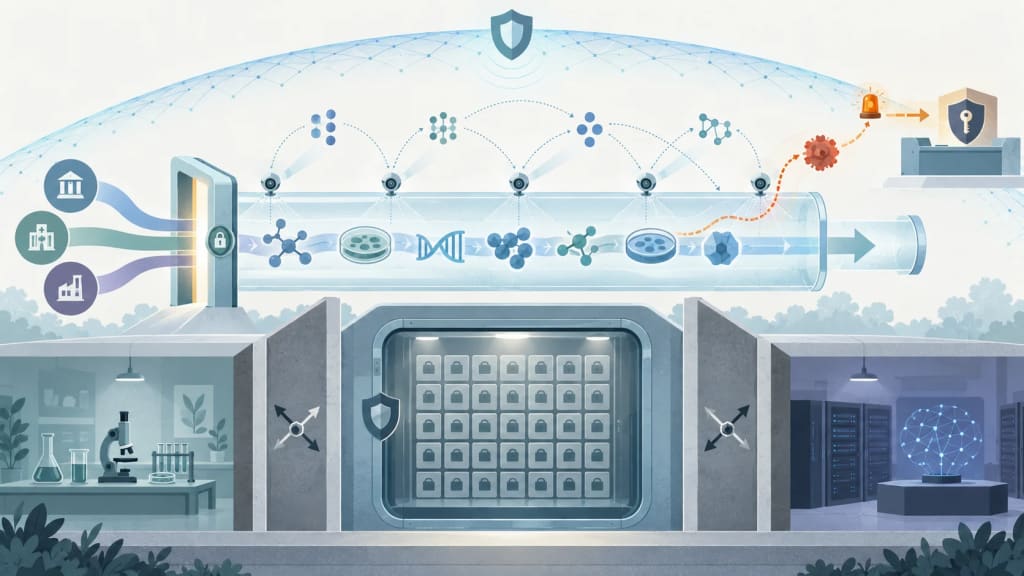
The trade-off is explicit: LSVP traffic must be retained for 30 days so flagged activity can be reviewed. Anthropic says that data is compartmentalized, cannot be used for model training, and is inaccessible to its life-sciences research teams. Cyber classifiers remain active under LSVP grants.
Access is limited, and healthcare compliance needs care
LSVP is available in Anthropic's first-party API console and on Claude Enterprise and Team plans. Individual plans are not supported yet, and the program is not available through third-party platforms. In Claude.ai and Claude Code, the initial experience uses a preselected default grant, except when Claude Code is authenticated through the API.
Anthropic also says the beta is not available for BAA-enabled organizations. Customers handling protected health information therefore need to use separate non-BAA, non-HIPAA organizations. That is a material deployment constraint for healthcare teams, not a footnote to the rollout.
Why the partner context is relevant
Xaira Therapeutics describes its own work as AI-driven drug discovery built around biological data, predictive models, and agentic systems. That independently illustrates the kind of organization Anthropic is targeting, while Anthropic's announcement supplies the actual LSVP terms and availability.
For now, the practical next step is an application and an internal review of grant scope, security controls, data-retention requirements, and HIPAA boundaries. The open question is how quickly Anthropic can expand high-risk access without weakening the verification and monitoring model that makes the beta possible.
Try the related loot
Give OpenClaw Agents Pre-Verified Web Actions with Actionbook