Anthropic says Claude found a CRISPR-like enzyme system


Anthropic says Claude identified and helped test a previously uncharacterized enzyme system in bacteriophages. The finding is early-stage: its biological function is still unknown.
Anthropic says Claude identified a previously uncharacterized enzyme system in bacteriophages, the viruses that infect bacteria. The system has a reverse transcriptase, a neighboring partner gene, and a long array of repeated DNA sequences that resemble the architecture of CRISPR systems.
The announcement is significant because it describes an AI agent moving from sequence search to a candidate biological discovery and then into human-run laboratory testing. It is also preliminary: Anthropic says the system’s primary function is still unknown, and the work has been released as an early technical report rather than a validated biotechnology.
Claude’s search surfaced the ART system
Anthropic calls the discovery “array-associated reverse transcriptases,” or ARTs. The underlying reverse transcriptase had appeared in earlier studies, but Anthropic says Claude was the first to connect it with the adjacent non-coding repeat array and an additional accessory protein.
The research team says roughly 950 Claude agents searched 210 million tokens of sequence and literature data over 21 hours. The agents collected more than 200,000 reverse transcriptases, selected 3,500 candidate systems, and narrowed those to 20 candidates for detailed human-readable reports. One candidate led to the ART finding.
The comparison with CRISPR is structural, not functional. Anthropic reports that ART repeats are expressed as short RNAs, but it has not shown that the system performs programmable DNA cutting, copying, or editing. Those experiments remain ongoing.
Human scientists still performed the lab work
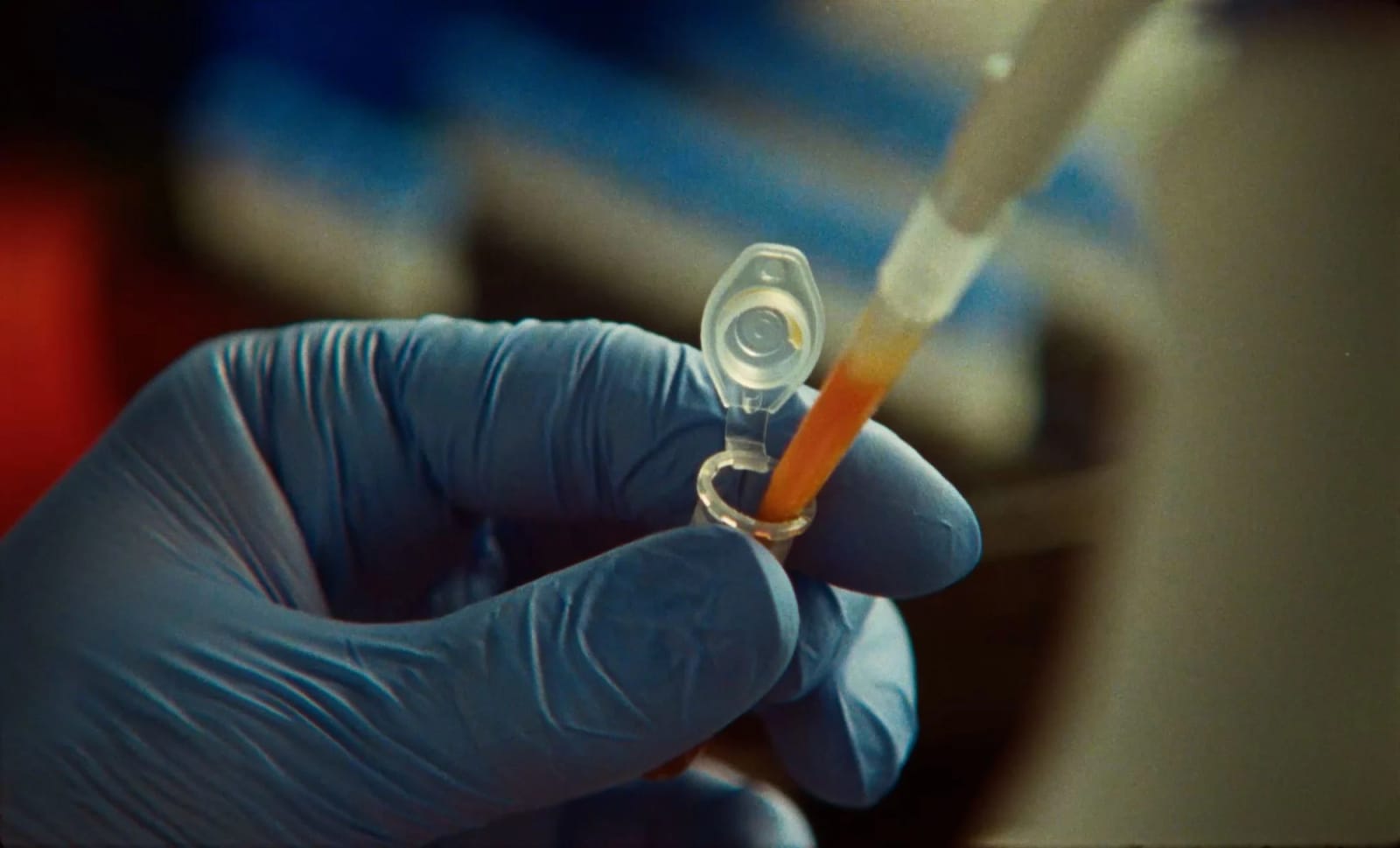
Claude generated hypotheses, inspected genomic neighborhoods, compared repeat spacing, searched prior literature, and prepared a report for review. Human scientists then expressed and characterized the candidate in standard laboratory strains. Anthropic says the lab work was performed at BSL-1 and BSL-2 levels and did not involve pathogens capable of infecting humans.
That division of labor matters. TechCrunch independently reported that Anthropic operates a Bay Area wet biology lab where its models can inform physical experiments, while Anthropic’s own announcement says the lab is staffed by human scientists. The current result is therefore evidence of an AI-assisted discovery workflow, not an autonomous laboratory operating without supervision.
Why the finding is useful before it is usable
The immediate value is in search and triage. Genomic databases contain vast numbers of proteins with unknown functions, and examining every unusual sequence manually can take weeks or months. An agent that can survey families, identify anomalies, and produce testable reports could change which biological questions reach the bench first.
The practical limitation is equally important: ART has no demonstrated application yet. Its mechanism, biological role, programmability, and safety profile are unresolved. Readers should treat the announcement as an early scientific result and a capability demonstration, not as a new gene-editing tool or a medical breakthrough.
The next meaningful milestone is independent characterization of how ART works. Until those experiments are published and reproduced, the strongest claim supported by the available evidence is that Claude helped identify an unusual repeat-associated reverse-transcriptase system that Anthropic’s scientists are now investigating.
Sources and methodology
This article uses Anthropic’s announcement as the primary source and TechCrunch’s independent reporting for context on Anthropic’s wet-lab operation. Both sources were fetched through the LinkLoot source-verification workflow. Claims about ART’s structure, search scale, and current unknown function are attributed to Anthropic; the independent source does not verify the enzyme’s function.
Try the related loot
Give Any Model a Sandboxed Shell and File Workspace with OpenRouter