GitHub Copilot app adds centrally managed OpenTelemetry export


GitHub now lets enterprise administrators configure OpenTelemetry export for the Copilot app, giving teams centralized visibility into agent sessions, model requests, and tool activity while excluding prompt and response content by default.
GitHub Copilot’s app can now export agent telemetry through OpenTelemetry, with the configuration controlled by enterprise-managed settings. Administrators can send traces and related activity data to their organization’s compatible monitoring stack instead of asking each developer to configure observability separately.
The change covers the parts of an agent session that are hardest to audit after the fact: requests to AI models, tool interactions, and the sequence of actions an agent took. GitHub says prompt and response content is excluded by default, but content-capture settings can change that boundary and should be reviewed before rollout.
GitHub Copilot adds a central telemetry control
The new telemetry property in managed-settings.json lets an enterprise specify the endpoint that receives exported data. Because the setting is centrally managed, teams can apply one monitoring policy across Copilot app users rather than relying on local developer configuration.
That gives platform owners a clearer route to investigate unexpected agent behavior. A trace can show whether a problem came from the model request, a tool call, a sequence of retries, or the surrounding application workflow. It also creates a common starting point for measuring agent latency and operational failures in existing monitoring systems.
What OpenTelemetry contributes
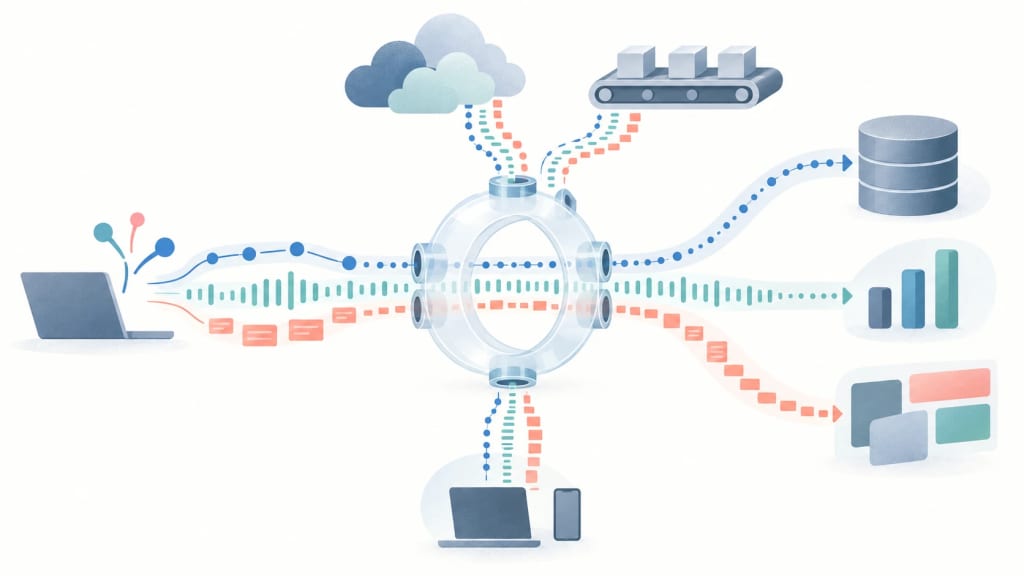
OpenTelemetry is an open-source, vendor-neutral framework for generating, collecting, and exporting telemetry such as traces, metrics, and logs. It does not provide the storage or visualization backend itself, so organizations can route Copilot data to the observability system they already operate or buy.
That portability matters for teams with mixed development environments. The same general telemetry model can sit alongside application traces from services, CI systems, and other agent clients. It also avoids making GitHub’s own dashboard the only place where administrators can inspect AI-assisted work.
The privacy boundary needs an explicit review
Excluding prompts and responses by default reduces the risk of sending source code, customer data, or confidential instructions into a telemetry pipeline. It does not remove the need for a data-flow review: traces can still reveal model usage, tool names, timing, identifiers, and workflow structure.
Before enabling export, administrators should confirm the collector endpoint, retention period, access controls, regional processing requirements, and whether downstream processors receive the data. If content capture is enabled for debugging, treat that as a separate privacy decision with a short retention window and restricted access.
A practical rollout path for platform teams
Start with a non-production enterprise or a limited developer group. Send metadata-only telemetry to the approved collector, confirm that traces can be correlated with application incidents, and verify that prompt and response content remains absent in the backend. Then document who can change managed-settings.json and how endpoint changes are reviewed.
Teams should also decide which agent signals are useful enough to keep. Session duration, model request failures, tool-call errors, retries, and token-related metrics can support capacity and reliability work. Raw trace volume can grow quickly when every agent step is exported, so define sampling and retention before broad deployment.
GitHub’s update makes Copilot agent activity observable through a standard ecosystem, but the operational value depends on the controls around the collector. The next checkpoint is whether organizations can combine these traces with their existing application and security signals without widening access to sensitive development context.
Sources and methodology
The GitHub Changelog is the primary source for the Copilot app capability, managed configuration, and default content boundary. OpenTelemetry’s documentation provides the independent technical context for the framework and its vendor-neutral export model. No claim here assumes that GitHub’s telemetry is enabled automatically or that every enterprise plan has identical rollout timing.
Try the related loot
Give Any Model a Sandboxed Shell and File Workspace with OpenRouter