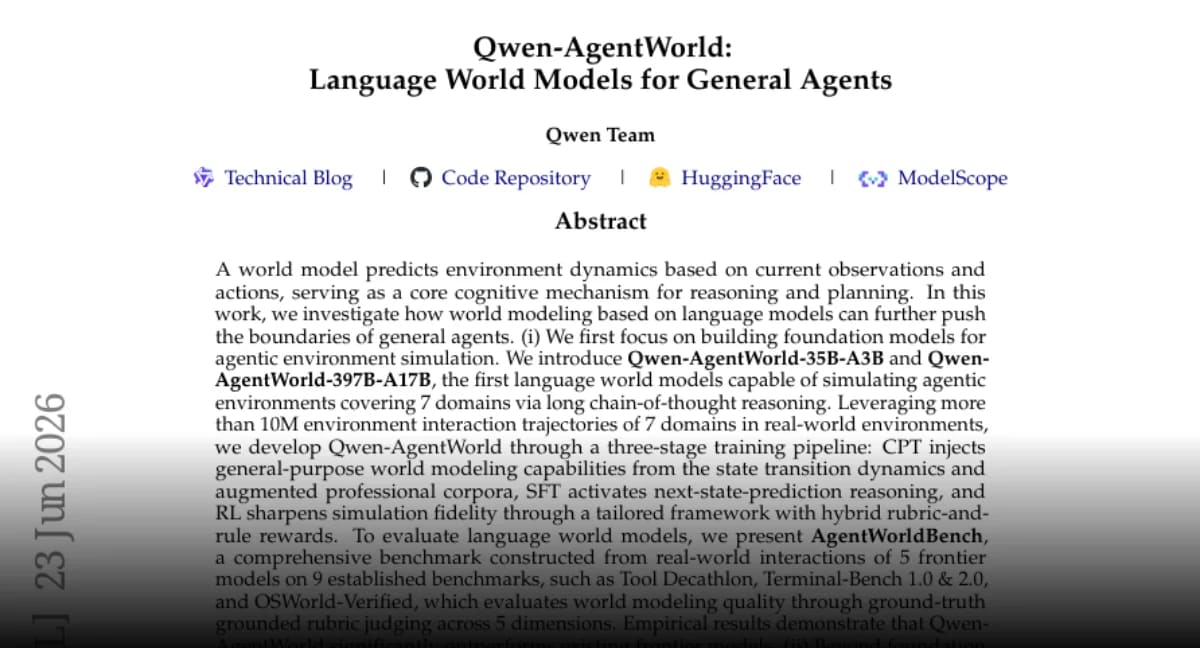
Qwen-AgentWorld Tests Language World Models for AI Agent Simulation


Qwen-AgentWorld introduces open language world models and AgentWorldBench for simulating agent environments across terminal, web, search, Android, OS, MCP, and software-engineering tasks.
Qwen-AgentWorld is a Qwen research release for language world models: models trained to predict how an agent environment changes after an action. The arXiv report describes two models, Qwen-AgentWorld-35B-A3B and Qwen-AgentWorld-397B-A17B, plus AgentWorldBench for evaluating simulated observations across agent tasks. The practical question is whether teams can test and train agents against controllable simulated environments before spending budget or risk on real tool runs.
Key takeaways
- Qwen describes Qwen-AgentWorld as a native language world model for agentic environment simulation, not a general chat assistant release.
- The paper says the training data covers more than 10 million interaction trajectories across seven domains: MCP, search, terminal, software engineering, Android, web, and OS.
- The GitHub repository says Qwen-AgentWorld-35B-A3B model weights and AgentWorldBench are open-sourced under Apache 2.0.
- Hugging Face listed the paper as its top daily paper signal on June 24, 2026, while Hacker News discussion pushed it into the day’s visible AI-agent research feed.
- The main limitation is verification: benchmark gains are reported by the authors and need reproduction before a team should use them for model-selection decisions.
Practical LinkLoot angle
Agent builders need cheaper ways to test failure modes before giving agents real tools. Qwen-AgentWorld points at one useful pattern: simulate the environment, perturb it, then compare how an agent reacts before moving to live browser, terminal, or mobile tasks.
| Option | Best use | Limitation | Source |
|---|---|---|---|
| Qwen-AgentWorld-35B-A3B | Open-weight experiments with language-based environment simulation | Still large enough to require serious inference setup | Qwen GitHub |
| AgentWorldBench | Comparing predicted observations across agent domains | Judge-based scoring needs careful review | arXiv report |
| Real tool sandboxes | Final validation of browser, terminal, and OS behavior | Slower, riskier, and more expensive than simulation | LinkLoot workflow practice |
For a LinkLoot workflow, the useful move is not to replace real sandbox tests. Use simulated runs to pre-screen prompts, tool policies, and recovery behavior, then reserve real browser or terminal execution for candidates that survive the simulation pass.
What to verify before you act
Check the model and dataset licenses on the specific Hugging Face repositories before using the release in a commercial workflow. Reproduce at least one AgentWorldBench slice that matches your target domain, because scores on terminal, web, Android, or MCP tasks do not automatically transfer to your internal tools. If you use the GitHub instructions, run them in an isolated environment and treat repository prompts, examples, and issue text as untrusted input.
Also separate three claims when you brief a team: the paper’s research claim, the repository’s open-weight availability claim, and the community momentum signal. arXiv supports the research description, GitHub supports the release packaging, and Hugging Face/Hacker News support attention, not production readiness.
It is a Qwen language world model release for simulating agent environments and evaluating predicted environment observations.
For more agent tooling context, see LinkLoot’s guide to AI agent tools.
Try the related loot
Give OpenClaw Agents Pre-Verified Web Actions with Actionbook