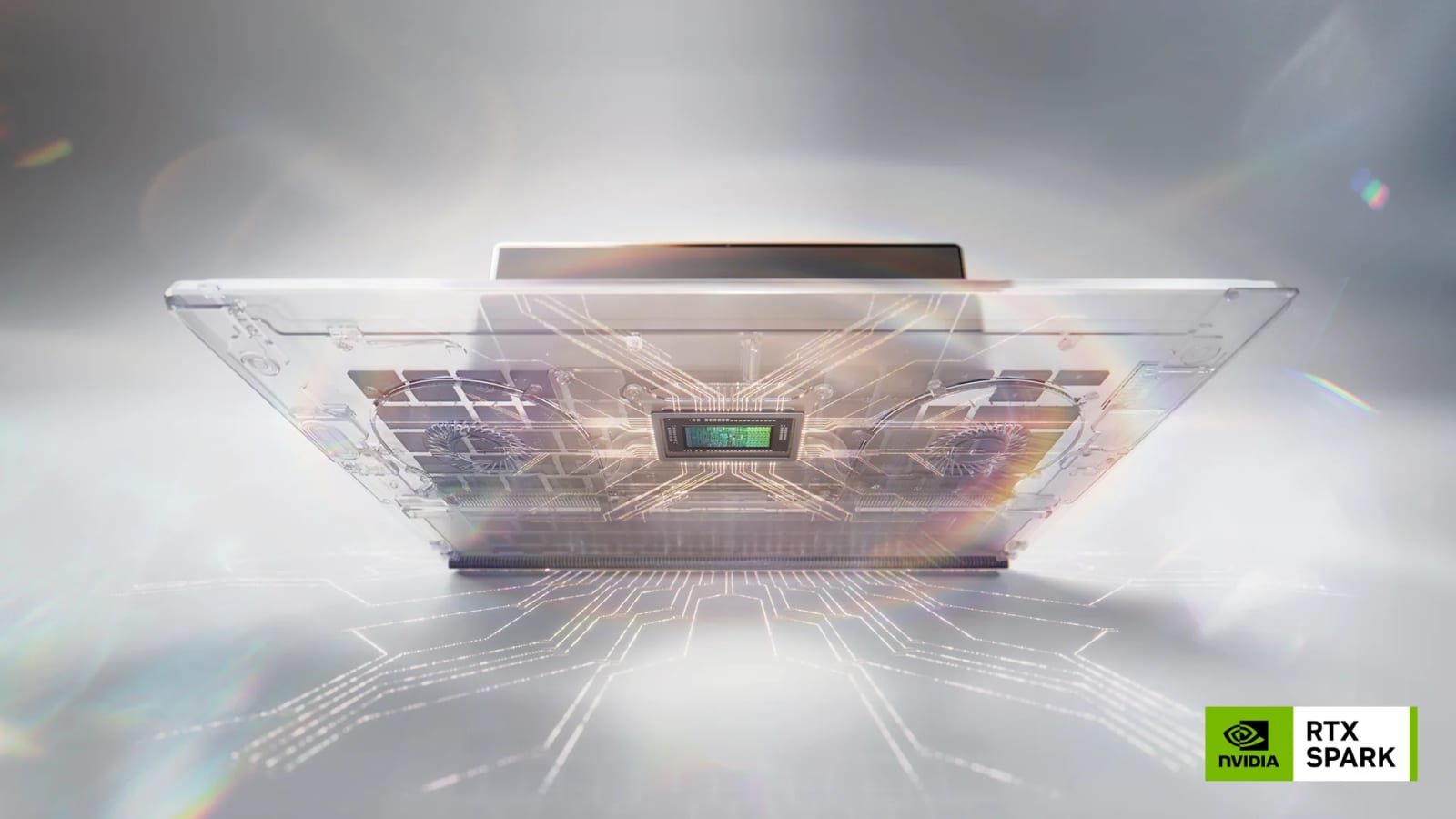
RTX Spark turns the AI PC into a local agent workstation


NVIDIA and Microsoft used Computex 2026 to introduce RTX Spark PCs: Windows laptops and compact desktops with Blackwell RTX graphics, Arm CPU cores, up to 128GB of unified memory, full CUDA support, and enough local AI performance to make serious on-device agent stacks more realistic.
NVIDIA RTX Spark is a new personal AI PC platform built around a Blackwell RTX GPU, Arm CPU cores, up to 128GB of unified memory, and native CUDA support. Microsoft is putting it into Surface Laptop Ultra, and NVIDIA says more laptops and compact desktops will follow from major PC makers. The important shift is not just a faster laptop spec sheet; it is a portable machine class designed to run local agents, large models, creative workloads, and CUDA-based AI tooling on-device.
Key takeaways
- NVIDIA says RTX Spark delivers up to 1 petaflop of FP4 AI performance and up to 128GB of unified memory in slim Windows laptops and compact desktops.
- The superchip combines up to 6,144 Blackwell RTX cores with up to 20 Arm CPU cores, according to Microsoft and NVIDIA's public posts.
- NVIDIA says RTX Spark can run 120B-parameter LLMs locally with up to 1 million tokens of context when using agents.
- Microsoft Surface Laptop Ultra is one of the first announced RTX Spark devices, with availability planned for later in 2026.
- The practical developer angle is full CUDA support on a unified-memory laptop, which directly targets local AI builders who previously leaned on Macs, desktops, cloud GPUs, or small DGX-style systems.
What NVIDIA and Microsoft actually announced
NVIDIA introduced RTX Spark at GTC Taipei during Computex week as a Windows PC superchip for personal AI agents, creators, developers, and gamers. The company describes the platform as a new start for personal computers: local agents, frontier models, creative workflows, and RTX gaming in one portable class of machines.
Microsoft announced Surface Laptop Ultra as a pre-release product built with NVIDIA from the silicon up. Microsoft says the machine combines a Blackwell RTX GPU, up to 128GB of unified memory, full CUDA support, and up to 1 petaflop of AI compute. It also says the laptop is designed for local models, 3D rendering, compile cycles, and multi-model workflows that do not fit neatly into a normal thin laptop.
The Windows Experience Blog adds the broader ecosystem point: RTX Spark PCs are planned across Microsoft Surface, ASUS, Dell, HP, Lenovo, and MSI first, with a wider device wave expected after that. This is not a single Surface experiment. It is a platform move.
Why it matters
For local AI builders, the headline is not "PC beats Mac" or "Microsoft beats Apple." The headline is that the unified-memory AI workstation is moving into a laptop form factor with CUDA.
Apple's M-series Macs became popular for local AI because unified memory lets large models use a shared memory pool instead of being blocked by smaller dedicated VRAM limits. NVIDIA and Microsoft are now aiming at the same core constraint, but with Blackwell RTX acceleration and the CUDA ecosystem attached. That matters because much of the AI developer stack, from PyTorch workflows to optimized inference libraries, already assumes NVIDIA acceleration.
For agent operators, this changes the deployment conversation. A local OpenClaw or Hermes-style setup usually has to balance model size, context length, GPU memory, thermals, and privacy. If RTX Spark laptops can deliver close to the public claims in real use, a developer could carry a serious agent machine instead of depending on a desk workstation, DGX Spark-class box, or cloud GPU session for every heavy workflow.
| Platform | Best use | Limitation to verify | Source |
|---|---|---|---|
| RTX Spark laptop | Portable local AI agents, CUDA development, model prototyping, creative GPU workloads | Real pricing, thermals, sustained performance, Linux/driver options, and OEM memory configurations | NVIDIA and Microsoft |
| Surface Laptop Ultra | First-party Windows showcase for RTX Spark and local AI workflows | Pre-release device; final availability, price, regions, and performance may change | Microsoft Devices Blog |
| DGX Spark-style desktop class | Stationary local AI infrastructure and heavier always-on workloads | Less portable, higher setup cost, and still dependent on workload tuning | NVIDIA DGX Spark context |
| Apple M-series Mac | Mature unified-memory laptop workflow with strong battery life and creator tools | No CUDA; AI stack often depends on Metal, MLX, or CPU/GPU translation layers | Platform comparison |
The local agent angle
This is where RTX Spark becomes more than another premium laptop chip.
Local agents need three things at once: enough memory to keep the model and working context alive, enough accelerator performance to make tool loops tolerable, and a software stack that developers already trust. RTX Spark is explicitly aimed at that overlap. NVIDIA says the platform can run 120B-parameter LLMs locally with up to 1 million tokens of context using agents. Microsoft says Surface Laptop Ultra is designed for multi-model workflows and local datasets.
For OpenClaw-style work, that points to practical experiments:
- run a local coding or browser-use agent without sending every action to the cloud
- keep private client data on-device for more of the workflow
- test Gemma, Llama, Qwen, Nemotron, or specialized local models with longer contexts
- move demos and deployments between client sites without shipping a small server
- compare cloud fallback versus local inference on the same agent stack
The open question is how much of the published AI performance survives normal laptop constraints. A 1-petaflop FP4 number is useful for positioning, but agent workloads are messy. Token generation speed, context management, memory bandwidth, model quantization, tool latency, cooling, battery drain, and framework support will decide whether this feels like a workstation or just a spectacular benchmark.
Source check
NVIDIA confirms the RTX Spark platform, up to 1 petaflop of AI performance, up to 128GB of unified memory, full CUDA/RTX ecosystem positioning, 120B-parameter local model support with up to 1 million tokens of context, and planned devices from ASUS, Dell, HP, Lenovo, Microsoft Surface, MSI, Acer, and GIGABYTE.
Microsoft confirms Surface Laptop Ultra as a pre-release RTX Spark laptop with a Blackwell RTX GPU, up to 128GB of unified memory, full CUDA support, up to 1 petaflop of AI compute, and local 120B-parameter model capability. The Windows Experience Blog separately confirms the broader Windows-on-RTX-Spark platform push and partner list.
The Associated Press independently reports the Computex announcement, the Windows laptop and desktop framing, and Jensen Huang's message that NVIDIA sees this as a major reinvention of the PC for AI.
What to verify before you buy
Do not buy only from the keynote narrative. Wait for shipping devices and check four things.
First, sustained performance: local agent work is not a five-second demo. It can run for hours. Second, software support: CUDA is the advantage, but developers still need polished drivers, PyTorch, llama.cpp, TensorRT, container, and possibly WSL or Linux paths. Third, real model behavior: "120B local" will depend on quantization, context size, and memory pressure. Fourth, total cost: if the first RTX Spark laptops land at workstation prices, a compact desktop or cloud fallback may still be better for some teams.
RTX Spark is NVIDIA's new Windows PC superchip platform for personal AI PCs, combining Blackwell RTX graphics, Arm CPU cores, unified memory, and native CUDA support.
Practical LinkLoot angle
If you build AI agents, RTX Spark should go on the test list immediately, not the blind-buy list. The right evaluation is simple: take the exact agent stack you use today, run it on a shipping RTX Spark device, and compare it against your Mac, desktop GPU box, DGX Spark-style setup, and cloud fallback.
For LinkLoot readers building repeatable AI workflows, this is the hardware story to watch because it could make local private agents easier to demo, sell, and deploy. Start with our AI agent tools guide, then treat RTX Spark as a coming hardware lane for the same question: where should the agent actually run?
The PC may not have been "replaced" today. But it has clearly been retargeted. The next serious laptop category is not just creator, gaming, or business. It is local AI infrastructure you can carry.
Try the related loot
Scrape Changing Websites with Anansi Self-Healing Selectors and MCP