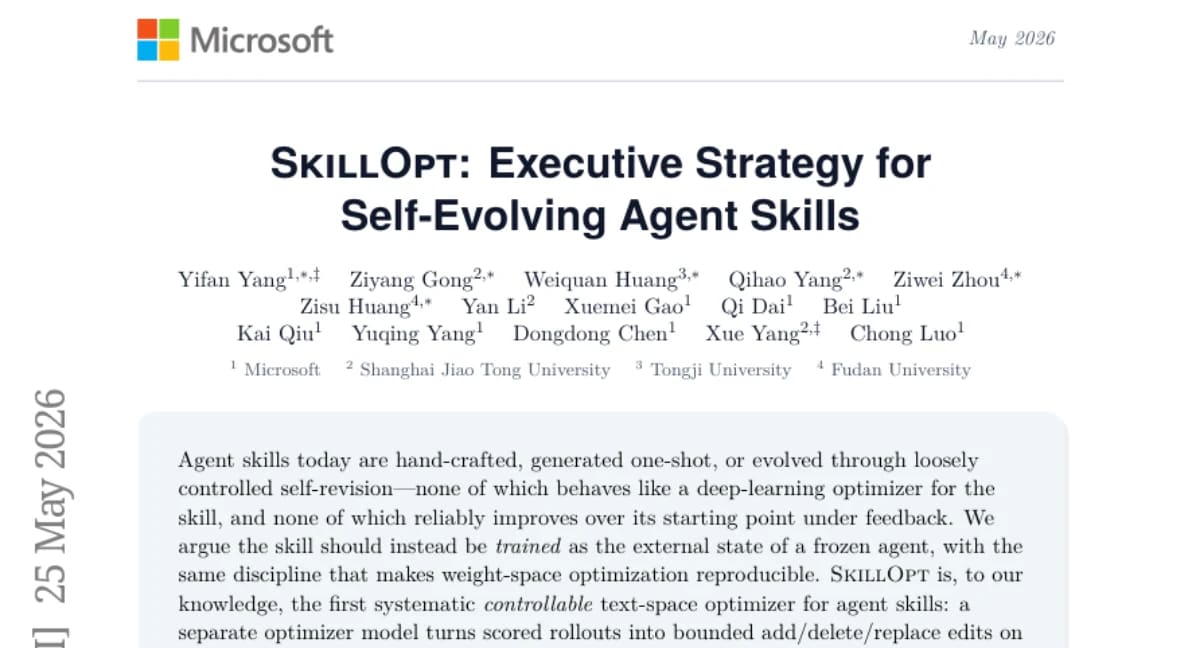
SkillOpt trains agent skills as editable artifacts, not model weights


SkillOpt is a Microsoft Research project and arXiv paper that treats natural-language agent skills as trainable external state, using scored rollouts, bounded edits, and held-out validation instead of model fine-tuning.
SkillOpt is a Microsoft Research project that trains natural-language agent skill files instead of changing model weights. The arXiv paper says a separate optimizer model turns scored rollouts into bounded edits, accepts only improvements on held-out validation, and deploys the final skill without extra inference-time model calls. For agent builders, the useful idea is simple: make the reusable procedure measurable, editable, and test-gated.
Key takeaways
- SkillOpt treats a compact skill document as the trainable state of a frozen language agent.
- The loop uses rollout evidence, reflection, bounded add/delete/replace edits, and held-out validation gates.
- The arXiv abstract reports evaluation across six benchmarks, seven target models, and three execution harnesses: direct chat, Codex, and Claude Code.
- The project page says the exported artifact is a compact
best_skill.mdthat can transfer across models, harnesses, and nearby tasks. - The limitation is practical: the method depends on scored tasks, validation sets, and enough rollout evidence to avoid overfitting a skill to one narrow path.
Practical LinkLoot angle
Most agent-skill workflows are still manual: write a SKILL.md, test it a few times, patch the wording, and hope it generalizes. SkillOpt points to a stricter workflow where skill edits are proposed from task traces and accepted only when validation improves. That makes agent skills feel less like hidden prompt craft and more like versioned operational procedures.
| Approach | Best use | Limitation | Source |
|---|---|---|---|
| Hand-written skill | Fast setup for known workflows | Hard to know whether wording changes improve reliability | LinkLoot editorial comparison |
| One-shot generated skill | Bootstrapping a new agent capability | Can encode brittle assumptions from one example | arXiv paper |
| SkillOpt loop | Reusable skills for tasks with scoring and validation | Needs rollout infrastructure, evaluators, and held-out tasks | SkillOpt project page, arXiv |
| Fine-tuning | Broad behavioral adaptation inside a model | More expensive to run, harder to inspect, and not always needed for procedure changes | arXiv paper |
The strongest near-term use case is internal agent operations: browser workflows, spreadsheet tasks, coding-agent checklists, data-cleaning routines, or support triage where success can be scored. The method is less convincing for vague strategy work unless the team can define a verifier that catches failure.
What to verify before you act
Check whether your agent task has a stable score before borrowing this pattern. A skill optimizer is only as useful as the feedback signal it trains against. Keep rejected edits and validation results visible, because a self-editing skill system without audit history can hide regressions behind better-looking prose.
Source check
The SkillOpt project page confirms the method framing: skills are external state, edits are bounded, and held-out validation gates candidate updates. The arXiv abstract provides the paper metadata, May 2026 revision date, authorship, benchmark scope, and headline reported gains. Hugging Face Papers corroborates the research trend signal by surfacing SkillOpt as a trending agent-skills paper with a linked GitHub repository and arXiv page.
For adjacent hands-on context, see LinkLoot's AI agent tools guide and AI workflow automation guide.
SkillOpt is a text-space optimizer for agent skills that edits a natural-language skill file based on scored rollouts and validation.
Try the related loot
Scrape Changing Websites with Anansi Self-Healing Selectors and MCP