Google Agents CLI v0.1.3 is a practical early signal for enterprise agent tooling on Google Cloud


Google’s Agents CLI is still early, but the v0.1.3 release shows a clearer pattern for how cloud agent tooling is maturing: safer infra defaults, cleaner local testing, and a tighter path from coding assistant to deployable agent workflow.
Google released Agents CLI v0.1.3 on May 6, 2026 as an update to its open-source tool for creating, evaluating, and deploying AI agents on Google Cloud. The release notes focus on safer infrastructure defaults, better local playground behavior, improved auth visibility, and a clearer background-server workflow. Combined with the repository’s roughly 2.3k GitHub stars one month after launch, this looks less like a cosmetic patch and more like an early maturity checkpoint for agent-dev tooling.
Key takeaways
- The v0.1.3 release changes
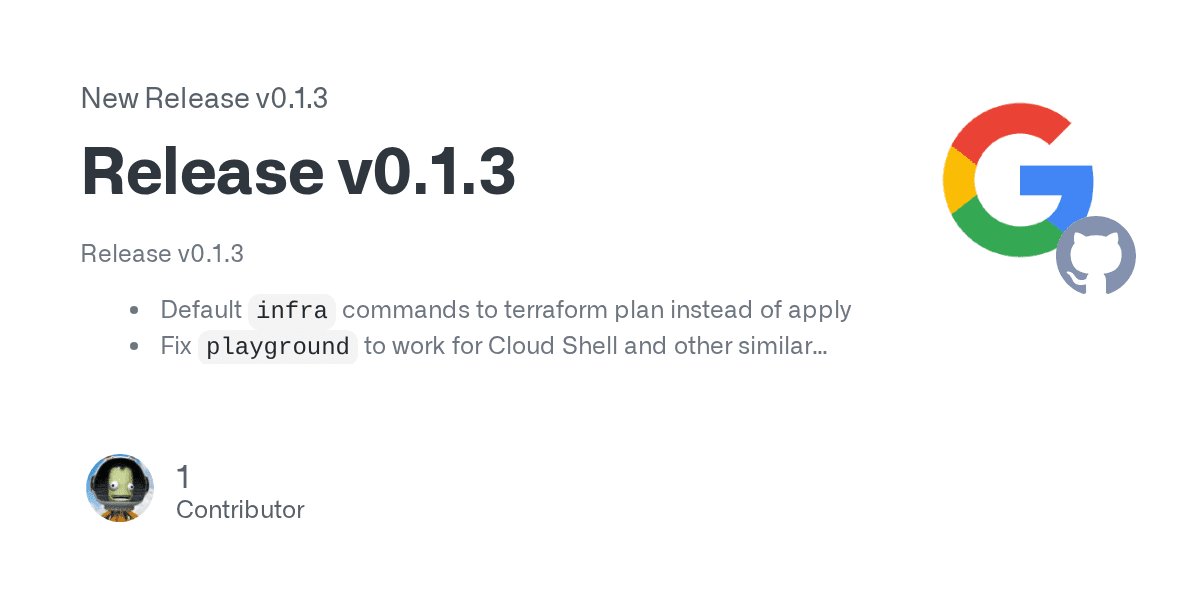
infracommands to default to Terraform plan instead of apply, which reduces the chance of accidental infra changes during evaluation. - Google also fixed
playgroundbehavior for Cloud Shell-like environments and made the underlying command flow more transparent. - The release improves operational clarity with better ADC auth display text, OS info in
agents-cli info, and clearer runtime target descriptions. - The repository describes the tool as a CLI plus skills layer that helps coding assistants create, evaluate, and deploy AI agents on Google Cloud.
- A Hacker News submission for the repo exists, but the stronger momentum signal right now is GitHub activity and the pace of updates, not HN score.
| What changed in v0.1.3 | Why it matters in practice |
|---|---|
infra defaults to Terraform plan | Safer for teams testing infra automation before letting tools apply changes |
playground fixes for Cloud Shell-like environments | Lowers friction for first-run demos and cloud-based experiments |
run only starts a background server when explicitly requested | Makes local behavior easier to reason about and debug |
| Better auth and OS diagnostics | Shortens setup and bug-reporting cycles for teams rolling this out internally |
Why it matters
A lot of agent tooling still looks impressive in demos but feels brittle once it touches deployment, credentials, and infrastructure. This release matters because the change log is full of operational details that working teams actually care about: safer defaults, clearer runtime behavior, and better debugging signals.
That is also the right lens for evaluating the project. Google is not just shipping another prompt wrapper here. It is building a CLI that tries to turn a coding assistant into a repeatable agent-delivery workflow. If that stack keeps improving, the useful question becomes less "which model is smartest?" and more "which tooling lets a team ship agents without creating infra or governance chaos?"
What to verify before you act
Check whether your team actually wants Google Cloud as the deployment center of gravity before you standardize on the CLI. You should also verify how the generated infra maps to your review rules, whether the current skill set covers your real use case, and how much manual policy work is still needed around secrets, runtime permissions, and deployment approvals. The release is promising, but it is still an early tool, so workflow fit matters more than launch excitement.
Practical LinkLoot angle
If you compare agent stacks, this release is a good reminder to grade tooling on operator ergonomics, not just agent demos. A practical shortlist for buyers and builders is:
- does the tool expose safe preview steps before applying changes?
- does it behave predictably in local and cloud-shell environments?
- does it make auth and runtime state obvious enough for debugging?
- can you hand the workflow to another operator without tribal knowledge?
That checklist is often more useful than benchmark charts when you are deciding whether a new agent tool belongs in a real delivery workflow.
The biggest operational change is that infra commands now default to Terraform plan instead of apply.
If you are mapping where agent tooling fits in a real stack, LinkLoot’s /guides/ai-agent-tools is the right follow-up lens.
The bigger story is not that Google shipped a small release. It is that the release priorities reveal what the next phase of agent tooling will probably reward: safer defaults, clearer execution paths, and fewer invisible surprises.
Try the related loot
Give OpenClaw Agents Pre-Verified Web Actions with Actionbook