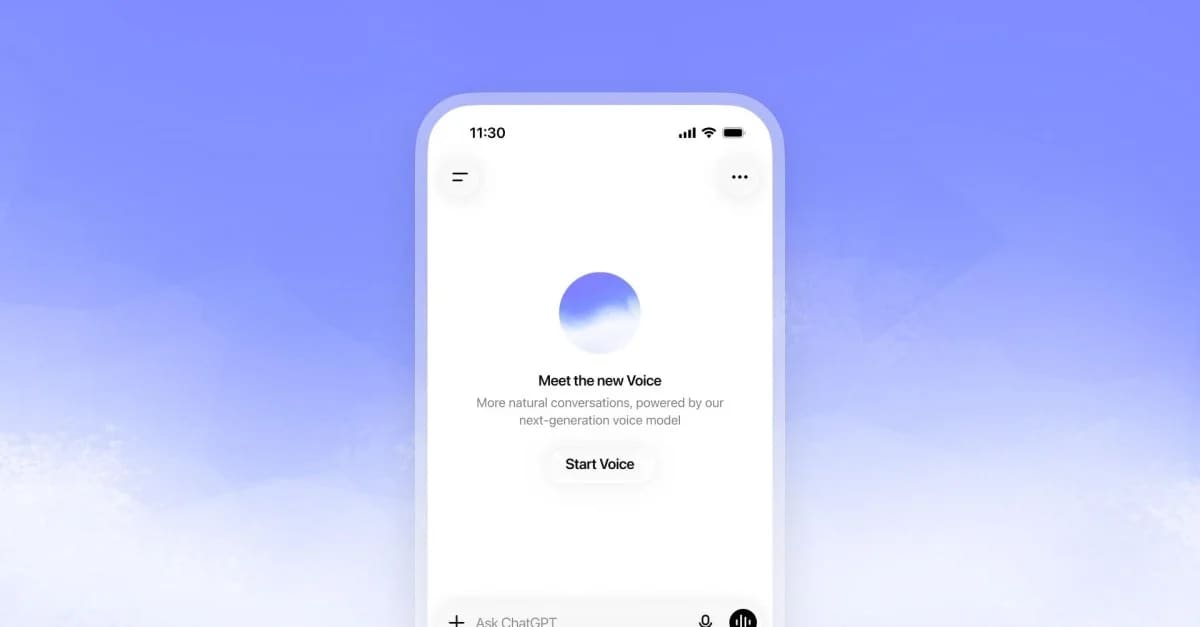
GPT-Live Rollout: Schedule, Availability and Access


GPT-Live availability for ChatGPT Voice and the OpenAI API: paid vs Free models, supported surfaces, SynthID update and current access checks.
Current GPT-Live availability update
Verified September 1, 2026: GPT-Live-1 remains the paid-consumer ChatGPT Voice rollout, while GPT-Live-1 mini serves Free users in supported regions. OpenAI's July 31 update now refers to supported audio generated with GPT-Live through both ChatGPT Voice and the OpenAI API, and says that audio includes SynthID watermarking. That supersedes this article's launch-day statement that API access was only planned.
For implementation decisions, check the current OpenAI model catalog and official GPT-Live announcement because ChatGPT-facing product names and developer-facing Realtime model IDs may differ.
OpenAI says GPT-Live-1 is for Go, Plus, and Pro consumer users, while GPT-Live-1 mini is for Free users in supported regions. Business, Enterprise, and Edu were excluded at launch.
OpenAI launched GPT-Live on July 8, 2026, and is rolling it out globally in ChatGPT Voice. GPT-Live-1 is intended for Go, Plus, and Pro users, while GPT-Live-1 mini is rolling out to Free users across iOS, Android, and ChatGPT.com. The rollout is gradual, so availability can differ by account; OpenAI later referenced GPT-Live audio generated through the OpenAI API in its July 31 provenance update.
GPT-Live rollout status and schedule
OpenAI introduced GPT-Live-1 and GPT-Live-1 mini as the new model family behind ChatGPT Voice. GPT-Live uses a full-duplex architecture, so it can process incoming audio while generating speech instead of waiting for a clean turn boundary.
OpenAI says GPT-Live-1 will become the default ChatGPT Voice model for Go, Plus, and Pro users. GPT-Live-1 mini will become the default for Free users. The rollout covers iOS, Android, and ChatGPT.com, and OpenAI later referenced GPT-Live audio generated through its API in a July 31 update.
| Model | Best fit | Access | Cost/status | Caveat |
|---|---|---|---|---|
| GPT-Live-1 | Paid ChatGPT Voice conversations | Go, Plus, Pro rollout | Included with eligible ChatGPT plans | Check the current API model catalog |
| GPT-Live-1 mini | Lighter everyday voice use | Free user rollout | Included with Free access | Capability is lower than GPT-Live-1 |
| GPT-Live-1 Medium/High | Voice with deeper reasoning | OpenAI describes these variants in evaluations | Not separately priced in the announcement | Availability details are not fully public |
Why this is early
The primary confirmation is OpenAI's own announcement and livestream listing from July 8, 2026. The Verge separately reported the rollout the same day and described the user-facing shift: better interruption handling, more natural listening, and a lighter mini version for free users.
This is not a rumor. What remains early is access consistency. Some users may see the new Voice experience before others because OpenAI describes the launch as a rollout, not an instant switch for every account and region.
Key takeaways
- GPT-Live brings full-duplex voice to ChatGPT, which should reduce awkward pauses and premature interruptions.
- Harder requests can be delegated to GPT-5.5 behind the scenes while the voice session keeps moving.
- Paid ChatGPT users get GPT-Live-1 as the default Voice model; Free users get GPT-Live-1 mini.
- OpenAI later confirmed GPT-Live audio generation through its API in a July 31 provenance update; developers should verify the current model ID, price, and region in the model catalog.
- Video and screen sharing are not supported at launch in the new GPT-Live Voice experience.
GPT-Live availability and access
OpenAI says the rollout starts globally today across iOS, Android, and ChatGPT.com. Paid ChatGPT plans get the stronger default model, while free accounts get the mini variant. The announcement does not give a region-by-region activation schedule, so account-level availability may lag.
OpenAI now references GPT-Live audio generated through its API. Production teams should still compare the current Realtime model catalog, pricing, data controls, and regional availability before migrating a voice agent.
Practical LinkLoot angle
Voice workflows should now be worth retesting. If you use ChatGPT for language practice, field research, hands-free note expansion, customer-call rehearsal, or quick spoken analysis, check whether the new model handles interruptions and pauses better than Advanced Voice Mode.
For automation builders, the bigger signal is architectural. OpenAI is separating live conversation handling from deeper reasoning work. That pattern may matter for future agent interfaces where the voice layer keeps the user engaged while a stronger model searches, reasons, or executes tools.
For more workflow ideas, see LinkLoot's guide to /guides/ai-workflow-automation.
What to verify before you act
- Check whether your ChatGPT account has the GPT-Live Voice experience on web and mobile.
- Test the languages you actually use; OpenAI says some languages may still have accent or fluency gaps.
- Confirm whether your plan receives GPT-Live-1 or GPT-Live-1 mini.
- Wait for an API changelog before changing production voice-agent architecture.
- Read the GPT-Live system card if your use case touches teens, mental health, safety-sensitive support, or regulated workflows.
Source check
Confirmed by:
- OpenAI's July 8, 2026 GPT-Live announcement.
- OpenAI's livestream listing for the next generation of ChatGPT Voice.
Independent context:
- The Verge's July 8, 2026 coverage confirms the upgraded ChatGPT Voice rollout and describes the practical user-facing behavior.
GPT-Live is OpenAI's new full-duplex voice model family for ChatGPT Voice. It can listen and speak at the same time and can delegate harder work to a frontier model.
Try the related loot
Scrape Changing Websites with Anansi Self-Healing Selectors and MCP