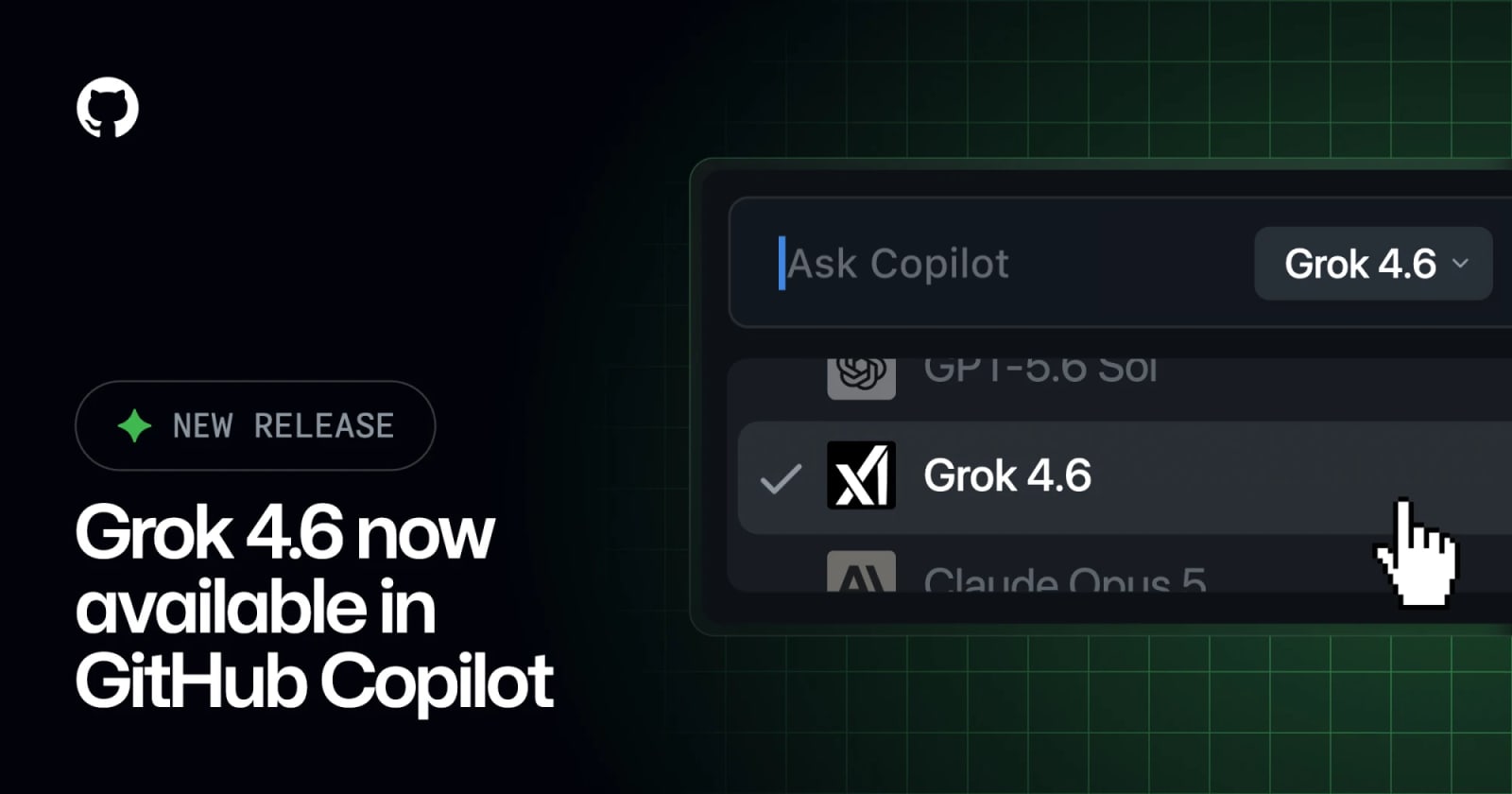
Grok 4.6 rolls into GitHub Copilot for longer coding tasks


GitHub is gradually rolling xAI's Grok 4.6 into Copilot across paid individual and organizational plans, with usage-based billing and an admin policy that starts disabled for Business and Enterprise.
GitHub is gradually rolling xAI's Grok 4.6 into GitHub Copilot for agentic coding and complex multi-step workflows. The model will be offered on Copilot Pro, Pro+, Max, Business, and Enterprise, with requests billed at provider list pricing under Copilot's usage-based billing.
For Business and Enterprise, the rollout has an administrative gate: the Grok 4.6 policy is off by default and an organization administrator must enable it in Copilot settings. Individual subscribers can select the model from the model picker once it reaches their account. GitHub says availability will expand gradually, so an absent model entry currently indicates rollout timing rather than a missing subscription.
What Grok 4.6 adds to the Copilot model mix
GitHub describes Grok 4.6 as xAI's latest reasoning model, aimed at terminal-based coding in Visual Studio Code and Copilot CLI. Its stated fit is longer-horizon work that requires sustained reasoning, repeated tool use, and several repair or verification steps rather than a single code completion.
That positioning is consistent with xAI's separate developer release notes, which list Grok 4.6 as an API model with a 500,000-token context window, text and image input, text-only output, and configurable reasoning effort from low through xhigh. xAI lists different input and output rates above and below 200,000 prompt tokens, so the same model name does not imply a single flat cost across workloads.
Plans, billing, and the rollout caveat
The Copilot announcement does not promise instant access or a Copilot-included price. It says the model is billed at provider list pricing through usage-based billing. Teams should therefore check the current Copilot model-pricing page, their organization policy, and any request or premium-request budget before moving a long-running agent onto Grok 4.6.
The administrator switch matters operationally. Enabling a model across an organization can change which agents employees use and how premium usage is consumed, while gradual rollout makes early comparisons uneven. Record the exact model, repository, tool permissions, reasoning setting, token usage, and test result when evaluating it.
A practical evaluation for coding teams
Start with a bounded set of repository tasks: multi-file changes, failing-test repair, shell-driven debugging, and a change that requires the agent to recover from an incorrect first attempt. Compare completion rate, test-passing rate, tool-call count, latency, and usage cost against the model your team uses today.
Keep approval boundaries in place for commands that alter infrastructure, dependencies, credentials, or production data. Stronger reasoning can help an agent persist through a difficult task, but it does not remove the need for repository tests, review, and least-privilege tool access.
The immediate next step is simple: Business and Enterprise administrators should decide whether to enable the policy, then verify the model's actual availability and billing behavior in a non-production project. GitHub's gradual rollout means the model picker is the authoritative signal for each account.
Sources and evidence
Try the related loot
Run your Serum 2 presets in a free open-source wavetable synth