
Inception’s Mercury 2.5 brings diffusion LLMs to 1,100 tokens/s


Inception’s Mercury 2.5 preview uses diffusion-based generation, offers a 260K context window and tool calling, and is listed on OpenRouter at $0.20 per million input tokens and $0.75 per million output tokens.
Inception’s Mercury 2.5 is now listed as a preview model for developers who need fast reasoning, tool use, and long-context workflows. The model uses a diffusion-based generation approach rather than producing tokens strictly one at a time. OpenRouter lists a 260,000-token context window, $0.20 per million input tokens, and $0.75 per million output tokens.
What Inception is releasing
Inception describes Mercury 2.5 as its most capable reasoning diffusion LLM. The company says the model can exceed 1,000 tokens per second on commercial NVIDIA GPUs and positions it for coding, search, voice agents, and other workloads where generation latency compounds across many calls.
The model page labels Mercury 2.5 as a preview. That matters for production planning: the architecture and interface are available to try, but the preview status leaves room for changes to behavior, pricing, limits, or model lifecycle.
Why diffusion generation matters for agents
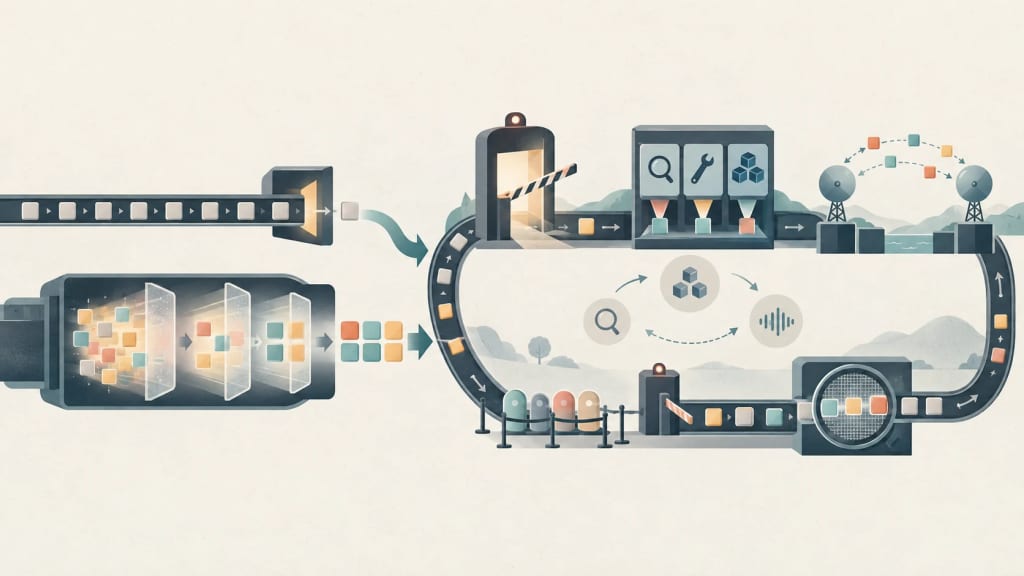
Most production language models generate text autoregressively, one token after another. Inception’s diffusion approach generates and refines multiple tokens in parallel. If the claimed throughput holds for a specific workload and provider, it could reduce the waiting time inside search loops, coding subagents, and voice interactions.
That advantage is workload-dependent. End-to-end latency still includes time to first token, tool execution, network round trips, provider queueing, and any reasoning or verification steps. A fast token stream does not automatically make a complete agent run fast.
Mercury 2.5 access, pricing, and capabilities
OpenRouter’s independent model listing records these practical details:
- 260K-token context window and up to 65,536 completion tokens
- tunable reasoning levels
- tool calling and parallel tool calls
- structured outputs through JSON schema
- $0.20 per million input tokens, $0.75 per million output tokens, and $0.02 per million cache-read tokens
- one upstream provider currently listed on OpenRouter
Inception also presents its API as OpenAI-compatible and says new API keys receive 10 million free tokens. Check the provider’s current terms before building around that allowance; free-token offers can have account, region, or expiry conditions that the model page does not spell out in full.
What developers should measure first
Mercury 2.5 is most interesting where latency is part of the product experience, rather than where a single large completion dominates the budget. Test it against the model you already use with the same prompts, tool schemas, concurrency, context sizes, and retry policy.
Track time to first token, completed-task latency, output quality, structured-output validity, tool-call accuracy, and cost per successful task. Keep a fallback route because preview models can change and OpenRouter currently reports only one provider for this model.
The evidence supports a notable preview release and a clear API experiment. It does not yet establish that Mercury 2.5 matches frontier models across broad benchmarks or that the headline throughput will appear in every application. Those questions belong in controlled workload tests as the model gains more usage data.
Sources and methodology
The primary source is Inception’s Mercury model page. OpenRouter’s Mercury 2.5 listing independently confirms the public model entry, pricing, context size, supported features, and September 8, 2026 release date. Vendor throughput and quality comparisons are reported claims and remain subject to independent evaluation.
Try the related loot
Self-host your music library with a lightweight Subsonic server