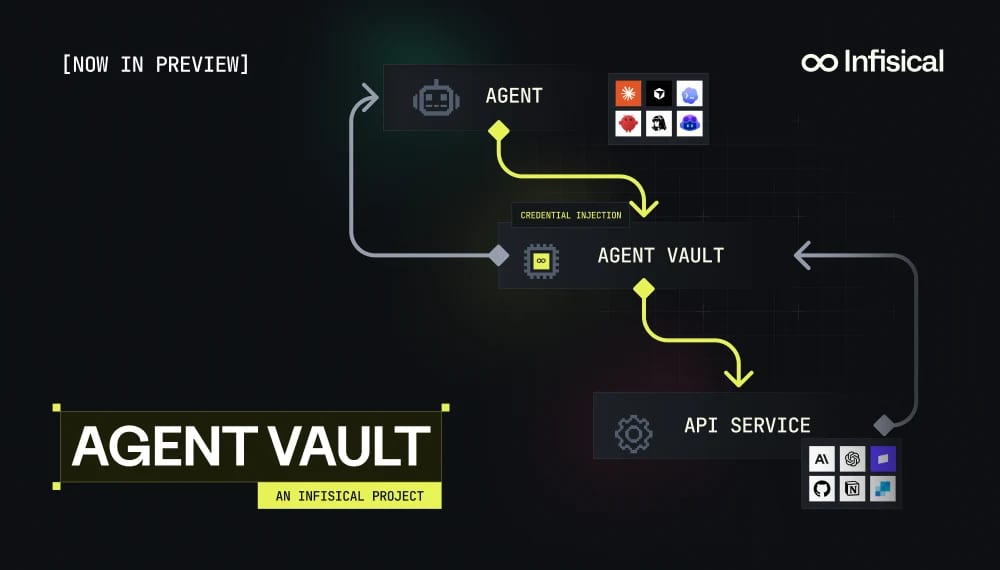
Infisical Agent Vault brings credential brokering to AI agent workflows


Infisical's open-source Agent Vault gives AI agents brokered API access through a proxy so they can call services without holding the underlying secrets directly.
Infisical Agent Vault is an open-source credential proxy and vault designed for AI agents. Instead of placing real API keys inside an agent environment, teams route outbound requests through Agent Vault, which can attach the required credentials at the proxy layer. The GitHub repository corroborates the proxy/vault design, while the Hacker News launch thread confirms the public launch and community discussion around the credential-brokering approach.
Key takeaways
- Agent Vault targets a specific agent security problem: agents may need API access, but direct secret exposure creates credential exfiltration risk.
- The project uses an HTTP/HTTPS proxy pattern so agents can call existing APIs, CLIs, SDKs, and MCP-style tools without directly seeing real credentials.
- Infisical frames it as research-preview infrastructure rather than a finished universal security layer.
- The GitHub repository documents features including credential brokering, transparent integration, egress filtering, and request logging.
- For teams running coding agents or custom agent sandboxes, the practical test is whether a proxy boundary is easier to govern than handing agents short-lived secrets.
Practical LinkLoot angle
Agent security usually fails at the boring boundary: where a tool call becomes a real API request. Agent Vault is useful because it moves the secret out of the agent process and into a brokered layer that can be logged, filtered, and scoped. That gives teams a concrete architecture to compare against environment variables, temporary tokens, cloud-specific credential injectors, or custom egress proxies.
| Approach | Best fit | Main advantage | Caveat |
|---|---|---|---|
| Environment variables | Simple local prototypes | Fast setup and broad compatibility | The agent can potentially read or leak the secret |
| Short-lived tokens | APIs with OAuth or token minting | Limits damage window | Still exposes a usable credential to the agent |
| Cloud-specific brokering | Platform-native sandboxes | Managed integration and policy hooks | May lock you into one provider's runtime |
| Agent Vault proxy | Portable agent stacks and self-hosted sandboxes | Separates agent behavior from underlying credentials | Requires proxy setup, network controls, and operational review |
A practical rollout path is to start with one non-critical API, give the agent a dummy credential value, force traffic through the proxy, and confirm the upstream call succeeds only through the broker. Then add a deny-by-default rule set, request logging, and alerting before connecting sensitive accounts like GitHub, Stripe, email, or production databases.
What to verify before you act
Do not treat a proxy as a complete safety model by itself. Verify that agents cannot bypass the proxy with direct network egress, that the Agent Vault management interface is private and authenticated, and that logs do not create a new sensitive-data store. If you plan to use TLS interception, review certificate handling and developer-device trust implications carefully. Finally, map each credential to a narrow service rule so a compromised agent cannot turn one granted workflow into broad API access.
Source check
Infisical's launch post confirms the product concept, the credential-brokering motivation, and the research-preview framing. The GitHub repository independently confirms the open-source project, proxy/vault features, installation paths, and supported agent workflow examples. The Hacker News thread adds launch-context corroboration and shows that the project was publicly presented to developer users.
It is an open-source HTTP credential proxy and vault that brokers API credentials for AI agents instead of giving agents the raw secrets.
For teams building agent workflows, connect this pattern with LinkLoot's guide to AI workflow automation: every automated action should have a credential boundary, a logging boundary, and a human approval boundary for risky operations.
Try the related loot
UI-TARS Desktop is a serious local computer-use agent — if you lock down the setup