NVIDIA releases Kumo Relational: a pretrained model that predicts on live databases with no training


NVIDIA Kumo Relational is a pre-trained relational foundation model that makes predictions directly on enterprise databases. Across 41 tasks on 15 benchmarks it beats expert-engineered XGBoost pipelines without task-specific training, scaling to 500B+ rows. Available now via an open-source GPU-native library or as an NVIDIA NIM, with code under Apache 2.0 and weights under OpenMDW 1.1.
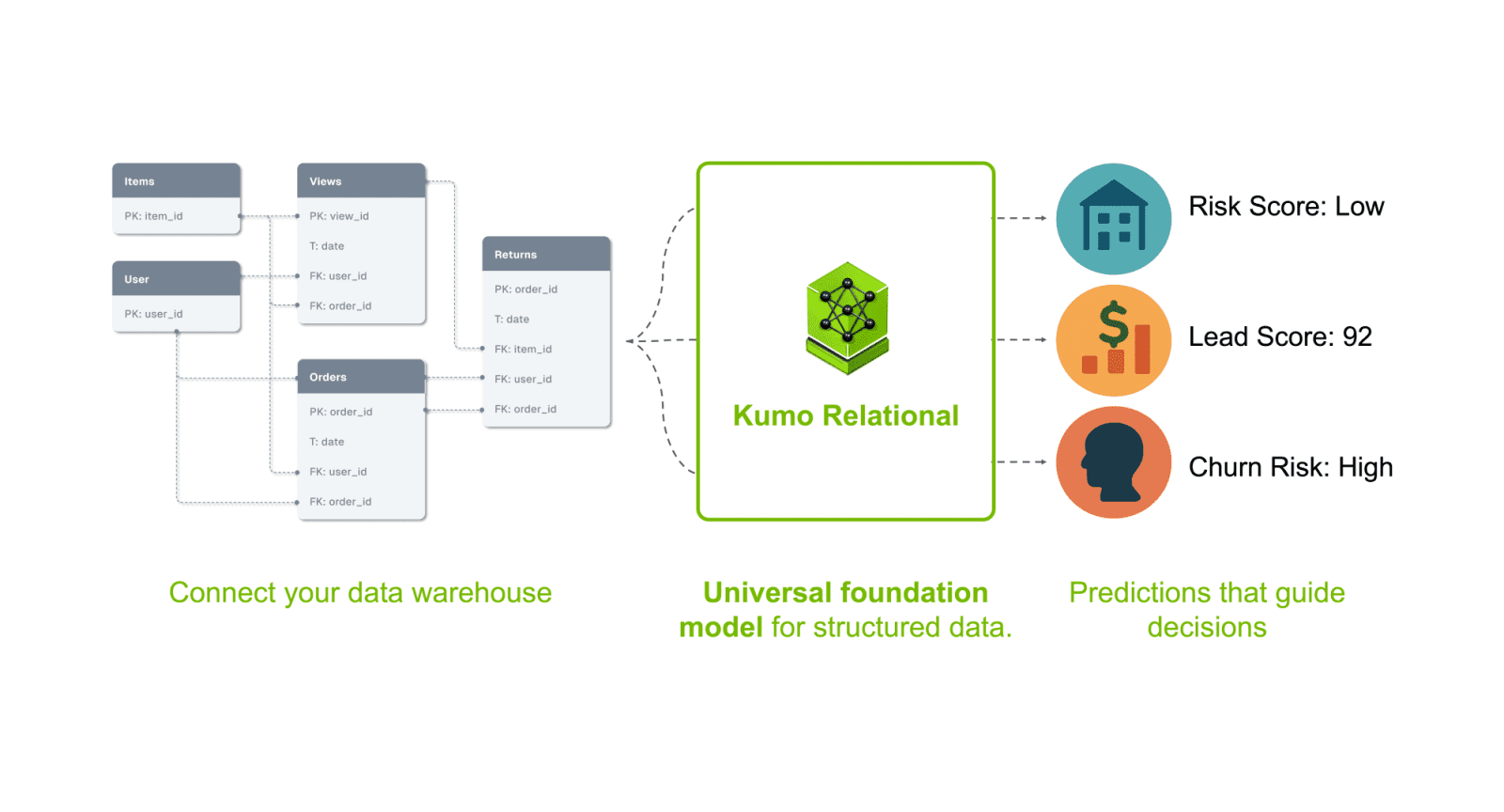
NVIDIA says its new pre-trained Kumo Relational model beats supervised machine learning on relational databases without any task-specific training. The model reads live tables, foreign keys and timestamps directly, pulls up to 10,000 labeled examples as context at inference time, and returns predictions for churn, demand or fraud in one forward pass. No feature engineering, no table flattening, no training run.
The claim is strong on purpose: NVIDIA calls it the first few-shot foundation model to outperform supervised ML on common relational benchmarks. For teams running XGBoost pipelines against enterprise databases, this is the structured-data moment LLMs created for text — one model replacing many bespoke pipelines.
One query, not one pipeline
In the launch post on Hugging Face, NVIDIA evaluated Kumo Relational on 41 tasks across 15 databases from RelBench V1 and V2, SAP SALT, and 4DBInfer. None of those datasets appeared in pre-training. On RelBench V1 classification, the model beats gradient-boosted trees built on expert-engineered features by nearly 4 AUROC points on average. On SAP SALT, it beats XGBoost by 7 MRR points out of the box, and by 13 after fine-tuning.
NVIDIA also claims an 8% mean reciprocal rank lead over large AutoGluon ensembles on SAP SALT, roughly 25% over recent tabular foundation models, and a 16-point lead over AutoGluon once fine-tuned. The associated paper, KumoRFM-2 on arXiv (Hudovernik, López, Kocijan, Nitta, Lenssen, Leskovec, Fey), independently states the model outperforms supervised and foundational approaches by up to 8% and scales to billion-row datasets.
The mechanism is in-context learning over database subgraphs. Tasks are written in Predictive Query Language (PQL): you declare what to predict, and the system samples entity-centered subgraphs up to an anchor timestamp to avoid leaking future data. Column and row attention work inside tables; graph attention and cross-sample attention connect them. Pre-training uses synthetic databases generated with the PluRel approach, staged from single tables to complex relational structures.
Benchmarks with caveats
On the RelArena-α leaderboard — a unified comparison framework from Prior Labs and the academic community, not an NVIDIA project — NVIDIA reports Kumo Relational sits on the accuracy-efficiency Pareto front: about 17 seconds per 1,000 samples at Elo 1,842, versus the highest-scoring entry at Elo 1,878 and roughly 7,300 seconds. Prior Labs' own paper ranks its TabPFN-Rel first on that leaderboard, so Kumo Relational leads on speed-at-accuracy rather than on every aggregate metric.
NVIDIA is also explicit about where the model loses: with very large training sets, task-specific supervised models can still edge out in-context predictions, and predictive signals must be reachable within a limited number of table hops. The robustness results are interesting — it holds up with as little as 0.2% of training data as context and stays stable when 75% of foreign-key links are removed.
Open weights, GPU-native, agents included
The model is available today through two routes. The open-source, GPU-native structured-data-models library on PyPI downloads weights from Hugging Face on first use; the separate structured-data-models-client talks to an NVIDIA NIM deployment, with example notebooks for local runs and Databricks. Code is Apache 2.0; weights ship under the OpenMDW License Agreement 1.1. The blog — and the fact that kumo.ai now redirects into NVIDIA docs — suggests this comes from NVIDIA's Kumo team; Jure Leskovec co-authored both the blog and the paper.
The agentic angle matters for LinkLoot readers: PQL gives AI agents a text interface for predictive questions — which customer churns next month, what demand looks like per SKU — so a foundation model can act on operational databases the way an LLM acts on documents.
Source check
Primary evidence is NVIDIA's official blog post and documentation. The KumoRFM-2 arXiv paper and Prior Labs' RelArena-α paper (arXiv 2608.16319) provide the benchmark framing; PyPI package records confirm the library is published. All performance numbers are vendor-reported. If you plan to replace an XGBoost pipeline, run the quickstart notebook against your own relational data before trusting any leaderboard.
Related: /guides/ai-agent-tools
Try the related loot
Run local AI tools on PhotoCraft layers without leaving the canvas