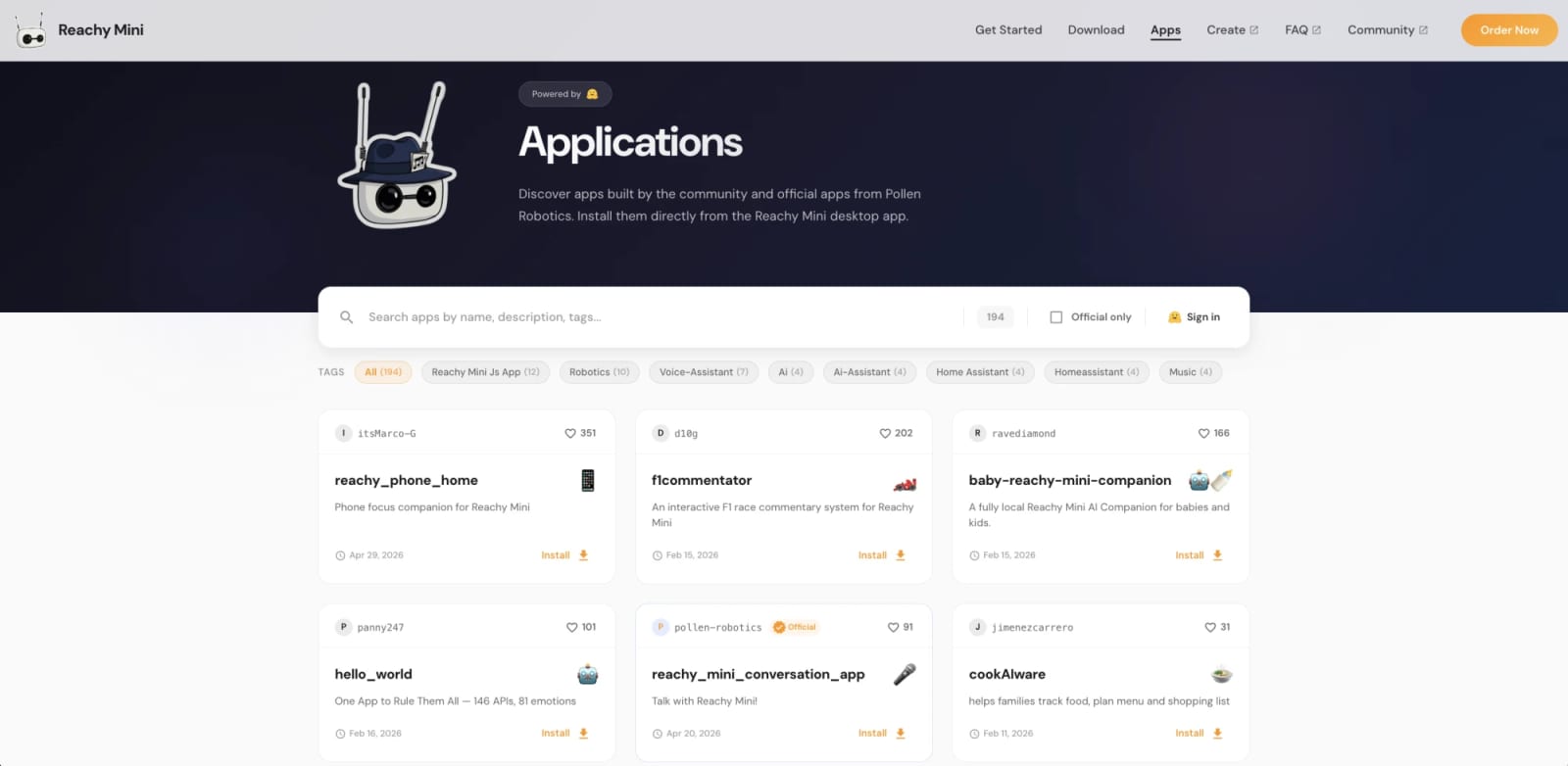
Hugging Face is turning Reachy Mini into an app-store robot platform


Hugging Face says its Reachy Mini ecosystem now includes an agentic app store for nearly 10,000 robots, with 200-plus apps and more than 150 creators already contributing.
Hugging Face has introduced an app-store layer for Reachy Mini and says the ecosystem now spans nearly 10,000 robots, more than 200 apps, and 150-plus creators. The announcement is backed up by the public Reachy Mini repository and official docs, which already describe one-click app installs through Hugging Face Spaces and position the robot as an open, developer-friendly platform. In practical terms, Reachy Mini is shifting from “cute hackable robot” toward a distribution platform for agentic robotics apps.
Key takeaways
- Hugging Face says the Reachy Mini app store is now live for a base of nearly 10,000 units in the wild.
- The launch post claims the ecosystem already includes 200-plus apps from more than 150 creators.
- The public repo and docs both confirm an app-store workflow powered by Hugging Face Spaces.
- Reachy Mini is still framed as open source, which matters for developers who want to build on-device behaviors instead of staying inside a closed robotics stack.
- The real story is distribution: publishing and installing robot apps is becoming simpler than piecing together bespoke demos.
Why it matters
Most hobby and developer robots struggle with the same bottleneck: you can build something once, but sharing, discovering, and reusing it is messy. An app-store model changes that. If the Reachy Mini ecosystem keeps growing, developers get a faster path from prototype to reusable robot behavior, while buyers get more value after the hardware arrives.
This also gives Hugging Face a stronger foothold in physical AI. Instead of only hosting models and Spaces, it is connecting model-centric workflows to an installable robotics surface. For makers, educators, and AI tinkerers, that is a more practical story than generic “robotics meets AI” hype.
| Checkpoint | What the public sources say | Why it matters |
|---|---|---|
| Ecosystem size | The blog says nearly 10,000 Reachy Minis are in the wild | A marketplace matters more when the installed base is real |
| App distribution | Docs and repo both describe app installs via Hugging Face Spaces | Confirms this is more than a one-off announcement |
| Open-source posture | The GitHub repo presents Reachy Mini as open source and actively maintained | Reduces the risk of a fully locked-down platform |
| Builder angle | Official docs highlight AI integrations, publishing apps, and SDK workflows | Useful for developers, not only end users |
What to verify before you act
If you are evaluating Reachy Mini as a platform, verify how many of the published apps are truly maintained, what hardware variant each app supports, and how much setup still happens outside the “one-click” promise. The biggest practical check is not whether the store exists, but whether the best apps are reliable enough for demos, classrooms, or repeatable experiments.
You should also confirm the boundary between cloud-hosted logic and local robot behavior. If your use case needs low latency, offline tolerance, or strict privacy, the app-store convenience may still need a more careful architecture than the headline suggests.
Hugging Face is pitching it less as a single robot SDK and more as a platform with an app-store distribution layer.
If you follow tools that connect agents, apps, and real-world workflows, LinkLoot’s /guides/ai-agent-tools is the most relevant next read.
The useful takeaway is not just that Reachy Mini has more apps. It is that Hugging Face appears to be building distribution infrastructure for open robotics, and that could matter more than any single demo app.
Try the related loot
This JS Agent Turns Any Website Into an AI Copilot