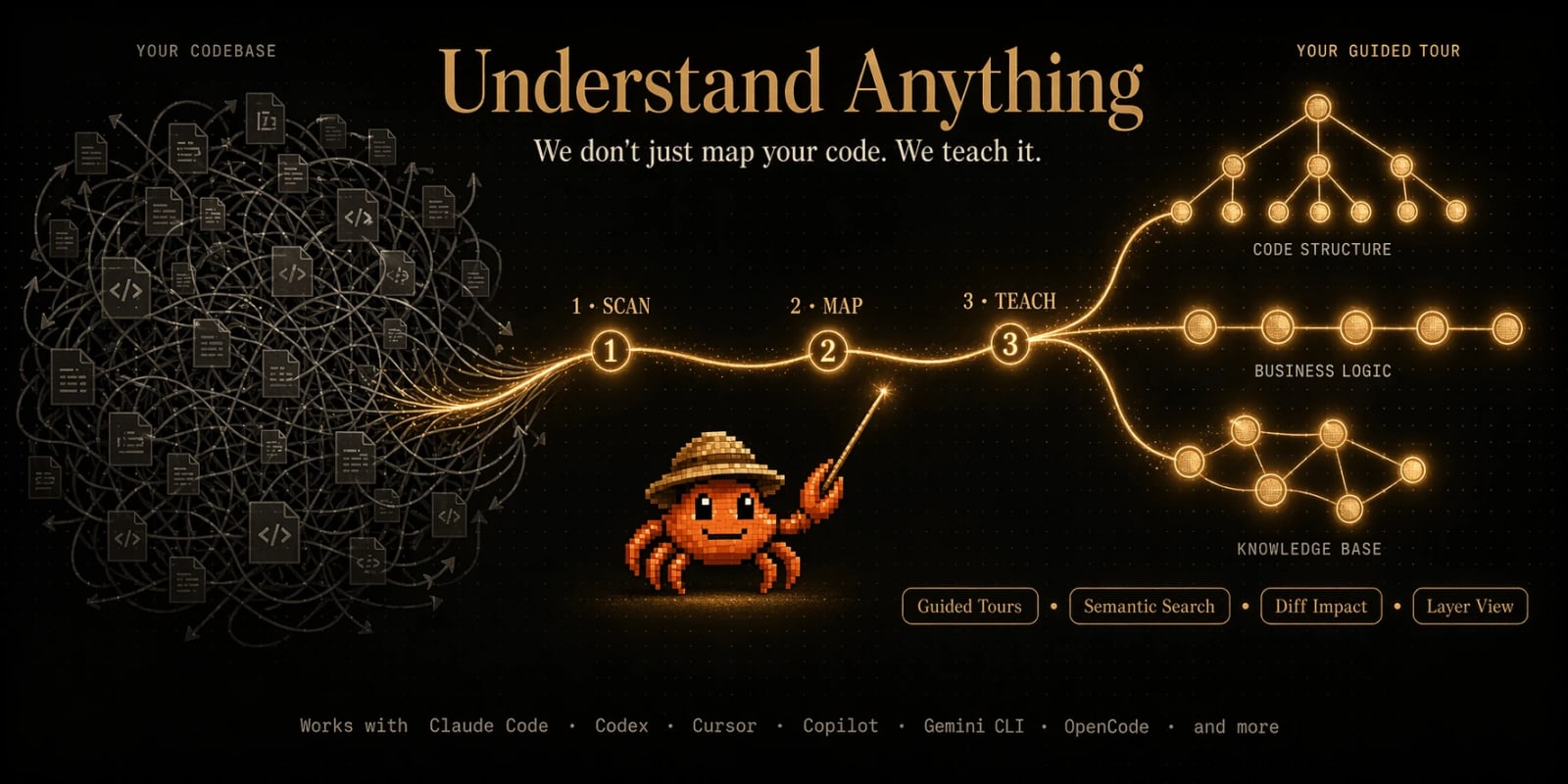
Understand Anything turns codebases into AI-readable knowledge graphs


Understand Anything is an open-source codebase-mapping plugin that converts repositories into interactive knowledge graphs for Claude Code, Codex, Cursor, Copilot, Gemini CLI, OpenClaw, and other agentic coding tools.
What is Understand Anything?
Understand Anything is an open-source developer tool that scans a codebase and produces an interactive knowledge graph for humans and AI coding agents. Its official repository describes a multi-agent pipeline that extracts files, functions, classes, imports, dependency edges, architectural layers, summaries, and guided tours. The practical promise is not just visualizing code, but giving Claude Code, Codex, Cursor, Copilot, Gemini CLI, OpenClaw, and similar tools a structured map of where logic lives and how changes may ripple through a project.
Key takeaways
- The project converts repositories, docs, and knowledge bases into explorable graphs with searchable nodes, summaries, relationships, and guided walkthroughs.
- Its official README says the structural side uses deterministic parsing while LLM agents add semantic summaries, domain mapping, and onboarding tours.
- The tool supports multiple coding-agent environments, including Claude Code, Codex, Cursor, Copilot, Gemini CLI, OpenCode, OpenClaw, and others.
- GitHub Trending surfaced the repository with unusually high daily momentum, making it worth checking for agent-assisted onboarding and review workflows.
- Treat it as a context-building layer, not a correctness guarantee: teams still need to review generated summaries, ignore untrusted install prompts, and verify dependency impact before relying on the graph.
Practical LinkLoot angle
For agent-heavy coding workflows, the useful angle is context compression. Instead of asking an agent to repeatedly grep through a large repository, a team can generate a portable .understand-anything/knowledge-graph.json, use the dashboard for onboarding, and then ask targeted questions about authentication, payments, infrastructure, or other domain flows.
| Option | Best use | Limitation | Source |
|---|---|---|---|
| Understand Anything | Building an explorable repository graph for humans and coding agents | Generated explanations still need review against source code | Official GitHub repository |
| Manual README/wiki docs | Stable onboarding notes for known architecture | Often stale and rarely maps every dependency edge | Team-maintained docs |
| Plain agent search/grep | Fast one-off code lookup | Expensive context use and weak project-wide structure | Local tooling |
| Static dependency graph tools | Deterministic structure-only maps | Usually miss business-domain meaning and plain-English tours | Build/dev tooling |
A good first workflow is to run it on a non-sensitive sample repository, inspect whether the graph correctly identifies core modules, and only then decide whether it belongs in a private monorepo workflow. If the graph is useful, commit only the intended generated graph artifacts and exclude intermediate scratch files, exactly as the project’s own documentation suggests.
What to verify before you act
First, verify the repository license, recent commits, and dependency tree before installing anything into a real developer machine or CI environment. Second, compare a few generated node summaries against the actual source files; if summaries miss critical security, payment, or data-retention logic, keep the graph as an onboarding aid rather than a review source of truth. Third, confirm which agent platform you use and follow only the platform’s official, reviewed installation path instead of copying commands from third-party articles.
Source check
The official GitHub repository confirms the core claim: Understand Anything builds a knowledge graph from code, supports an interactive dashboard, and targets multiple agentic coding platforms. The official site confirms the positioning around code understanding, business-domain views, search, guided tours, and quick-start usage. The independent PyShine overview corroborates the high-level architecture and describes the hybrid Tree-sitter plus LLM approach, while GitHub Trending provided the momentum signal for why the project appeared in today’s quick scan.
It turns a codebase or knowledge base into an interactive knowledge graph with nodes, relationships, summaries, search, and guided tours.
For more agent-tool discovery and workflow ideas, see LinkLoot’s guide to AI agent tools.
Try the related loot
UI-TARS Desktop is a serious local computer-use agent — if you lock down the setup