Vercel Sandbox reaches four regions for lower-latency agent workloads


Vercel Sandbox is now available in four regions, adding Paris alongside three U.S. locations and introducing project-level failover settings for teams running isolated code or agent workloads.
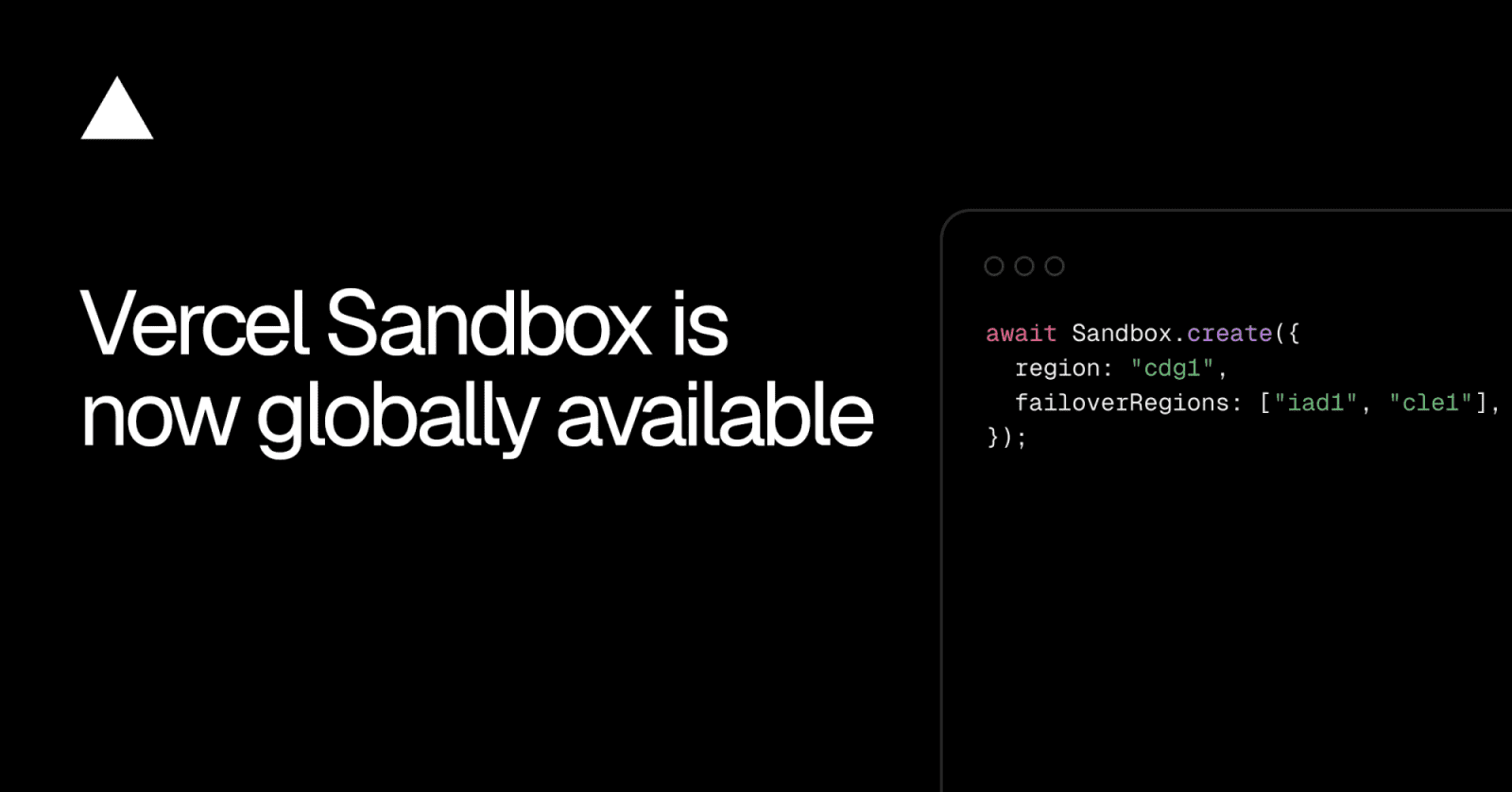
Vercel Sandbox is no longer confined to one default location. Vercel now provisions sandboxes in Washington, D.C. (iad1), San Francisco (sfo1), Cleveland (cle1), and Paris (cdg1), giving teams a European execution option for isolated code, previews, and agent workloads.
The rollout also adds region selection per sandbox, a project-level default, and failover regions for Pro and Enterprise teams. That turns placement into an operational setting rather than an infrastructure detail developers have to work around.
Four Vercel Sandbox regions change the latency trade-off
The Paris region is the most consequential addition for European teams. A sandbox can now run closer to European databases, APIs, and users, reducing round trips for workflows where an agent repeatedly executes commands, reads files, or calls application tools. The U.S. regions remain available for workloads already centered there.
Vercel describes the launch as a starting point rather than a complete global footprint. The initial list is limited to four regions, and the platform says more Vercel regions are planned. Teams with strict data-location requirements should therefore treat region selection as a deployment constraint, not assume that every Vercel location is available for Sandbox.
Failover is useful, with a snapshot constraint
Pro and Enterprise teams can configure failover regions so new sandboxes can start elsewhere when the preferred region is unavailable. This matters for long-running agent workflows and CI-like jobs that should not stop because one regional control plane or capacity pool is degraded.
Snapshots remain tied to the region where they were created. During failover, Vercel can load a snapshot across regions, but teams should test recovery behavior with their own files, startup scripts, and external services. Region failover improves availability; it does not remove the need to validate data locality and recovery assumptions.
What developers need to change
The update is relevant to applications that use Sandbox through the SDK, CLI, or Vercel project settings. Existing sandboxes do not automatically become geographically optimal: teams need to choose a region or set a project default, then review database and service placement around it.
For coding agents, the practical decision is straightforward: place the sandbox near the systems it calls most often, keep a compatible failover region configured where the plan allows it, and verify that snapshots and secrets behave as expected after a regional move. Vercel’s open-source Sandbox repository documents the underlying ephemeral Linux VM model; it is useful context for teams evaluating isolation boundaries, but it is not a substitute for reviewing their production threat model.
If this fits a broader agent workflow, LinkLoot’s AI agent tools guide provides a useful checklist for comparing execution environments, tool access, and operational controls.
Sources and scope
Vercel’s changelog is the primary source for the regional rollout and its configuration details. Daily.dev independently summarizes the same four-region availability and the snapshot limitation. This report covers availability and configuration; it does not claim that every Vercel plan has identical failover controls or that additional regions are already live.
Try the related loot
Catch AI-generated code that looks correct but breaks its contract