Try GLM-5.2 on a real long-context coding task
A practical starter kit for evaluating Z.ai GLM-5.2 with a repository audit, a bounded refactor, and a security-review sanity check before trusting it in production.
Put this loot to use
3 min readTry GLM-5.2 on a real long-context coding task
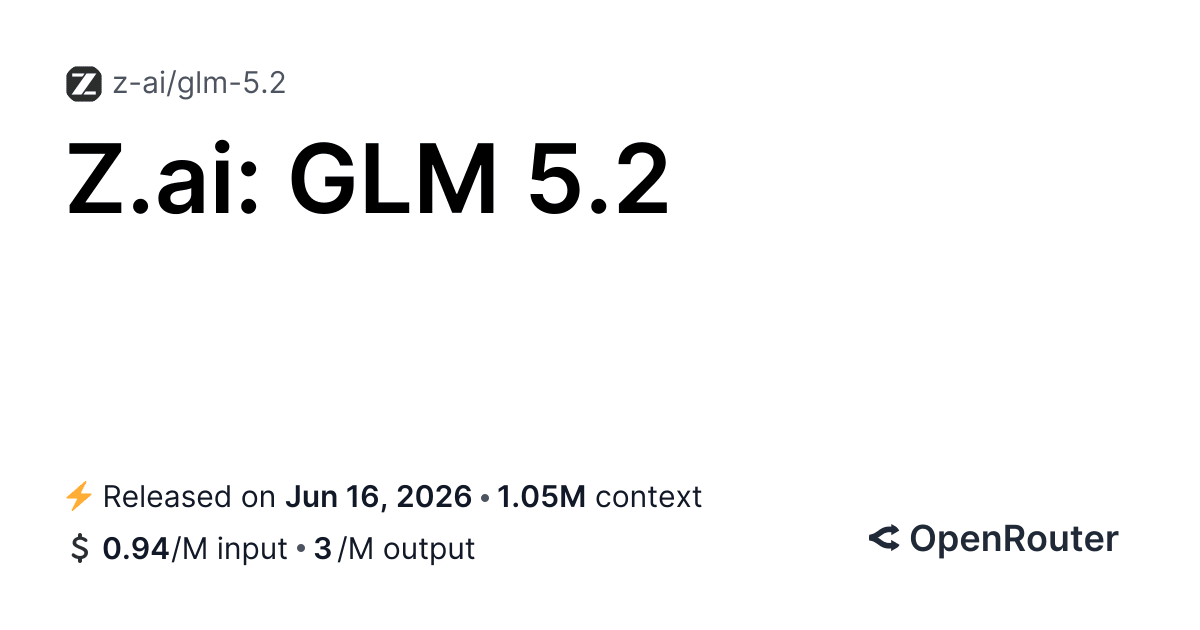
GLM-5.2 is useful to test when your normal coding model loses track of repository-wide context. The practical angle is not another generic chat prompt. Use it on one bounded engineering workflow where the 1M-token context, OpenAI-compatible API access, and open-weight deployment options can be compared against your current agent stack.
What to test first
Start with a repository you own. Give GLM-5.2 the project structure, key docs, test commands, and one clearly scoped task. Do not begin with production write access or secrets.
Use this evaluation sequence:
- Ask for an architecture map and risk boundaries.
- Run one medium refactor that should not change public APIs.
- Require build, lint, and test verification.
- Ask for a short self-review that lists files changed, assumptions, and remaining risks.
- Compare the result with your current primary coding model on the same task.
Copyable evaluation prompt
You are evaluating GLM-5.2 for long-context coding work in this repository.

Goal: complete one bounded engineering task without changing public API behavior.

First, read the provided project context and return:
- architecture map
- relevant modules
- data flow and API contracts
- constraints you must preserve
- risk boundaries
- verification plan

Then implement only the requested change. Do not introduce new dependencies unless explicitly justified. After implementation, run the available build, lint, and tests. Finish with a concise report: files changed, commands run, failures, assumptions, and what a human should review before merge.
Best fit
| Use case | Why GLM-5.2 fits | Caveat |
|---|---|---|
| Repository-wide audit | Z.ai documents a 1M-token context and long-horizon engineering focus. | Validate claims on your own codebase, not only public benchmarks. |
| Bounded refactor | The model is positioned for multi-file agentic engineering tasks. | Keep API, behavior, and dependency boundaries explicit. |
| Local/open-weight experiments | Hugging Face lists the model and serving options through vLLM, SGLang, Docker Model Runner, and quantization paths. | Hardware, quantization, and provider quality will change results. |
| Security review trial | Semgrep reported strong IDOR-benchmark results for GLM-5.2 under its harness. | One benchmark is not proof of general security-review superiority. |
Access paths to compare
- Z.ai API: fastest path to a direct vendor test.
- OpenRouter: useful when you already route model calls through one API gateway.
- Hugging Face weights: useful for local or private serving experiments.
- GitHub repository: useful for release notes, model links, and serving guidance.
Safety checklist
- Use owned or authorized repositories only.
- Remove secrets and customer data from prompts and logs.
- Keep the task bounded to one change request.
- Require reproducible commands, not just a confident summary.
- Treat benchmark wins as signals, not guarantees.
- Review dependency changes and generated code before merge.
Source links
- Z.ai GLM-5.2 docs: https://docs.z.ai/guides/llm/glm-5.2
- Z.ai GLM-5.2 blog: https://z.ai/blog/glm-5.2
- GitHub repository: https://github.com/zai-org/GLM-5
- Hugging Face model: https://huggingface.co/zai-org/GLM-5.2
- OpenRouter model page: https://openrouter.ai/z-ai/glm-5.2
- Semgrep benchmark context: https://semgrep.dev/blog/2026/we-have-mythos-at-home-glm-52-beats-claude-in-our-cyber-benchmarks/
Discussion
Share practical experience, questions, or warnings with the community.
Sign in to join the discussion and vote on comments.
Sign in