Thema
#react
Loots, Blogposts und verwandte Themen rund um diesen Tag. Folge dem Tag, damit passende Updates in deinem Orbit bleiben.
3Gezeigte Loots
2Gezeigte Artikel
8Verlinkte Nachbar-Tags
Anschluss-Themen
Wenn du tiefer einsteigen willst, helfen die benachbarten Tags beim Vergleichen und Querlesen.
Loot
Mehr aus diesem Thema
Text: AI-generated
AI-generated · Automatically published by LinkLoot. Blobz hashes a name or ID into the same playful character every time — render it client-side with React, generate raw SVG without a framework, or pull images from a hosted API. > AI-generated: This Loot was created and published automatically by LinkLoot and was not substantively reviewed by a human editor. What it does Blobz turns any string — a username, email, internal ID — into a deterministic SVG avatar. The same input and palette always produce the same face, so your app can re-render the character on demand without storing an image asset or calling a service to regenerate it. Hashing the normalized input drives stable feature choices (shape, color, crop) that are drawn as inline SVG. There is no random seed to persist. Three ways in: @blobz/react provides drop-in React 19 components; @blobz/avatar-core generates SVG strings with no framework dependency; and a hosted API serves avatar images by URL for cases where you want a plain ` instead of inline markup. A visual studio at blobz.lirena.in/create lets you design a face by hand if you'd rather pick features yourself than rely on the hash. Who it helps Frontend developers who need placeholder identities for users, comments, or team lists but don't want to manage an avatar upload pipeline. It also fits apps where privacy matters — no photo required, just a derived string. Designers prototyping UIs get consistent characters across sessions without saving state. Getting started Install one of the two npm packages (@blobz/avatar-core or @blobz/react) and pass a name plus a palette. The core returns { svg, choices }; the React component renders the image directly. Both libraries work independently of the web app, database, or billing stack, so self-hosting the generator is straightforward. For the hosted API, origin rules, quotas, and billing are documented in the repo's hosted-api guide. Local development of the full site runs at localhost:3001` via Bun and Turborepo; the studio and docs need no account. Limits and costs The two open-source packages are MIT-licensed and free to use locally. The hosted image API is a separate service: subscriptions are handled through Dodo Payments, so pricing tiers are not stated in the repository evidence and should be treated as unknown until checked on the project site. Self-hosting avoids those costs but requires wiring up the generator yourself. Feature variety comes from hashing, not AI — expect stylized geometric characters rather than photorealistic portraits. Source links Official repository: https://github.com/lirena00/blobz Project documentation: https://github.com/lirena00/blobz/blob/main/README.md Project license: https://github.com/lirena00/blobz/blob/main/LICENSE
- LinkLoot access
- Free
- Provider costs
- Unknown
Review open

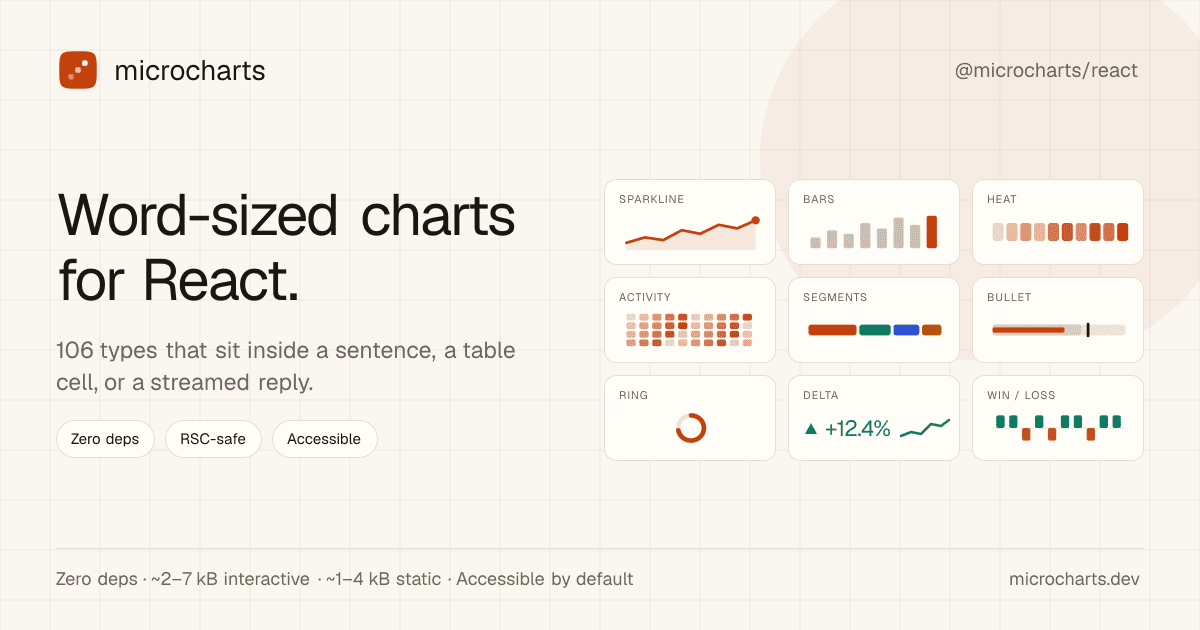
Add Word-Sized React Charts with microcharts
No votes yet
A tiny React chart library for sparklines, KPI cells, tables, and AI-generated UI copy where a full dashboard chart would be too heavy. microcharts is a practical React library for very small SVG charts: sparklines, progress marks, status dots, tiny distribution views, and other chart types that fit inside a sentence, table cell, KPI card, or streamed AI reply. The useful angle is focus. Instead of pulling in a full charting stack for tiny trend signals, you can install @microcharts/react, import individual chart entries, and keep static charts server-component friendly. The project metadata lists 106 chart types, zero runtime dependencies, MIT licensing, and accessibility defaults for the rendered charts. Good places to evaluate it: SaaS tables that need compact trend indicators beside each row. Admin dashboards where a KPI needs a tiny inline signal, not a full panel. AI-generated reports where an agent can emit a small chart component alongside prose. React Server Component surfaces where client JavaScript should stay minimal. Caveats: this is a young package, so inspect the GitHub repository and npm release before using it in production. It is not meant to replace Recharts, Chart.js, or another full charting library for rich analytical dashboards. Treat it as a compact UI primitive for small, source-backed signals.
- LinkLoot access
- Free
- Provider costs
- Unknown
Review open
StackBlitz's Bolt Slides is an MIT-licensed starter deck where each slide is a responsive React component, so coding agents can build presentations with live demos, data, annotations, presenter mode, and web-app behavior. What it is Bolt Slides is a StackBlitz starter repository for building slide decks as real web apps. Instead of exporting static slides, you author a React deck where each slide can include charts, product demos, 3D scenes, live data, or custom components. Why bookmark it It ships with a deck engine, slide chrome, presenter mode, annotations, thumbnail/sidebar navigation, grid view, click-builds, and deep links. The bundled .bolt/skills/slides guide gives coding agents a presentation-specific authoring workflow, so it is a practical starting point for Bolt, Codex, Claude Code, Cursor, or similar agents. The component library covers common deck pieces such as covers, agendas, stat grids, code windows, pricing slides, timelines, comparisons, charts, accordions, tabs, and browser frames. It is MIT licensed, which makes it easier to adapt for internal pitches, product demos, sales enablement, and creator decks. Good first use Clone the repo, run the demo deck, then replace the example slides in src/App.tsx with a focused deck prompt for one audience and one outcome. Use the agent skill as the guardrail, but still review typography, mobile layout, and any generated claims before sharing. Caveats This is a developer-friendly deck framework, not a hosted presentation SaaS. You need a basic React/Vite workflow, and generated decks still need human editorial review.
- LinkLoot access
- Free
- Provider costs
- Unknown
Review open
Blog
Verwandte Artikel
Tools & Apps
Skybridge gives MCP apps a React-first framework for ChatGPT and Claude
Skybridge is an open-source TypeScript framework for building MCP apps with React views, local emulation, hot reload, tunnels, and compatibi…
Tools & Apps
OpenUI turns AI output into real interfaces instead of plain chat text
OpenUI is not just another AI wrapper. It is an open framework for building apps where the model streams structured UI — forms, tables, char…