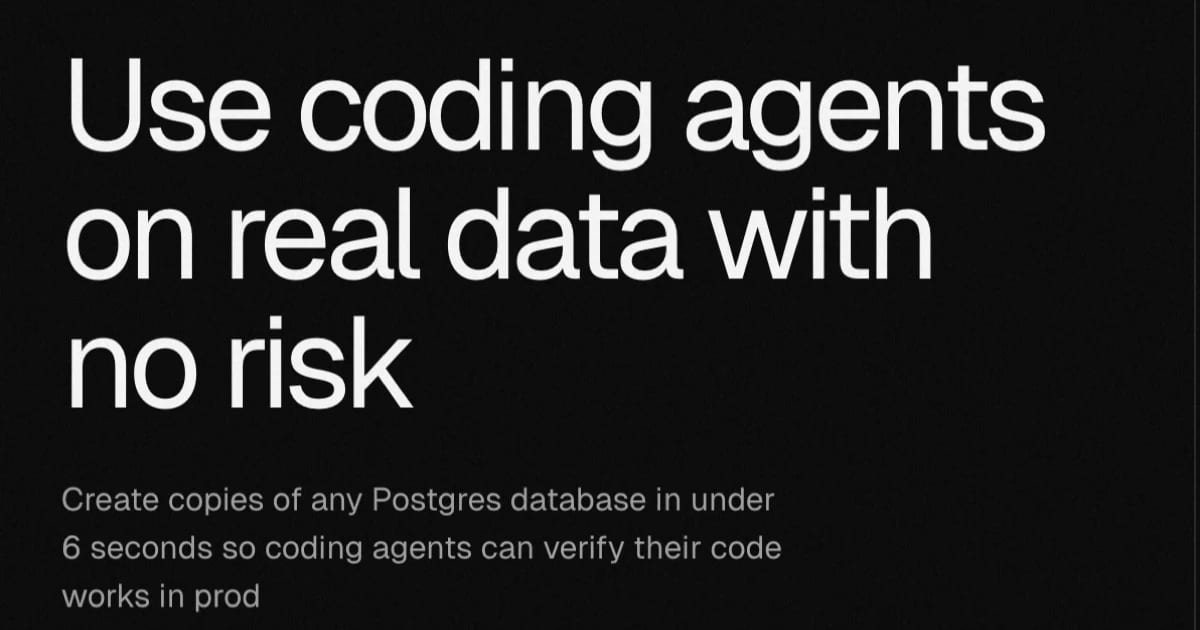
Ardent pitches 6-second Postgres sandboxes so coding agents can test against production-like data


Ardent is launching a database-branching workflow for coding agents that promises near-instant Postgres clones, copy-on-write efficiency, and isolated testing without forcing teams onto a new database provider.
Ardent is launching a hosted workflow for teams that want coding agents to test database changes against production-like Postgres data before anything touches a live system. The company says it can clone any Postgres database in under six seconds, keep clones isolated at the compute and storage level, and avoid a forced migration to a new database provider. Its YC page and Launch HN thread frame the product as a response to a practical gap in agent tooling: generated database code is getting better, but safe DB-level test environments still lag behind.
Key takeaways
- Ardent’s pitch is fast, isolated Postgres cloning for developers and coding agents.
- The company says teams can branch existing hosted Postgres setups without moving production to a new platform first.
- Copy-on-write storage and scale-to-zero behavior are central to the cost and speed story.
- The product is aimed at risky workflows such as migrations, backfills, cleanup jobs, and agent-written database code.
- The real differentiator is not “AI for databases,” but whether Ardent makes realistic sandbox testing easier than today’s mix of staging databases, read replicas, and manual branching.
Why it matters
A lot of coding-agent demos stop at source files, but real breakage often happens at the database layer. If an agent writes a migration, a cleanup script, or a backfill job, teams need somewhere realistic to test that work with representative data, permissions, and schema complexity. Ardent is trying to turn that missing step into a fast default instead of a fragile ops project.
That makes this more interesting than a generic “AI devtools” launch. If the product works as described, it could help teams move agent-written database work out of the dangerous zone between toy fixtures and production. For readers comparing agent infrastructure, this sits closer to branching, safety, and validation than to code generation itself. Related guide: /guides/ai-agent-tools.
What Ardent appears to offer
Based on the official site, YC company page, and launch discussion, Ardent focuses on a few specific claims:
| Claimed capability | What it means in practice | Why a team might care |
|---|---|---|
| Clone any Postgres DB in under 6 seconds | Fast spin-up of isolated sandboxes for devs or agents | Shortens the loop for testing migrations and DB-heavy changes |
| No forced platform migration | Works against existing hosted Postgres setups | Lowers the switching cost compared with database-native branching products |
| Copy-on-write efficiency | Clones reuse storage instead of duplicating full datasets | Makes production-like testing more affordable |
| Scale-to-zero compute | Idle branches should not burn full runtime cost | Better fit for bursty agent workflows |
| SQL-based anonymization hooks | Teams can alter or redact data before a branch is handed over | Important when production-like data includes sensitive records |
The HN launch text adds extra color here. Ardent says it uses logical replication plus DDL triggers so teams can branch hosted Postgres setups that do not expose the low-level replication controls usually used for full clones. That is a meaningful implementation detail because it explains why the product could appeal to teams on managed databases, not just self-hosted Postgres.
Practical LinkLoot angle
The best fit is not every software team. It is teams already experimenting with coding agents on workflows where database mistakes are expensive: schema changes, ETL fixes, cleanup jobs, or data-heavy product development. If your agent output regularly touches SQL, migrations, or tables with real operational consequences, Ardent’s value proposition is easier to understand than yet another agent wrapper.
The tougher comparison is with what you already have. Some teams can get far enough with staging databases, read replicas, provider-native branches, or stricter migration review. Ardent only wins if the full workflow — clone, protect data, test, inspect, and tear down — ends up simpler and safer than those existing paths.
What to verify before you act
Check the edge cases before you treat this as a production safety net. Ask how branch freshness works under ongoing write traffic, what data-masking guarantees exist in practice, and how credentials are scoped so agents cannot accidentally pivot from a sandbox to production. If your team uses extensions, custom auth, or provider-specific Postgres features, verify compatibility there too.
It is also worth testing the operational promise, not just the headline number. A six-second clone sounds great, but you should measure the full path from branch creation to a usable environment with app connections, permissions, representative data, and teardown. That full loop is what determines whether agents actually become safer to trust.
It is a database-sandbox product focused on fast Postgres clones for developers and coding agents.
Try the related loot
This JS Agent Turns Any Website Into an AI Copilot