Run Copilot agent sessions through your own model keys


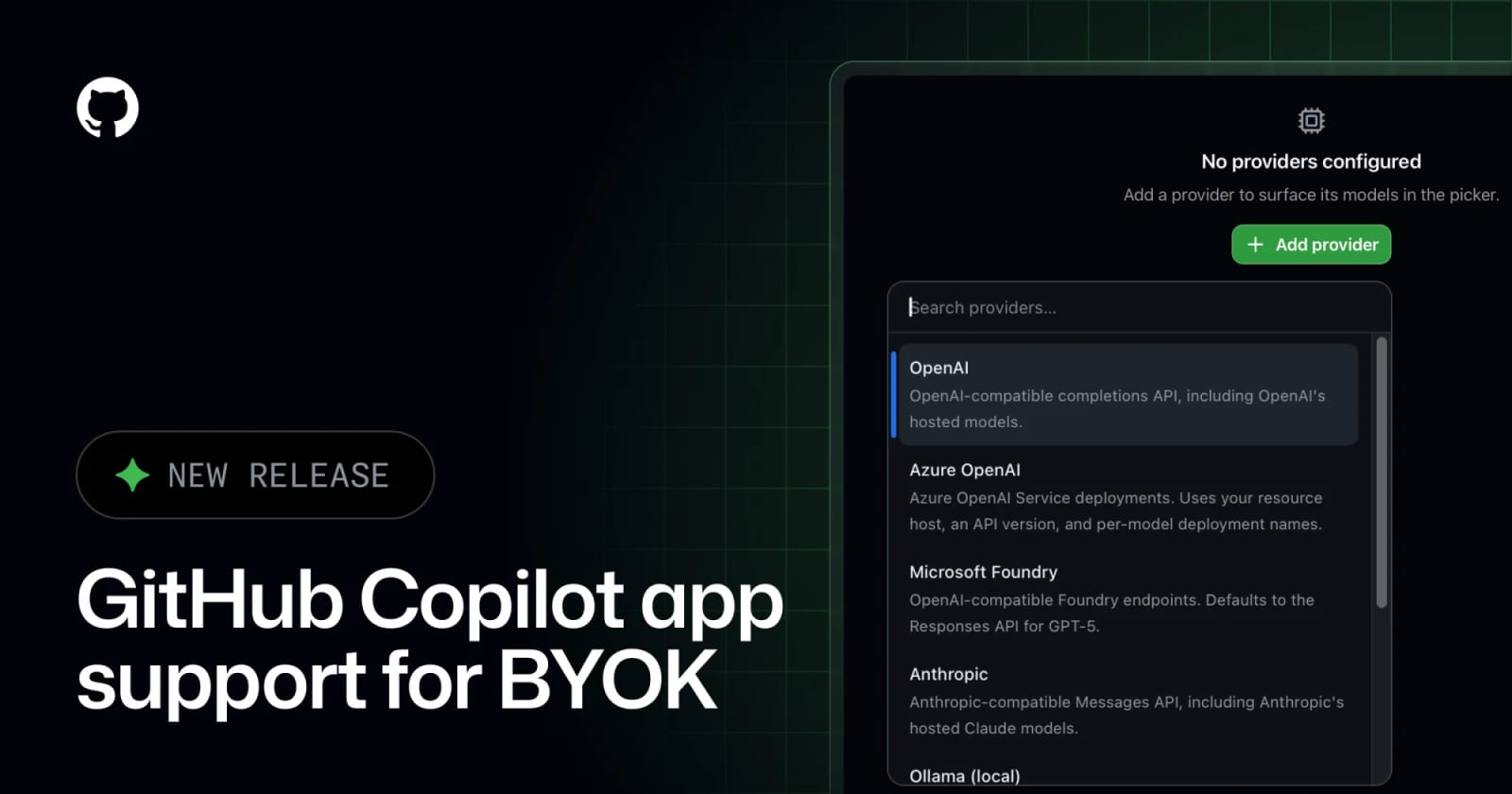
GitHub Copilot app now supports bring your own key for agent sessions, letting teams connect OpenAI, Azure OpenAI, Anthropic, Ollama, LM Studio, Microsoft Foundry, or OpenAI-compatible endpoints.
GitHub has confirmed bring-your-own-key support in the GitHub Copilot app for agent sessions. Confidence level: confirmed. The change matters for teams that want Copilot's agent interface while keeping model billing, quotas, region choices, and data terms tied to their own provider accounts.
What changed
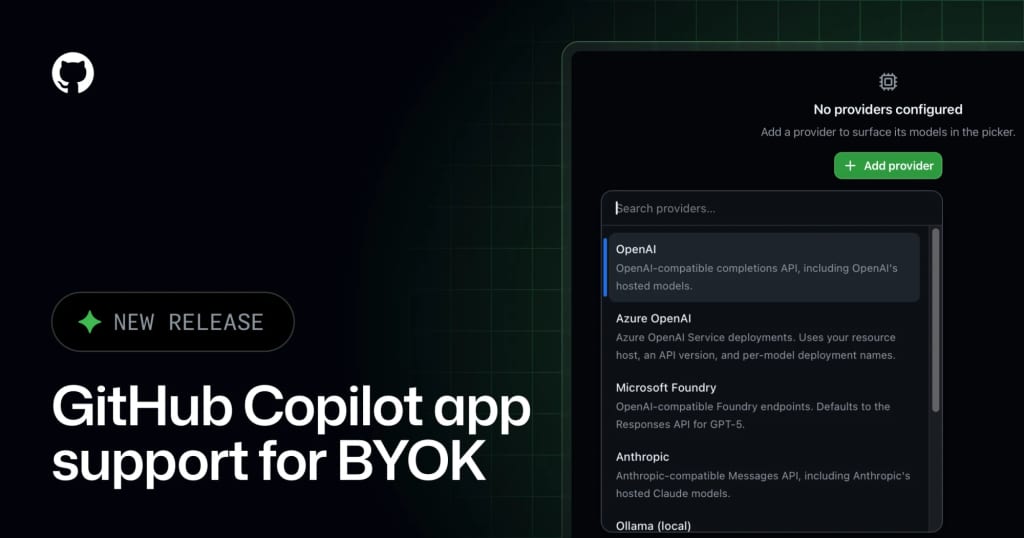
GitHub's June 23, 2026 changelog says the Copilot app now supports BYOK for agent sessions. Supported provider paths include OpenAI, Azure OpenAI, Microsoft Foundry, Anthropic, LM Studio, Ollama, and OpenAI-compatible endpoints.
Users add a provider in Settings -> Model Providers with an endpoint and API key, or a host for local options such as LM Studio or Ollama. GitHub says configured models appear next to Copilot-hosted models in the model picker, and keys are stored in the local OS keychain.
| Provider path | Best use | Setup note | Caveat |
|---|---|---|---|
| OpenAI / Azure OpenAI | Existing enterprise contracts and quotas | Add endpoint and API key | Cost and data terms come from your provider setup |
| Anthropic | Teams standardized on Claude models | Add endpoint and key | Availability depends on account and region |
| Ollama / LM Studio | Local or self-hosted sessions | Add host details | Local model quality varies by task |
| OpenAI-compatible gateway | Internal routing or governance | Add compatible endpoint | Admins must validate logging and retention |
Key takeaways
- Copilot app BYOK is confirmed in GitHub's official changelog.
- The feature targets agent sessions, not only simple chat completion.
- Keys are stored locally in the OS keychain and are not read back by the UI, according to GitHub.
- Business and Enterprise users need the Copilot CLI enabled by an organization or enterprise admin.
- The main value is control over model routing, billing, data boundary, and local-vs-frontier model choice.
Availability and access
GitHub says users can download the GitHub Copilot app and add a model provider through settings. For Copilot Business or Enterprise, the organization or enterprise admin must enable the Copilot CLI in policy settings before users can access the app.
This is not a free-model announcement. BYOK usually means your own provider account pays for usage under its own terms. Teams should check which models are allowed, whether the endpoint can handle agent traffic, and how usage is logged before rolling it out broadly.
Practical LinkLoot angle
BYOK makes Copilot more useful for teams that already manage model contracts or run local models for sensitive work. A practical setup is to use a frontier model for planning and complex code review, then switch to a local or internal model for repetitive execution where latency, cost, or data boundaries matter more.
For broader tool selection, compare this against dedicated agent IDEs and CLI agents in LinkLoot's AI agent tools guide. The right choice depends less on branding and more on how well your team controls credentials, network access, audit trails, and model spend.
What to verify before you act
- Confirm your Copilot plan and admin policy allow the Copilot app and CLI.
- Check whether your chosen provider supports the required API shape for agent sessions.
- Test local-key storage and endpoint logging before using sensitive repositories.
- Compare BYOK usage costs with Copilot-hosted model usage.
- Document which model handles planning, code edits, tests, and commit messages.
Source check
Confirmed by: GitHub's official changelog and the linked GitHub Community discussion tied to the announcement.
Independent context: GitHub's June 2026 changelog index lists the BYOK item among the month's Copilot updates. No third-party benchmark source was needed because this is a product-surface change rather than a performance claim.
It lets users connect their own model provider keys or endpoints for Copilot app agent sessions.
Try the related loot
Scrape Changing Websites with Anansi Self-Healing Selectors and MCP